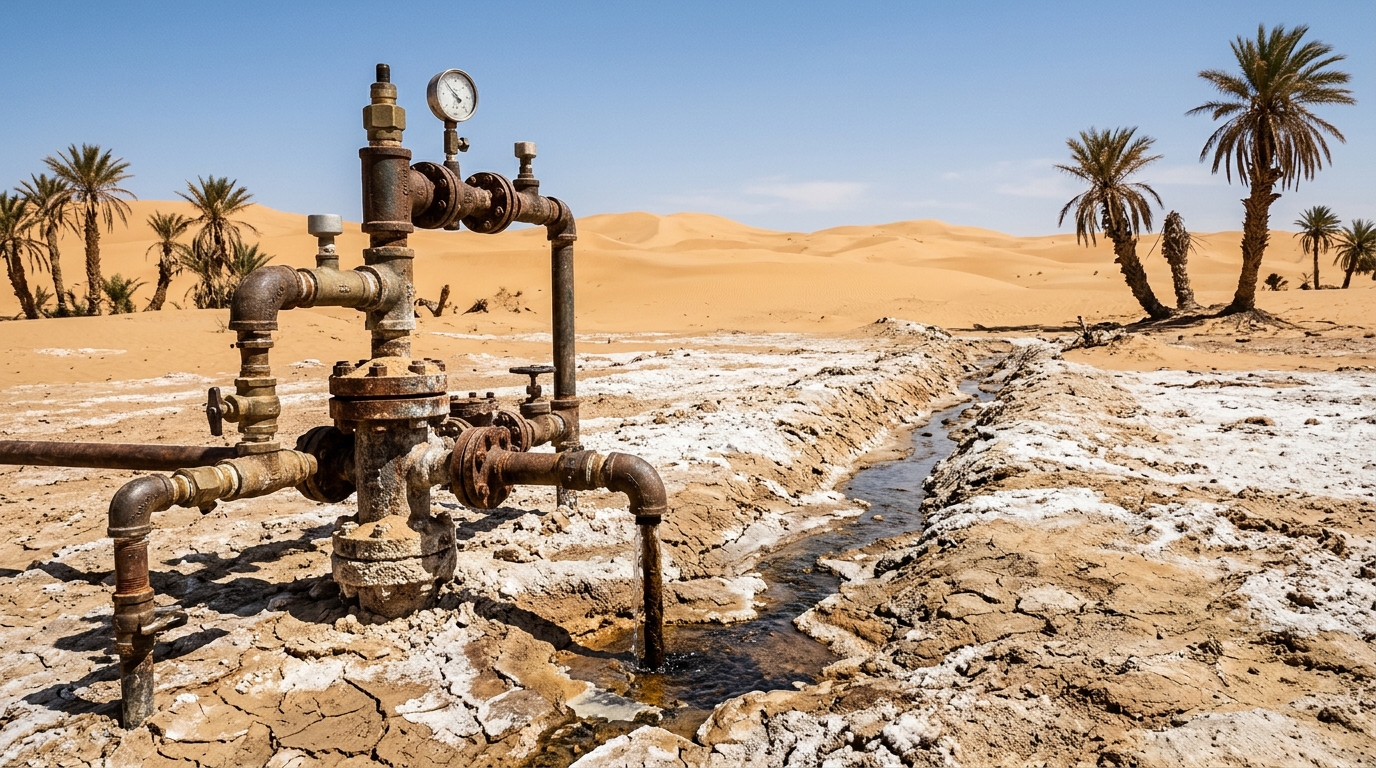
Deep geothermal groundwater drawn from the Continental Intercalaire aquifer in the northern Algerian Sahara is largely unsuitable for irrigation without careful management, according to a study published in Environmental Geochemistry and Health. Researchers evaluated 32 geothermal groundwater samples using an Irrigation Water Quality Index combined with geographic information system-based spatial analysis, and found that most samples fell into moderate to high restriction categories for agricultural use, with salinity identified as the main limiting factor.
The Continental Intercalaire aquifer is the main, and often the only, source of irrigation water in the region, where the geothermal waters are exploited intensively. The study authors note that this heavy reliance can impair water quality and threaten ecosystems, soils, crops, and public health, yet the suitability of the water for irrigation and the long-term sustainability of its use had remained insufficiently studied. The new assessment addresses that gap by applying a composite index that integrates multiple water quality parameters into a single classification of irrigation constraints.
The 32 samples were collected from geothermal wells and analyzed for key physicochemical parameters using standard laboratory techniques. The waters had a mean temperature of 48.6 degrees Celsius, a mean pH of 7.44, and a mean electrical conductivity of 2752 microsiemens per centimeter, a value that reflects substantial dissolved mineral content. The hydrochemical composition was mixed, with sodium as the dominant cation at 203.47 milligrams per liter, accounting for 36 percent of cations, followed closely by calcium at 173.31 milligrams per liter, or 35 percent. Magnesium contributed 79.70 milligrams per liter, or 27 percent, and potassium 21.79 milligrams per liter, or 2 percent.
Among the anions, chloride dominated at 443.32 milligrams per liter, representing 52 percent of the total anion composition, while sulfate followed at 415.99 milligrams per liter, or 37 percent. Together these two ions accounted for approximately 89 percent of total anions, with bicarbonate representing a minor proportion of 11 percent. The authors interpret this pattern as a mixed calcium-magnesium-chloride-sulfate hydrochemical facies, suggesting that evaporite dissolution is an important contributor to groundwater mineralization, although other geochemical processes may also influence the observed composition.
The team calculated a suite of standard irrigation hazard indices to characterize risks to soil structure and crop productivity. Sodium percentage ranged from 30.2 to 47.2 percent, the sodium adsorption ratio ranged from 2.1 to 4.3, magnesium hazard ranged from 33.9 to 51.5 percent, permeability index ranged from 35.9 to 53.5 percent, and Kelley’s index ranged from 0.39 to 0.84. Residual sodium carbonate values remained negative across all samples, between minus 17.6 and minus 8.9 milliequivalents per liter. According to the authors, these results indicate that sodicity and carbonate-related hazards are not the principal concerns for the sampled waters, since low sodium adsorption ratios and negative residual sodium carbonate values point away from those specific threats.
The composite Irrigation Water Quality Index values ranged from 32.09 to 65.95, with a mean of 50.67. Under the adopted classification scheme, 18 samples, or 56.3 percent, fell into the high-restriction category, meaning the water would require substantial management for irrigation use. Eleven samples, or 34.4 percent, corresponded to the moderate restrictions category, and the remaining three samples, or 9.4 percent, fell into the severe restrictions category.
A notable finding concerned the spatial distribution of water quality. None of the calculated indices showed significant spatial autocorrelation, with Moran’s I tests yielding p-values of 0.14 or higher, and no interpolation method predicted the index values better than the simple sample mean in leave-one-out cross-validation. This statistical result means that irrigation water quality varies from well to well rather than along regional gradients. The researchers therefore mapped the results as classified sampling points rather than as continuous interpolated surfaces, a choice that reflects the localized, site-specific nature of the quality variations across the aquifer.
The study concludes that geothermal water from the Continental Intercalaire aquifer in the Ouargla region presents substantial constraints for irrigation. Although the individual hazard indices suggest that sodicity and carbonate-related problems are not the dominant threats, the composite index results point to generally poor irrigation suitability, with salinity as the main limiting factor.
The authors emphasize that appropriate irrigation management, including effective drainage and salinity control, is necessary to reduce the risk of soil salinization and support the long-term sustainability of agricultural water use. In a region where the deep geothermal aquifer is often the only available irrigation source, the findings highlight the need for water and soil management practices tailored to minimizing salinity-related risks. The well-to-well variability documented in the study suggests that management decisions may need to be made at the level of individual extraction points rather than across broad zones, since neighboring wells can differ substantially in their irrigation suitability classifications.
Subject of Research: Irrigation suitability of geothermal groundwater from the Continental Intercalaire aquifer in the Algerian Sahara, assessed with a water quality index and GIS analysis
Article Title: An integrated water quality index and GIS-based assessment of the irrigation suitability of geothermal waters in the Sahara Desert
Article References: Kherbouche, K., Slimani, R., Hamdi-Aissa, B., Kouadri, S., & Chenchouni, H. (2026). An integrated water quality index and GIS-based assessment of the irrigation suitability of geothermal waters in the Sahara Desert. Environmental Geochemistry and Health, 48(17), Article 680. https://doi.org/10.1007/s10653-026-03576-z
Image Credits: AI Generated
DOI: 10.1007/s10653-026-03576-z
Keywords: geothermal water, irrigation water quality index, Algerian Sahara, Continental Intercalaire aquifer, soil salinization, GIS spatial analysis, hydrochemistry, sodium adsorption ratio, arid region agriculture, groundwater quality, Ouargla, evaporite dissolution
News Source: Bethany Barker. (November 5, 2026). Geothermal Wells in the Algerian Sahara Show Poor Irrigation Suitability, Index Study Finds. Scienmag.