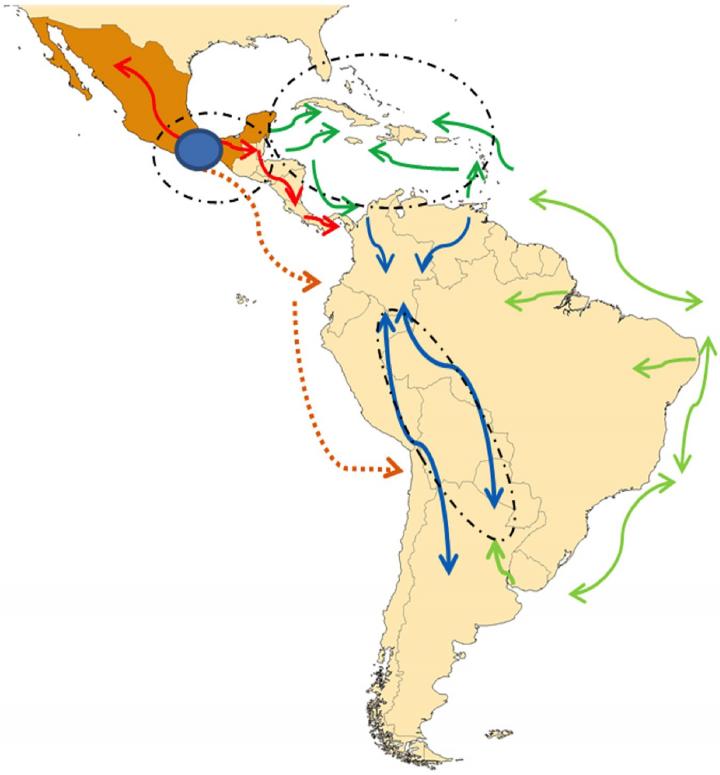
Credit: Bedoya et al (2017)
Variations in Latin American and Caribbean maize populations may be linked to anthropological events such as migration and agriculture, according to a study published April 12, 2017 in the open-access journal PLOS ONE by Claudia Bedoya from the International Maize and Wheat Improvement Center (CIMMYT) and colleagues.
Maize was likely domesticated in Mexico about 9,000 years ago and has provided a nutritional cornerstone in the Americas for many years. As it diffused to different geographic regions, different varieties of maize, known as landraces, arose. While advances in the fields of genetics and archaeology have provided new insights into the diversification and geographic dispersal of maize, the archaeological record on early maize history is incomplete.
To further investigate the geographic and genetic variations in maize, the authors of the present study analyzed 194 native Latin American maize populations, representing 131 classified landraces from 23 countries. The authors planted thirty seeds of each population in a greenhouse and harvested and analyzed the DNA of their leaf fragments.
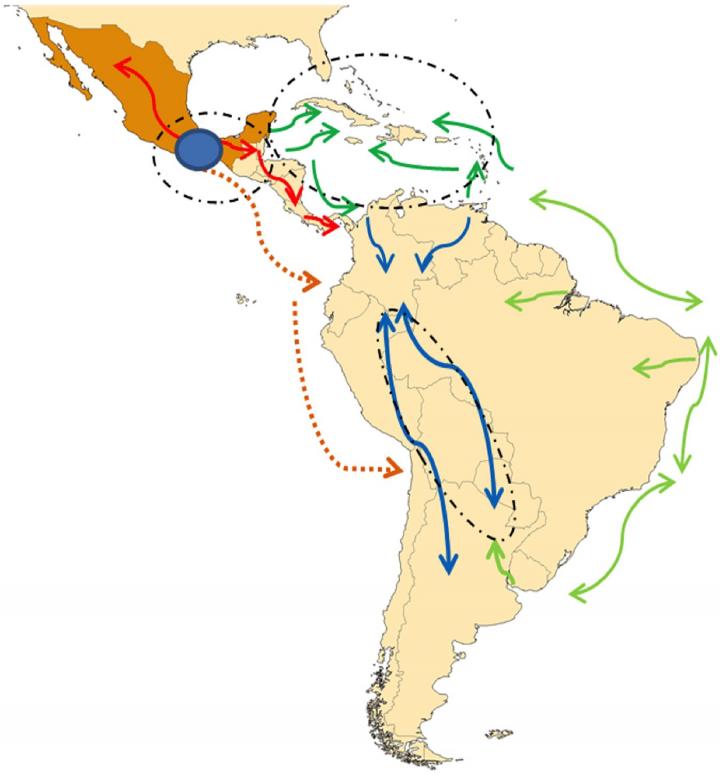
The researchers identified three distinct geographic groups of maize in Mexico, and four groups in South America and the Caribbean. Their classifications of maize based on genetic analysis aligned with previous studies examining their molecular and morphological characteristics.
While it is difficult to link the dispersal and cultivation of maize with a specific historical timeline, the geographic locations of the different maize populations and their genetic profiles may reflect known human migration patterns from northern Mexico both down toward South America as well as up through the US toward Canada. The authors also suggest that the understanding of maize genetics can be useful in its conservation and in its agricultural application, as this knowledge is essential for breeding and cultivating maize.
"The current genetic structure of maize genetic pools in Latin America and the Caribbean, as examined in the current manuscript, can shed light on events and activities in the pre- and post-Columbian Americas," says co-author Marilyn Warburton. "These events include the domestication and migration history of maize, and closely mirror the lifestyles and migrations of indigenous people."
###
In your coverage please use this URL to provide access to the freely available article in PLOS ONE: http://journals.plos.org/plosone/articleid=10.1371/journal.pone.0173488
Citation: Bedoya CA, Dreisigacker S, Hearne S, Franco J, Mir C, Prasanna BM, et al. (2017) Genetic diversity and population structure of native maize populations in Latin America and the Caribbean. PLoS ONE 12(4): e0173488. doi:10.1371/journal.pone.0173488
Funding: All work, prior to statistical analysis and publication, was funded by the Generation Challenge Program (grant 3005.14). The GCP has concluded its work and has evolved into the Integrated Breeding Platform . The GCP was funded by the CGIAR.
Competing Interests: The authors have declared that no competing interests exist.
Media Contact
Tessa Gregory
[email protected]
############
Story Source: Materials provided by Scienmag