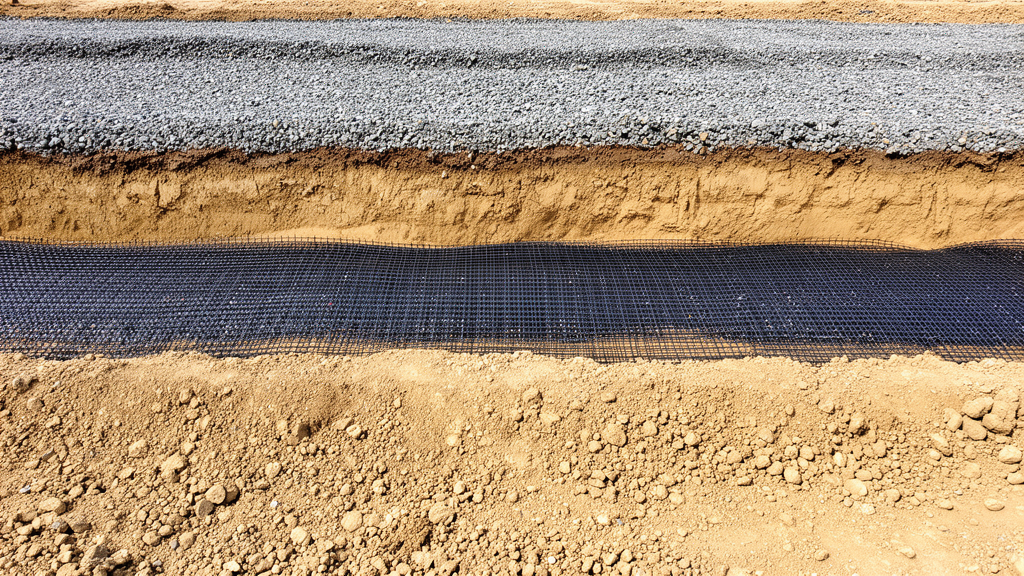
Installing a hybrid geocomposite layer directly at the boundary between a soft cohesive subgrade and a granular capping layer significantly enhances the ultimate bearing capacity of temporary working platforms, providing the greatest efficiency improvements at shallower fill depths. Geotechnical engineers investigating the structural mechanics of temporary platforms constructed over weak cohesive soils discovered that embedding a dual-function geosynthetic—which integrates geogrid reinforcement with geotextile separation—substantially improves load distribution under heavy surface pressures. Large-scale experimental testing conducted in an instrumented model box demonstrated that this interface reinforcement notably elevates bearing resistance while allowing for substantial reductions in the volume of imported granular material required to support heavy construction equipment such as drilling rigs and mobile cranes.
Temporary working platforms represent vital civil engineering structures designed to sustain heavy construction machinery while operating over unstable or low-bearing-capacity ground. Conventional engineering design methodologies for these two-layer foundation systems have long relied on classical unreinforced analytical models, including Terzaghi and Peck’s load-spread formulation and Meyerhof’s punching shear evaluation, or empirical guidelines such as the BR470 and Temporary Works Forum recommendations. While existing industry standards have gradually acknowledged the operational benefits of geosynthetic stabilization, quantitative design charts and experimentally verified calculation frameworks remain scarce. Without robust analytical tools, practicing engineers often resort to simply increasing the granular capping thickness to mitigate localized shear failures, an approach that rapidly escalates project construction expenses, consumes scarce aggregate resources, and leaves platforms vulnerable to inter-layer contamination caused by aggregate intrusion and fine subgrade pumping.
To establish an experimentally verified design methodology, the research team fabricated a specialized, rigid steel testing box measuring 1.0 meter in length, 1.0 meter in width, and 1.2 meters in height to simulate field-representative boundary and vertical loading conditions. The experimental program evaluated the performance of two distinct soft subgrade foundations formed from a bulk sample of expansive black clayey soil retrieved from an active road construction site in Queensland, Australia. Classified as high-plasticity silt under the Unified Soil Classification System and as A-7-6 under AASHTO criteria, the clay exhibited a maximum dry density of 1.3 grams per cubic centimeter at an optimum moisture content of 32 percent under standard Proctor compaction. Granular capping layers were constructed using a high-quality Type 2.1 Unbound Granular Material meeting local road authority specifications, placed over the subgrade with or without a commercially available Australian geocomposite featuring encapsulated geotextile within welded geogrid ribs.
Achieving precise, repeatable subgrade strengths required rigorous moisture conditioning and density verification across the entire experimental matrix. The clay soil was oven-dried, crushed mechanically, and blended with predetermined water quantities in a barrel mixer before curing for at least seven days in sealed containers to ensure thorough moisture homogenization. Controlled target California Bearing Ratio values of 2.5 percent and 1.0 percent were reproduced using an established empirical prediction model linking subgrade strength to compaction degree and moisture content. The 2.5 percent California Bearing Ratio condition was achieved at a moisture content of 46.5 percent and a dry density of 1.12 grams per cubic centimeter, while the 1.0 percent California Bearing Ratio subgrade was established at 50 percent moisture content and a dry density of 1.04 grams per cubic centimeter, corresponding to apparent cohesion values of 57 kilopascals and 32 kilopascals, respectively.
Physical construction of each laboratory model proceeded systematically by compacting the conditioned cohesive soil in ten uniform 50-millimeter lifts using a 20-kilogram manual tamper to achieve a continuous 500-millimeter-thick subgrade foundation. Above this foundation, the Type 2.1 unbound granular capping material was placed in successive 100-millimeter lifts at a controlled moisture content of 5.5 percent—intentionally kept 1.5 percent below its optimum moisture content to avoid premature saturation failure—and compacted to a uniform dry density of 2.3 grams per cubic centimeter using a vibratory compactor. Strict quality control during specimen preparation was maintained through Light Falling Weight Deflectometer testing, measuring the dynamic elastic modulus across multiple surface positions on both soil strata to ensure uniform compaction. For reinforced configurations, the geocomposite sheet was carefully installed directly along the horizontal interface separating the compacted subgrade and the granular cover.
Monotonic vertical plate load tests were executed in accordance with DIN 18134 standards utilizing a 200-millimeter-diameter, 25-millimeter-thick rigid circular steel plate driven by a hydraulic actuator capable of delivering 250 kilonewtons at a controlled displacement rate of 1.0 millimeter per minute. In compliance with testing protocols, an initial conditioning load cycle was applied up to a surface stress of 550 kilopascals or a 5-millimeter displacement before unloading, ensuring intimate plate contact and eliminating localized surface looseness. Continuous displacement-controlled loading during the subsequent stage permitted unambiguous identification of the ultimate bearing capacity, defined as the peak applied surface stress on the resulting stress-deformation curves. Across all twelve tested model variations, distinct stress peaks developed, establishing a consistent basis for assessing ultimate capacity improvements across variable capping thicknesses and subgrade stiffnesses.
To evaluate internal stress mechanics, three earth pressure cells were positioned horizontally along the granular-subgrade interface directly below the central loading axis and at radial offsets of 0.75 and 1.5 times the plate diameter. In unreinforced benchmark tests conducted over the subgrade with a California Bearing Ratio of 2.5 percent, increasing the granular capping thickness from 200 millimeters to 300 millimeters and 400 millimeters yielded ultimate bearing capacity improvement ratios of 4.2, 7.5, and 11.9 relative to unreinforced subgrade-only conditions. Sensor measurements recorded under a constant surface stress of 550 kilopascals revealed that a 200-millimeter capping layer transmitted 21 percent of the surface load to the subgrade centerline, whereas a 400-millimeter capping layer reduced transmitted stress to approximately 7 percent, reflecting an expansion in the back-calculated apparent stress distribution angle from 29.7 degrees to 34.6 degrees.
The incorporation of the interfacial geocomposite yielded substantial bearing capacity enhancements that were strongly governed by the thickness of the overlying granular platform. Over the subgrade with a California Bearing Ratio of 2.5 percent, geocomposite inclusion increased the ultimate bearing capacity by 60 percent for a 200-millimeter capping layer and by 37 percent for a 300-millimeter layer compared to identical unreinforced configurations. Over the extremely soft subgrade with a California Bearing Ratio of 1.0 percent, the geocomposite produced bearing capacity increases of 52 percent and 44 percent at capping thicknesses of 100 millimeters and 200 millimeters, respectively. These observations confirm that tensile reinforcement and aggregate interlocking are most effectively mobilized when the capping layer remains relatively thin, ensuring that high shear stresses reach the geosynthetic plane to activate its tensile resistance.
Conversely, when the granular capping thickness over the subgrade with a California Bearing Ratio of 2.5 percent was increased to 400 millimeters—representing a cover ratio of two full plate diameters—the inclusion of the geocomposite produced only a marginal performance improvement. Internal stress measurements under 550 kilopascals of applied plate stress explained this behavioral shift: while geocomposite reinforcement lowered centerline subgrade stress from 120 to 97 kilopascals at 200 millimeters thickness and from 68 to 55 kilopascals at 300 millimeters thickness, the reduction at 400 millimeters was minimal, shifting from 39 kilopascals to 35 kilopascals. Correspondingly, the reinforcement-induced increase in the apparent stress distribution angle dropped from 5.0 degrees at 200 millimeters to only 1.3 degrees at 400 millimeters, demonstrating that positioning geosynthetics beyond the primary stress influence zone of approximately 1.5 plate diameters yields negligible structural benefit.
Comparative evaluations between the two subgrade stiffness conditions highlighted fundamental differences in system behavior and stress transfer mechanics. Although the working platform constructed over the subgrade with a California Bearing Ratio of 2.5 percent consistently achieved higher ultimate bearing capacities due to superior shear strength and resilience, pressure cell readings revealed that the softer foundation with a California Bearing Ratio of 1.0 percent exhibited lower interface stresses and higher apparent distribution angles under equivalent 550-kilopascal loads. Rather than indicating superior platform performance, this broader stress footprint in softer subgrades aligns with Burmister’s two-layer elastic theory, wherein a high modular ratio between a stiff capping layer and a compliant subgrade forces wider load spreading. Because the softer subgrade possesses an inherently lower shear strength threshold, it undergoes substantial vertical deformation and governs ultimate failure at much lower applied stresses.
Synthesizing these experimental results, the authors formulated a performance-based design chart establishing the non-dimensional relationship between the ultimate bearing capacity improvement ratio and the platform cover ratio, defined as capping layer thickness divided by loading diameter. To illustrate practical implementation, a design case study was presented for a mobile crane imposing a 1000-kilopascal contact pressure through a 0.4-meter-diameter footing over a weak subgrade with an ultimate capacity of 250 kilopascals and a California Bearing Ratio of 2.5 percent. Applying a design safety factor of two dictates a target bearing capacity of 2000 kilopascals, requiring an improvement ratio of eight. Utilizing the developed design curves, an unreinforced configuration requires a cover ratio of 1.56, demanding 624 millimeters of aggregate fill, whereas the geocomposite-reinforced configuration requires a cover ratio of only 1.15, corresponding to 460 millimeters of fill and delivering a 26 percent aggregate savings.
The authors emphasize specific operational boundaries and engineering constraints associated with the proposed design framework. The empirical design charts were derived specifically using an 800-kilonewton-per-meter tensile stiffness geocomposite and Type 2.1 unbound granular base over cohesive subgrades with California Bearing Ratio values of 1.0 percent and 2.5 percent under static circular loading conditions. While normalizing thickness against loading diameter provides a rational preliminary engineering methodology, field applications involving significantly different geosynthetic products, larger industrial footing dimensions, or cyclic machine vibrations should incorporate site-specific verification testing, numerical modeling, or conservative design bounds to account for potential scale and stiffness effects.
Subject of Research: Geocomposite reinforcement mechanics and design chart development for granular working platforms on soft cohesive subgrades
Article Title: Experimental evaluation and design framework for geocomposite-reinforced working platforms on soft subgrades
Article References: Mithila, S., Gallage, C., Wimalasena, K., & Pathirana, A. (2026). Experimental evaluation and design framework for geocomposite-reinforced working platforms on soft subgrades. International Journal of Geo-Engineering, 17(1), Article 33. https://doi.org/10.1186/s40703-026-00291-7
Image Credits: AI Generated
DOI: 10.1186/s40703-026-00291-7
Keywords: working platforms, geocomposite reinforcement, soft subgrade, plate load test, bearing capacity, California Bearing Ratio, capping layer, stress distribution, unbound granular material, geotextile separation, geogrid interlocking, soil mechanics, temporary works, load spread angle, geotechnical engineering, ground improvement
News Source: Denise Maddox. (November 19, 2026). Geocomposite Layers Strengthen Soft Subgrade Working Platforms and Cut Capping Thickness. Scienmag.