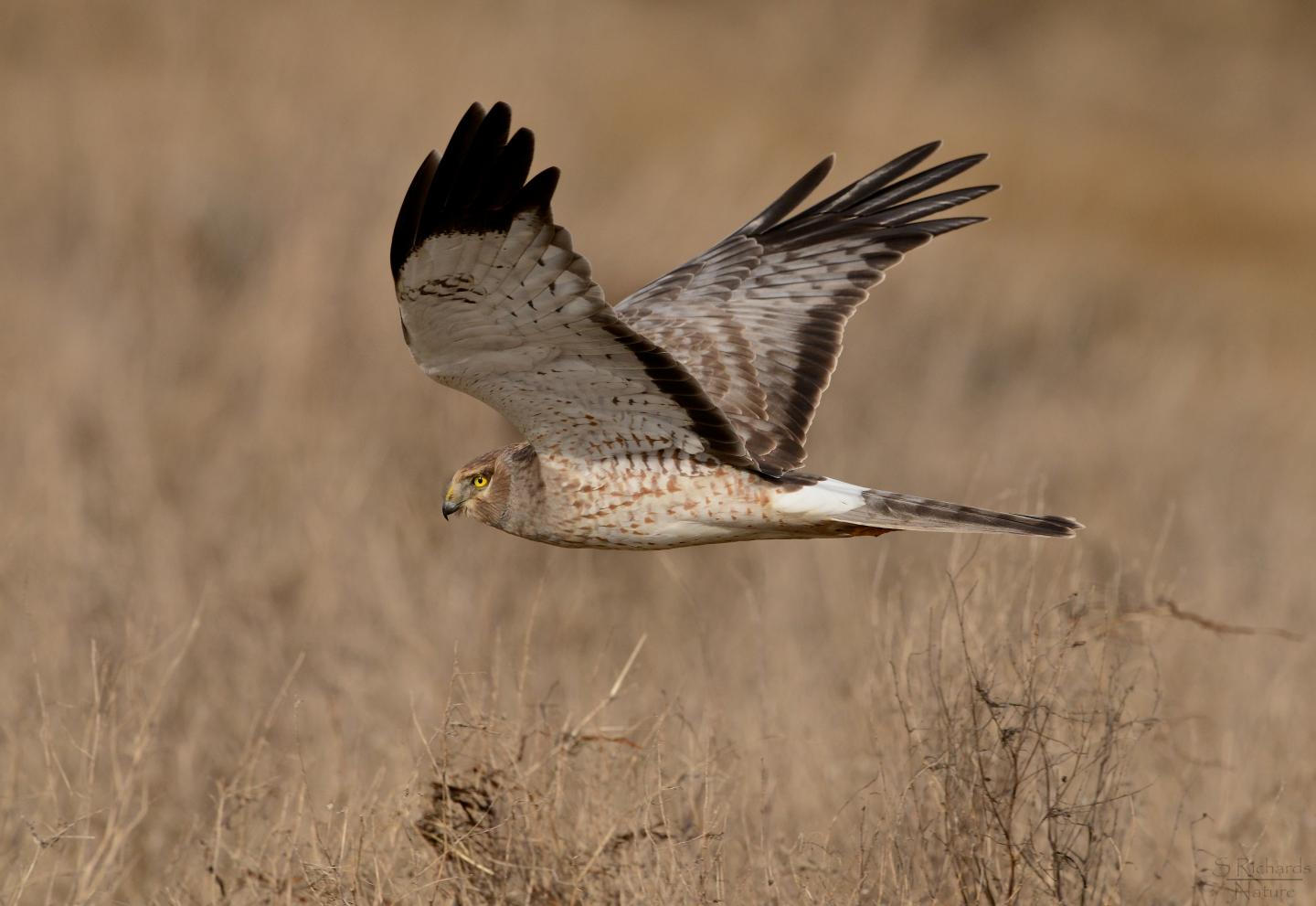
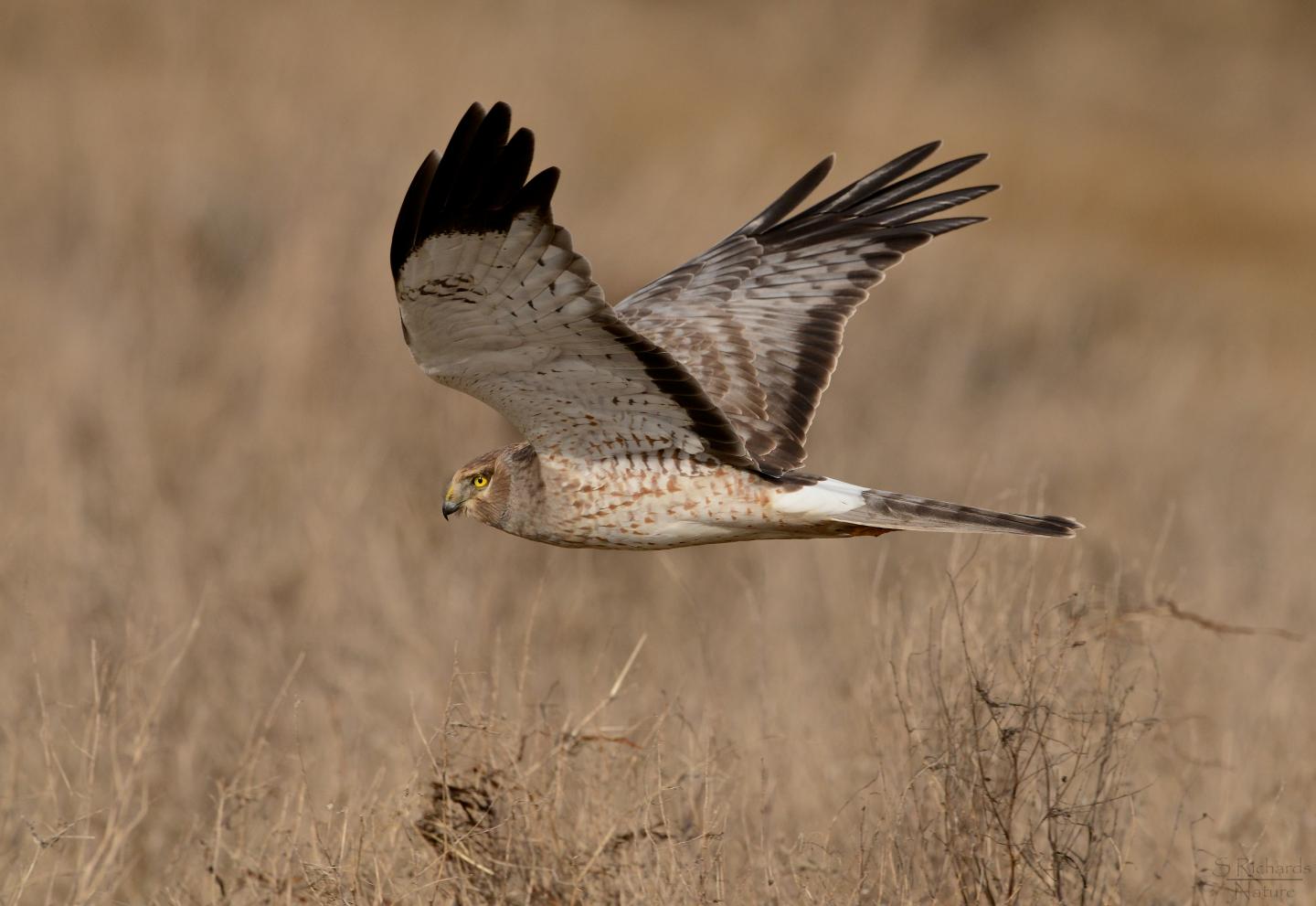
Credit: Simon Richards
The study, published as the cover article in BioMed Central's Avian Research, led by the Earlham Institute and the Museum of Vertebrate Zoology at the University of California, explores the phylogenetic relationship between two forms of Harriers (Circus cyaneus); the Eurasian Hen Harrier (C. c. cyaneus) and the American Northern Harrier (C. c. hudsonius) to distinguish their ancestry and evolution.
Already accepted as different species by the British Ornithologists' Union, the American Ornithologists' Union and other avian taxonomic committees are yet to classify the bird of prey as separate species.
As the most intensely persecuted bird of prey in the UK, Hen Harriers are under particular threat from being caught up in the crossfire of grouse hunts in upland moors where they feed on red grouse. After the number of breeding birds increased after the Second World War, the bird of prey is in trouble again. Ongoing illegal hunting and habitat disruption is forcing the species to edge of extinction in England.
To understand the Hen Harrier species' genetic make-up is of extreme importance to its future and will help aid the national conservation efforts such as the RSPB's Hen Harrier LIFE project.
Lead-author and conservation genomics expert Dr Graham Etherington in the Di Palma Group at EI, said: "Molecular phylogenetics was applied to the Hen Harriers and the Northern Harriers to see if genetics could shed some light on whether the accepted morphological nuances between the species indeed represent a genuine distinction. From a conservation point, the work shows the European Hen Harrier is not the same as the American Northern Harrier and should receive appropriate recognition and protection.
"Before the advent of sequencing technology, species were categorised by shared and divergent morphological features. However, new technology allows us to quantify the amount of genetic change between populations and identify divergent lineages."
In his research, Dr Etherington collected tissue samples from museums around the world. Using both DNA sequencing and morphology, along with differences in plumage, breeding biology, vocalisation, habitat, distribution, dispersal and migration it was possible to show the differences between the two species.
"These genetic indicators distinguish the Hen Harrier and its close relative the Northern Harrier, genetically as well as morphologically, suggesting geographical isolation is enough to form two distinct lineages," added Dr Etherington.
Further evidence from another study which provided additional data for Dr Etherington's paper also found that Northern Harrier was, in fact, more closely related to the Cinereous Harrier of South America than the Hen Harrier of Eurasia providing further evidence that the forms represent two distinct species.
###
Notes to Editors
1) For press queries at Earlham Institute, please contact:
Hayley London
Marcomms Officer, Earlham Institute (EI)
+44 (0)1603 450107
[email protected]
2) The paper, titled: "Molecular phylogeny, morphology and life-history comparisons within Circus cyaneus reveal the presence of two distinct evolutionary lineages" is published in Avian Research – BioMed Central. DOI: 10.1186/s40657-016-0052-3
3) About Earlham Institute (EI)
The Earlham Institute (EI) is a world-leading research institute focusing on the development of genomics and computational biology. EI is based within the Norwich Research Park and is one of eight institutes that receive strategic funding from Biotechnology and Biological Science Research Council (BBSRC) – £6.45M in 2015/2016 – as well as support from other research funders. EI operates a National Capability to promote the application of genomics and bioinformatics to advance bioscience research and innovation.
EI offers a state of the art DNA sequencing facility, unique by its operation of multiple complementary technologies for data generation. The Institute is a UK hub for innovative bioinformatics through research, analysis and interpretation of multiple, complex data sets. It hosts one of the largest computing hardware facilities dedicated to life science research in Europe. It is also actively involved in developing novel platforms to provide access to computational tools and processing capacity for multiple academic and industrial users and promoting applications of computational Bioscience. Additionally, the Institute offers a training programme through courses and workshops, and an outreach programme targeting key stakeholders, and wider public audiences through dialogue and science communication activities. http://www.earlham.ac.uk / @EarlhamInst
Media Contact
Hayley London
[email protected]
01-603-450-107
http://www.earlham.ac.uk/
############
Story Source: Materials provided by Scienmag