• HOME
  • NEWS
  • EXPLORE
    • CAREER
      • Companies
      • Jobs
    • EVENTS
    • iGEM
      • News
      • Team
    • PHOTOS
    • VIDEO
    • WIKI
  • BLOG
  • COMMUNITY
    • FACEBOOK
    • INSTAGRAM
    • TWITTER
Sunday, July 5, 2026
BIOENGINEER.ORG
No Result
View All Result
  • Login
  • HOME
  • NEWS
  • EXPLORE
    • CAREER
      • Companies
      • Jobs
        • Lecturer
        • PhD Studentship
        • Postdoc
        • Research Assistant
    • EVENTS
    • iGEM
      • News
      • Team
    • PHOTOS
    • VIDEO
    • WIKI
  • BLOG
  • COMMUNITY
    • FACEBOOK
    • INSTAGRAM
    • TWITTER
  • HOME
  • NEWS
  • EXPLORE
    • CAREER
      • Companies
      • Jobs
        • Lecturer
        • PhD Studentship
        • Postdoc
        • Research Assistant
    • EVENTS
    • iGEM
      • News
      • Team
    • PHOTOS
    • VIDEO
    • WIKI
  • BLOG
  • COMMUNITY
    • FACEBOOK
    • INSTAGRAM
    • TWITTER
No Result
View All Result
Bioengineer.org
No Result
View All Result
Home NEWS Science News Biology

Genomic stability: A double-edged sword for sharks

Bioengineer by Bioengineer
October 23, 2023
in Biology
Reading Time: 3 mins read
0
Epaulette Sharks
Share on FacebookShare on TwitterShare on LinkedinShare on RedditShare on Telegram

Sharks have been populating the oceans for about 400 to 500 million years. While our planet and many of its inhabitants have undergone massive changes several times during this period, this basal group of vertebrates has remained somewhat constant. Their body shape and biology has hardly changed since then.
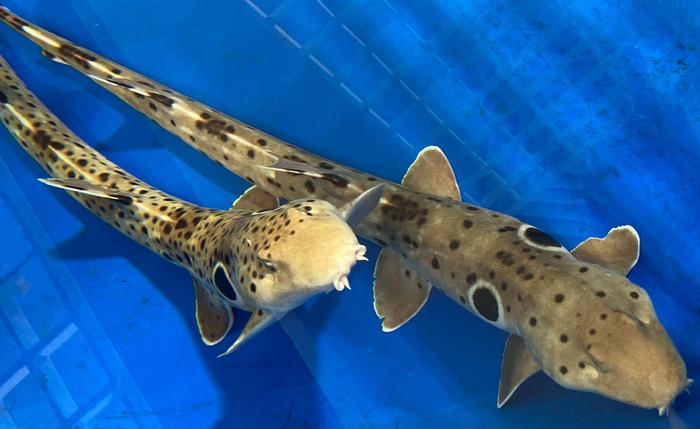
Epaulette Sharks

Credit: Frank J. Tulenko

Sharks have been populating the oceans for about 400 to 500 million years. While our planet and many of its inhabitants have undergone massive changes several times during this period, this basal group of vertebrates has remained somewhat constant. Their body shape and biology has hardly changed since then.

An international research team from Germany, Australia, Sweden, and the USA has now discovered the reason for this. They found that sharks have the lowest mutation rate between generations ever recorded in vertebrates.

The study was led and coordinated by the research group of Senior Professor Manfred Schartl at the Department of Developmental Biochemistry of the Julius-Maximilians-Universität Würzburg (JMU).

It has now been published in the journal Nature Communications.

Studies on Epaulette Sharks

For the study, epaulette sharks were caught off the northeast coast of Australia and a breeding station was subsequently set up at the Australian Regenerative Medicine Institute (ARMI) at Monash University. This made it possible for the first time to genetically assess the mutation rate within a shark family tree.

First, the research team was able to create a high-quality reference genome and sequence the entire genomes of the parents and then the nine offspring to discover new mutations occurring in the progeny.

The result: with an estimated mutation rate of 7×10⁻¹⁰ per base pair per generation, they have the lowest mutation rate yet recorded in vertebrates. It is ten to twenty times lower than in mammals.

Low Mutation Rate as a Double-Edged Sword

Sharks have long been said to have an exceptionally low cancer rate. “The low mutation rate could play a decisive role in this,” explains Manfred Schartl. What initially sounds like good news for the animals, however, also brings with it some problems.

Mutations are crucial because they increase genetic variability within populations, enabling adaptation to new conditions and evolutionary change. Because sharks evolve very slowly, they are at risk of being unable to withstand ecological stresses such as overfishing and habitat loss.

Particularly Worthy of Protection

Shark populations worldwide are experiencing sometimes dramatic declines. Of around 530 known shark species, several are already considered to be in acute danger of extinction. They are particularly threatened by changes in their habitat, for example due to ocean warming or bycatch in fisheries. However, sharks are also actively hunted, for example to produce anti-cancer supplements – without any scientific basis, of course.

Because sharks play a crucial role in many marine ecosystems, it is vital to support and intensify efforts to protect all shark species and preserve their genetic diversity.


Journal

Nature Communications

DOI

10.1038/s41467-023-42238

Article Title

Low mutation rate in epaulette sharks is consistent with a slow rate of evolution in sharks

Article Publication Date

19-Oct-2023

COI Statement

No COI

Share12Tweet8Share2ShareShareShare2

Related Posts

Evolution-Inspired Biosensors Revolutionize Lipid Tracking in Real Time — Biology

Evolution-Inspired Biosensors Revolutionize Lipid Tracking in Real Time

July 2, 2026
New Study Reveals How to Reduce Risk of Dangerous Wildlife Encounters This Summer — Biology

New Study Reveals How to Reduce Risk of Dangerous Wildlife Encounters This Summer

July 2, 2026

Hepatic IFRD1 Alleviates Metabolic Dysfunction-Linked Steatohepatitis Through the GLUD1/α-KG Pathway

July 2, 2026

Intricate Food Webs Support Ecosystem Health and Stability

July 2, 2026

POPULAR NEWS

  • Detection of EDCs in Breast Milk and Infant Urine Up to Six Months Highlights Early Exposure Risks

    77 shares
    Share 31 Tweet 19
  • Saying Goodbye to PGY-6: Pediatric Fellowship Realities

    103 shares
    Share 41 Tweet 26
  • New Drug Candidate Developed at McMaster Shows Potential for Treating Brain Cancer

    58 shares
    Share 23 Tweet 15
  • KTU Researchers Explore Ultrasound’s Role in Enhancing Blood Flow Beyond Diagnostics

    53 shares
    Share 21 Tweet 13

About

We bring you the latest biotechnology news from best research centers and universities around the world. Check our website.

Follow us

Recent News

Quasi-Bound States Boost Quantum Well Photoresponse

Lysine Pyruvylation Links Glycolysis to Epigenetics

Multiphysics Coupling: Single vs. Multiple DeepONet Branches

Subscribe to Blog via Email

Success! An email was just sent to confirm your subscription. Please find the email now and click 'Confirm' to start subscribing.

Join 83 other subscribers
  • Contact Us

Bioengineer.org © Copyright 2023 All Rights Reserved.

Welcome Back!

Login to your account below

Forgotten Password?

Retrieve your password

Please enter your username or email address to reset your password.

Log In
No Result
View All Result
  • Homepages
    • Home Page 1
    • Home Page 2
  • News
  • National
  • Business
  • Health
  • Lifestyle
  • Science

Bioengineer.org © Copyright 2023 All Rights Reserved.