Antimicrobial resistance has become one of the defining health threats of the twenty-first century, and few organisms embody the problem as completely as Escherichia coli. A new comparative genomic study of multidrug-resistant E. coli circulating in Bangladeshi poultry farms, published in MicrobiologyOpen, offers a detailed look at how these bacteria carry their resistance arsenals, how their virulence machinery is organized, and how they fit within the global population structure of the species. The findings arrive at a moment when global health authorities are warning that resistance already contributed to nearly five million deaths in 2019, including approximately 1.27 million deaths directly attributable to resistant infections, with projected economic losses reaching as high as 100 trillion US dollars by 2050 if current trends continue unchecked.
The research team, working under the ethical approval of the Bangladesh Livestock Research Institute, collected 400 pooled fecal samples from commercial poultry farms across four districts: Dhaka, Tangail, Mymensingh, and Sylhet. The sampling strategy deliberately spanned the three major poultry production systems in the country, with 160 samples each from broiler and layer farms and 80 from Sonali farms, a locally important dual-purpose breed. Each composite sample was gathered from five separate locations within a single farm, then pre-enriched in buffered peptone water and cultured on selective media. Molecular confirmation by polymerase chain reaction targeting the 16S rRNA gene identified E. coli in 280 of the 400 samples, a striking 70 percent detection rate that underscores how pervasive the organism is in these production environments.
Antimicrobial susceptibility testing against twelve antibiotics from nine classes revealed alarming phenotypic patterns. Resistance to ampicillin reached 97.86 percent, tetracycline resistance stood at 97.50 percent, and trimethoprim-sulfamethoxazole resistance was recorded at 91.79 percent, while nearly 69 percent of isolates resisted ciprofloxacin, a fluoroquinolone classified as critically important for human medicine. Only imipenem, a last-resort carbapenem, retained high effectiveness, with 96.43 percent of isolates remaining susceptible. These figures reflect decades of unrestricted over-the-counter antibiotic availability in Bangladesh, where antimicrobials have long been used as growth promoters and prophylactic agents, creating sustained selective pressure that favors the emergence and persistence of multidrug-resistant strains.
From this collection, the researchers selected three multidrug-resistant isolates, one from each production system, for whole-genome sequencing on an Illumina NextSeq 2000 platform. The sequencing generated roughly 8.2 to 9.8 million paired-end reads per isolate, achieving approximately 300-fold coverage. Assembled genome sizes ranged from 4.4 to 5.4 megabases with GC contents between 50 and 51 percent. These three genomes were then compared against 83 publicly available genomes from NCBI GenBank, drawn from poultry, human, and environmental sources across the world, producing a comparative dataset of 86 genomes designed to place the Bangladeshi isolates within a genuinely global context.
The resistance gene analysis revealed dense and varied arsenals. The layer isolate proved the most heavily burdened, harboring blaCTX-M-15, blaOXA-1, blaTEM-1B, qnrS1, sul2, sul3, tet(A), tet(M), and aac(6′)-Ib-cr, a combination conferring resistance across beta-lactams, fluoroquinolones, sulfonamides, tetracyclines, and aminoglycosides through mechanisms including antibiotic inactivation, target protection, target alteration, and efflux. The broiler isolate carried blaCTX-M-27 alongside floR, cmlA7, aph genes, dfrA14, sul2, and tet(A), while the Sonali isolate combined blaCTX-M-15 and blaTEM-1B with mph(A), qnrS1, sul3, and dfrA14. The CTX-M family of extended-spectrum beta-lactamases, particularly CTX-M-15 and CTX-M-27, is among the most clinically consequential resistance determinants worldwide, and its consistent presence in poultry-associated isolates signals a reservoir of genes with direct human health implications.
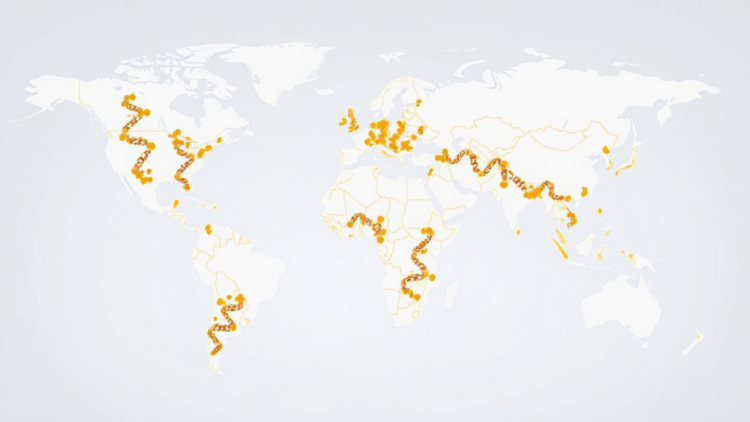
Country-level comparison using the Jaccard similarity index showed that the Bangladeshi isolates shared the highest average AMR gene profile similarity with isolates from Japan at approximately 0.32, followed by South Korea and Norway at around 0.30, with lower similarity to isolates from Argentina, Cambodia, Vietnam, and India. At the individual strain level, the closest matches were strain 45E from Switzerland with a similarity of 0.55, strain 1500 from Norway at 0.50, and EC10 from Italy at 0.49. While these values are moderate rather than close, they indicate that the resistance gene content of the Bangladeshi poultry isolates overlaps meaningfully with globally distributed strains rather than representing an isolated local phenomenon.
Virulence gene profiling painted an equally detailed picture. All three isolates carried the conserved fimbrial adhesin cluster fimA through fimI and curli-associated genes csgA through csgC, indicating strong colonization capacity. The broiler isolate carried the largest virulence repertoire, including extensive type II and type VI secretion system genes, the invasion-associated ibeB and ibeC genes, a full kps capsule gene cluster, and ompA. The layer isolate showed a reduced set dominated by adhesion and iron acquisition genes, including the yersiniabactin system, while the Sonali isolate displayed an intermediate profile with additional immune modulation genes gndA and gtrA. Shared virulence genes with global isolates were highest for Italy at roughly 110 genes, China and Japan at around 109 and 108, and the United States at 108, while Jaccard similarity of virulence profiles peaked with Norway at 0.63, Vietnam at 0.60, and Pakistan at 0.59. A conserved core of adhesion, motility, iron acquisition, and regulatory genes, including fur, phoP, pmrA, rcsB, and rpoS, was present across all three isolates, reflecting the stable machinery required for host adaptation.
Plasmid analysis added another layer of complexity. The broiler isolate harbored the most elaborate plasmid architecture, carrying Col(pHAD28), Col440I, IncFIB, and IncFIB(pLF82) replicon types, a family of plasmids well recognized as major vehicles for the co-dissemination of resistance and virulence genes. The layer isolate carried Col(MG828), IncFIB, and IncFIC(FII), while the Sonali isolate carried only IncX1, the simplest profile. Plasmid profile similarity with global strains was highest for Denmark at approximately 0.40 and the Philippines at 0.39, and lowest for India, Thailand, the United Kingdom, and Germany, underscoring the heterogeneous and regionally variable nature of plasmid content. Because IncF-type plasmids are notorious for linking multiple resistance genes onto single mobile elements, their prominence raises concerns about co-selection, in which the use of any single antibiotic can maintain an entire multidrug resistance payload.
Pangenome analysis across the three poultry isolates identified 7550 gene clusters, of which 2238, or 29.6 percent, were core genes shared by all three, while the remaining 70.4 percent formed the accessory genome, with the layer isolate alone contributing 5078 unique genes. Scaling up to the full 86-genome dataset revealed a pangenome of 29,366 gene clusters with only 4.6 percent core genes and nearly 80 percent cloud genes, a signature of the famously open pangenome of E. coli, which expands continuously as new genomes are added. Multilocus sequence typing assigned all three Bangladeshi isolates to sequence type ST457, a type also reported in Italy. In the minimum spanning tree, ST457 sat within a central clonal complex connected to globally dominant lineages including ST10, ST167, ST648, and the notorious ST131, which was documented across Argentina, Denmark, Italy, Malaysia, the United Kingdom, and the United States in the comparison dataset.
The authors caution that the small number of sequenced Bangladeshi isolates, the heavily fragmented assembly of the layer isolate, and the absence of simultaneously sampled human and environmental isolates limit direct inference of transmission routes. The genetic similarity with international strains indicates shared ancestry and gene exchange patterns rather than proven transmission. Nevertheless, the study delivers a clear message: poultry production systems in Bangladesh harbor E. coli carrying clinically relevant resistance and virulence determinants embedded in globally connected lineages. Strengthening antimicrobial stewardship in veterinary sectors, improving farm-level biosecurity, and building integrated One Health surveillance that links human, animal, and environmental sampling are highlighted as urgent priorities to interrupt the circulation of these genes before their passage into the food chain and human populations becomes still more efficient.
Subject of Research: Comparative genomics of multidrug-resistant poultry-associated Escherichia coli in Bangladesh
Article Title: Comparative Genomic Analysis of Multidrug‐Resistant Escherichia coli Across Poultry–Human–Environmental Interfaces
Article References: Shanto, M. R. H., Ashab Uddin, A. S. M., Supto, M. S. M., Mahim, N. J., Howlader, M. M. R., Ahmed, S. S. U., & Uddin, M. B. (2026). Comparative Genomic Analysis of Multidrug‐Resistant Escherichia coli Across Poultry–Human–Environmental Interfaces. MicrobiologyOpen, 15(5), Article e70406. https://doi.org/10.1002/mbo3.70406
Image Credits: AI Generated
DOI: 10.1002/mbo3.70406
Keywords: antimicrobial resistance, Escherichia coli, whole-genome sequencing, poultry, Bangladesh, pangenome, blaCTX-M, virulence genes, plasmids, ST457, One Health, genomic surveillance
Cite Scienmag News
APA MLA Chicago
Juliet Wilcox. (September 23, 2026). Genomes of Drug-Resistant Poultry E. coli Reveal Global Genetic Connections. Scienmag. https://scienmag.com/genomes-of-drug-resistant-poultry-e-coli-reveal-global-genetic-connections/
Juliet Wilcox. “Genomes of Drug-Resistant Poultry E. coli Reveal Global Genetic Connections.” Scienmag, 23 September 2026, https://scienmag.com/genomes-of-drug-resistant-poultry-e-coli-reveal-global-genetic-connections/. Accessed 23 September 2026.
Juliet Wilcox. “Genomes of Drug-Resistant Poultry E. coli Reveal Global Genetic Connections.” Scienmag. September 23, 2026. https://scienmag.com/genomes-of-drug-resistant-poultry-e-coli-reveal-global-genetic-connections/
Copy citation Download RIS
Tags: Antimicrobial Resistanceantimicrobial resistance in Bangladeshi poultryAntimicrobial resistance in poultry E. coliBangladeshblaCTX-Mcomparative genomics of multidrug-resistant bacteriaeconomic and health implications of resistant infectionsEscherichia coligenomic analysis of poultry farm bacteriagenomic surveillanceglobal genetic connections of resistant E. coliglobal spread of drug-resistant E. coli strainsimpact of antibiotic resistance on public healthmultidrug resistance mechanisms in Escherichia coliOne Healthpangenomeplasmidspoultrysampling strategies in poultry microbiology studiesST457surveillance of antimicrobialvirulence gene organization in resistant bacteriavirulence geneswhole genome sequencing