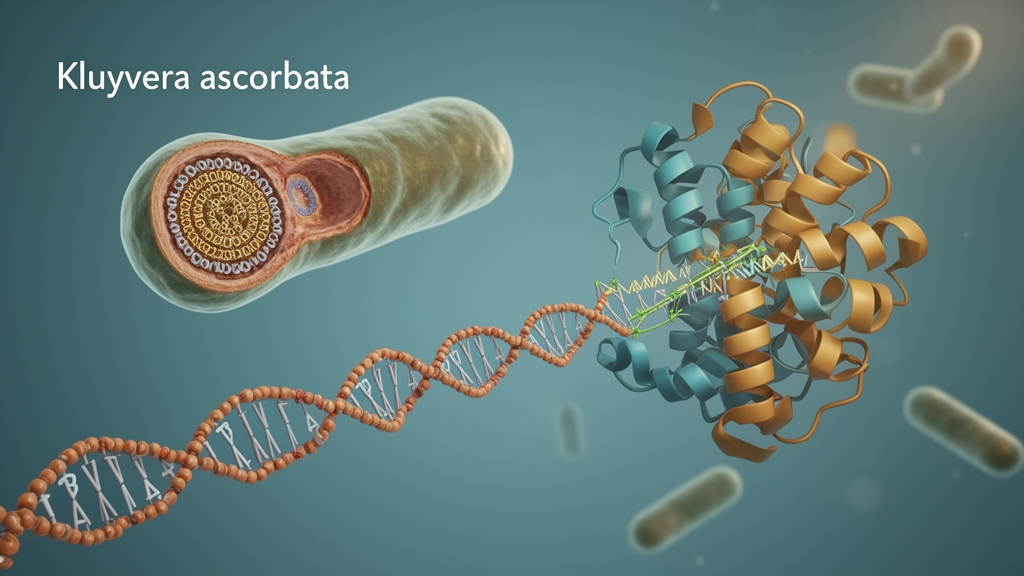
Only one species in the bacterial genus Kluyvera carries a complete, apparently intact CRISPR-Cas immune system, according to a new genomic survey published in Current Genetics. Çiğdem Yilmaz-Çolak mined the publicly available genomes of the genus and found that among thirteen fully assembled Kluyvera genomes, only Kluyvera ascorbata strain SK harbored a complete CRISPR locus, consisting of two CRISPR arrays and a full set of cas genes characteristic of a type I-E system. The finding offers the first detailed look at the CRISPR-Cas architecture of this emerging opportunistic pathogen, a genus better known as a reservoir of extended-spectrum beta-lactamase genes that can spread antibiotic resistance to other bacteria.
Kluyvera species are facultatively anaerobic Gram-negative bacteria in the Enterobacteriaceae family, first described in the 1980s. They live in soil, water, and the gastrointestinal tracts of humans and animals, and are closely related to familiar genera such as Escherichia and Citrobacter. While their clinical importance was once considered limited, recent reports have linked Kluyvera to bacteremia and urinary tract infections, particularly in patients with weakened immune systems. The genus is also increasingly recognized as a progenitor of ESBL genes such as blaCTX-M, which can disseminate antibiotic resistance worldwide through horizontal transfer. Some isolates tolerate heavy metals, including lead-resistant K. intermedia and nickel-tolerant K. cryocrescens and K. ascorbata strains, which has drawn interest for bioremediation applications.
CRISPR-Cas systems serve as adaptive immune defenses in bacteria, storing short sequences of invading DNA, called spacers, in the host genome. These spacers later guide recognition of matching sequences during subsequent viral or plasmid invasions. Because plasmids often mediate the spread of antibiotic resistance genes, the presence or absence of active CRISPR-Cas loci can influence the success of horizontal gene transfer events. Conversely, the absence or inactivation of CRISPR-Cas systems may allow greater acquisition of resistance plasmids or phage-borne virulence factors. Understanding whether Kluyvera loci are intact and potentially active therefore offers clues about the historical encounters of these bacteria with phages and plasmids, and a foundation for exploring how CRISPR-mediated immunity shapes the mobilome and resistance landscape of an opportunistic pathogen.
To close the knowledge gap, the study took advantage of the fact that 170 Kluyvera genomes were available in the NCBI Genome Bank as of April 2025, but only thirteen had been assembled to the complete level. All thirteen complete genomes, spanning K. ascorbata, K. intermedia, K. sichuanensis, K. cryocrescens, Kluyvera sp. CRP, and Kluyvera genomosp. 3, were downloaded and annotated with Prokka to ensure consistent open reading frame identification. CRISPR arrays were predicted with CRISPRCasFinder and cross-validated in CRISPRDetect, with inclusion criteria requiring an evidence level above 1, the presence of cas genes, and more than five repeats. Manual inspection confirmed repeat periodicity, repeat-spacer organization, and nearby cas genes, reducing the risk of false positives from orphan arrays that may represent remnants of previously functional systems.
The search revealed that only the K. ascorbata SK strain carried a complete CRISPR locus, detected with the highest confidence level of 4 in CRISPRCasFinder. The locus contains two arrays and one cas operon. The first array, designated CRISPR1, spans positions 1,039,436 to 1,039,890 in the genome and holds seven spacers separated by direct repeat sequences 28 nucleotides long. The second array, CRISPR2, spans positions 1,048,801 to 1,050,051, with direct repeats of 29 nucleotides and 20 spacer positions, two of which share the same sequence, yielding 19 unique spacers. Based on the genomic architecture, the system was designated type I-E, the subtype most commonly found among Enterobacteriaceae. The cas operon adjacent to CRISPR2 encodes cas3, cse2, cse2gr11, cas7, cas5, cas6, cas1, and cas2, covering the interference, adaptation, and accessory modules typical of the subtype.
Analysis of the direct repeat sequences confirmed a total of 29 DR sequences, which grouped into six sequence families: two groups in CRISPR1 and four in CRISPR2. Although the repeats were not 100 percent identical, conservation was high, at 96.20 percent in CRISPR1 and 86.41 percent in CRISPR2. RNA secondary structure predictions with the RNAfold server showed the typical stem-loop architecture in all groups, with a stem connecting two loops. Because DR stem-loops are recognized and cleaved by Cas6e in type I-E systems to generate mature crRNAs, their stability is directly relevant to processing efficiency and complex formation. Groups 2 and 4, despite relatively high GC contents of 65.5 and 71.4 percent, contained mismatched bases in their stems and showed the least negative minimum free energy values, suggesting comparatively less stable hairpins that could reduce Cas6e processing efficiency. The authors cautioned that these functional implications rest on in silico estimates that depend on ionic conditions and sequence context.
Spacer analysis provided the most striking ecological signal. Of 26 unique spacers, only four showed matches in protospacer searches against RefSeq plasmid, GenBank phage, and IMG/VR viral databases at a stringent identity threshold of 85 percent or higher. CRISPR1 spacers produced 153 spacer-protospacer interactions, of which 138, or 90.2 percent, matched plasmid sequences and 15, or 9.8 percent, matched viral genomes. All of these matches traced to just two spacers, Spacer3 and Spacer4, with plasmid targets originating from Citrobacter, Klebsiella, Escherichia, Enterobacter, Salmonella, and Kosakonia species. Spacer4 included one perfect match to a plasmid of Citrobacter amalonaticus Y19. The strong plasmid bias suggests that K. ascorbata may experience frequent horizontal gene transfer events and likely shares a gene pool with other Enterobacteriaceae in environments such as the human gut, soil, or wastewater, where plasmid exchange is prevalent.
The CRISPR2 array told a different story. Its 11 matches, all associated with Spacer4 and Spacer16 against IMG/VR viral entries, each contained at least five mismatches, falling to 84.37 percent identity, just below the strong-protospacer threshold. The authors interpret these weak matches cautiously: they may reflect historical interactions with phages that have since evolved escape mutations, or false positives from the computational pipeline, and they may no longer trigger effective Cas-mediated interference, particularly if mismatches fall in the seed region. The majority of spacers in both arrays matched nothing in the databases, which the study attributes to incomplete coverage of viral and plasmid sequences, rapid evolution of mobile elements relative to spacer age, and factors such as PAM constraints not modeled by the search tool. Because so few unique spacers matched known targets, no conserved PAM could be identified with confidence.
Phylogenetic analysis of Cas3, considered the signature protein of type I systems, placed K. ascorbata in a strongly supported clade with Salmonella enterica, Salmonella bongori, Citrobacter europaeus, and Kosakonia grimontii, with 100 percent bootstrap support for the group and 86 percent for the node connecting to C. europaeus. K. ascorbata fell clearly outside the clade containing Escherichia and Shigella, suggesting divergence in Cas3 sequence or function in those lineages. The result points to a shared ancestor for the Cas3 protein among these genera and possible functional or evolutionary conservation. Direct repeat conservation between K. ascorbata and E. coli, Salmonella, and Citrobacter species is consistent with a shared ancestral origin for the CRISPR array, although the spacer repertoires differ markedly: whereas spacers in the model enterics frequently target phage genomes, those in K. ascorbata predominantly match plasmid-derived sequences, hinting at distinct ecological pressures.
Because the CRISPR locus appeared only in K. ascorbata SK, the study also profiled its resistance genes using the NCBI MicroBIGG-E browser and the CARD Resistance Gene Identifier. The genome carries the ESBL gene CTX-M-95, the fosfomycin resistance gene fosA3, several efflux pump families, regulatory variants, and mutations in UhpT, EF-Tu, and PBP3 associated with resistance to fosfomycin, elfamycins, and beta-lactams respectively, with most homologs showing more than 85 percent identity and near-complete coverage. The coexistence of an intact type I-E system with multiple resistance determinants suggests that, in this strain, CRISPR-Cas does not strictly prevent horizontal transfer of resistance genes, echoing studies that find CRISPR systems play broader regulatory roles rather than acting as absolute barriers. The authors note that the spacer content could serve as an intrinsic barcode of past exposures for molecular strain typing and diagnostics, and that synthetic spacers might one day direct the endogenous system against resistance genes or virulence factors. All such applications, they stress, remain contingent on direct experimental evidence of activity, which has yet to be obtained; future work must demonstrate that the cas genes are expressed, that new spacers are acquired upon challenge, and that the system mediates sequence-specific defense.
Subject of Research: CRISPR-Cas systems in the genomes of Kluyvera bacteria
Article Title: The CRISPR-cas repertoire of Kluyvera ascorbata: insights from genomic data
Article References: Yilmaz-Çolak, Ç. (2025). The CRISPR-cas repertoire of Kluyvera ascorbata: insights from genomic data. Current Genetics, 71(1), Article 28. https://doi.org/10.1007/s00294-025-01332-x
Image Credits: AI Generated
DOI: 10.1007/s00294-025-01332-x
Keywords: CRISPR-Cas, Kluyvera ascorbata, type I-E system, genome mining, Enterobacteriaceae, antibiotic resistance genes, spacers, plasmids, bacteriophages, Cas3 phylogeny, opportunistic pathogens, direct repeats
News Source: Juliet Wilcox. (October 28, 2026). Genome mining reveals a complete type I-E CRISPR-Cas system in Kluyvera ascorbata. Scienmag.