


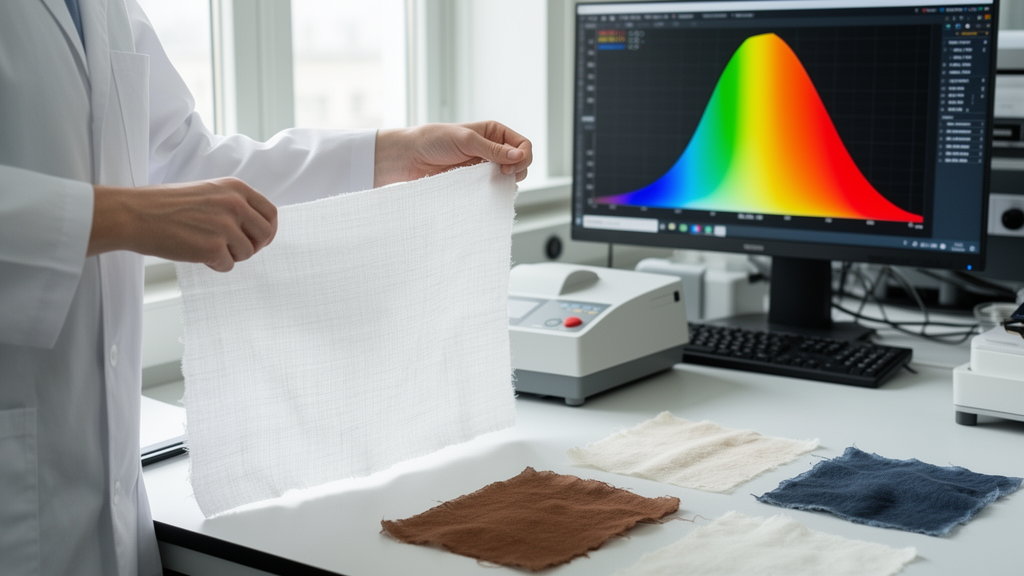
Researchers have built a genetic programming model that predicts how much solar radiation a raw cotton woven fabric will reflect anywhere in the 210–1200 nanometre range, from the deep ultraviolet through the visible spectrum into the near-infrared. For textile engineers, the payoff is practical: instead of weaving and testing dozens of trial fabrics, a designer can select yarn fineness, weave and density, feed those values into the model’s equations, and iterate on screen until the predicted reflectance matches a protection target.
The study, led by Polona Dobnik Dubrovski, Tadeja Penko and Miran Brezocnik, was motivated by the health stakes of solar exposure. The authors note that chronic ultraviolet exposure is linked to skin cancer, premature ageing and eye damage, that high-energy visible light can generate oxidative stress and stimulate melanogenesis, aggravating hyperpigmentation and melasma, and that infrared radiation raises skin temperature to roughly 40 °C, triggering matrix-metalloproteinases that break down collagen and elastic fibres and accelerate skin ageing. Because woven fabrics are a first line of defence, the industry has moved beyond aesthetics toward materials that protect across the entire solar spectrum. Yet predicting how a fabric’s structure will shape its optical behaviour has remained difficult, and design of new woven constructions has historically depended on extensive trial weaving and laboratory testing guided by expert intuition.
Earlier approaches each cover only part of the problem. Physics-based frameworks, from classical Kubelka–Munk theory to ray tracing and finite-element electromagnetic simulations, can be computationally demanding or treat the fabric as a homogeneous medium, and research cited in the paper showed that two-dimensional Kubelka–Munk models often miss the nuanced effects of yarn geometry on lightness and chroma. Data-driven methods such as artificial neural networks and multi-output linear regression have achieved high accuracy in narrower bands; a recent linear-regression model reached average R² values of 0.9986 for yarn-to-fabric and 0.9947 for fabric-to-yarn spectral prediction. Empirical equations linking cover factor to reflectance work well for specific cases. The new work positions itself as a unified, data-driven alternative: a single genetic programming model spanning the full UV–Vis-NIR continuum for one material, 100% cotton, so that fibre-blend variation cannot confound the structural analysis.
To build the dataset, the team constructed 27 untreated cotton shirting fabrics on Picanol weaving machines under identical technological conditions, following Kienbaum’s setting theory of limit fabric structure. Yarn fineness took values of 14, 25 and 36 tex; weave types were plain, 4-ply double-sided twill and 5-ply warp satin, with weave factors of 0.904, 1.188 and 1.379 respectively; and relative fabric density fell into three classes of 55–65%, 65–75% and 75–85%. Restricting the study to raw, untreated fabrics removed the influence of dyeing, bleaching, printing and chemical finishing, so only fabric geometry could drive the results. Reflectance was measured with a PerkinElmer Lambda 900 UV/VIS/NIR spectrophotometer equipped with an integrating sphere, at 10-nanometre intervals from 210 to 1200 nm, and surface roughness was quantified with a KES-FB4 surface analyser. Analysis of variance, run in SPSS at a significance level of 0.05, tested which structural factors mattered at representative wavelengths of 240, 500 and 1000 nm.
The measurements revealed three spectral regions with distinct behaviour. Between 210 and 290 nm, reflectance rose rapidly to a distinct peak around 240 nm and then fell sharply. From 290 to 600 nm, reflectance climbed steadily from a minimum to a near-maximum value. Above 600 nm, out to 1200 nm, it stayed almost constant. Reflectance was highest in the visible and infrared regions, ranging from roughly 45% to 75% depending on structure, and lowest in the ultraviolet below 290 nm, at 27% to 47%. The analysis of variance showed that the governing factors changed with wavelength: at 240 nm no main factor was individually significant, though the interaction between yarn fineness and weave type was; at 500 nm weave type and relative fabric density dominated, with yarn fineness mattering only through its interaction with weave; and at 1000 nm all three primary factors were statistically significant.
In the 600–1200 nm region, satin-woven fabrics reflected the most, twill followed and plain fabrics reflected least at equal relative density, and higher relative density consistently raised reflectance within every yarn group. The explanation lies in thread packing: satin weaves can reach higher warp and weft densities, producing a smoother surface and greater specular reflection that cuts transmission through yarns and macropores. One satin sample made from 14 tex yarns at the highest density level reflected 71.4% and transmitted 33.1% at 1000 nm, an apparent absorbance of −1.9%. The authors attribute this physically: in the near-infrared, cotton’s natural pigments absorb almost nothing, so scattering dominates, and with an integrating sphere capturing radiation emerging from both fabric faces, the summed reflectance and transmittance can exceed the incident radiation rather than indicating a measurement error.
A surprise emerged among the yarn groups. Fabrics woven from 25 tex yarns consistently out-reflected those made from finer 14 tex yarns in the region above 600 nm, across plain, twill and satin structures, contrary to the conventional expectation that finer yarns produce smoother, more uniform surfaces with better specular reflectance. The likely culprit is yarn processing: the 14 tex yarns were combed, leaving fewer protruding fibres and a more compact structure that reduces diffuse reflectance, while the 25 and 36 tex yarns were carded, with greater surface irregularity and porosity that enhance diffuse scattering. Because natural pigment content in the raw cotton yarns was not measured, the authors restricted structural analysis to fabrics of defined yarn fineness.
The middle region, 290–600 nm, told a subtler story about surface roughness. Higher fabric density correlated with lower surface roughness, and rougher surfaces generally reflected less, but the relationship was not a simple inverse one. Two comparisons made the point. A plain fabric and a twill fabric with very different roughness values, 6.1 versus 4.6, reflected nearly identically at 500 nm, about 51.6% and 52.2%, because the plain fabric’s higher density suppressed macroporosity and offset its roughness, while the smoother twill’s lower density left inter-yarn voids that limited its reflective area. Meanwhile a twill and a satin fabric with almost identical roughness, 4.6 versus 4.5, differed sharply at 52.2% versus 58.7%, because visible reed marks in the twill created periodic gaps that disrupted surface continuity. Reflectance, the authors conclude, results from how weave-induced float lengths and packing density balance specular against diffuse reflection.
The genetic programming system itself evolved explicit equations rather than a black box. The team’s in-house Python system ran 55 independent evolutionary runs, each with a different random split of the 2700 data points into 2160 training and 540 testing cases, using a function set of addition, subtraction, multiplication, division and sine, a population of 3000 individuals, up to 10,000 generations, and a fitness function based on mean absolute error with penalties for model complexity and structural depth. The winning model takes four inputs—yarn fineness in tex, weave factor, relative fabric density in percent and wavelength in nanometres, all z-score standardised—and outputs solar-radiation reflectance in percent. On the training data it achieved a coefficient of determination of 0.98, a mean absolute error of 1.14% and a root mean squared error of 1.46%; on the unseen test data, R² reached 0.986 with a mean absolute error of 1.15%. Sensitivity analysis ranked wavelength as the dominant influence at 77.34% on the training set, followed by the weave factor at 15.96%, relative fabric density at 4.89% and yarn fineness at 1.82%, with test-set values closely matching.
The authors are candid about one limitation: because the 2700 data points came from only 27 fabric samples and the train–test split was random, individual fabrics appeared in both subsets, which may make the reported performance slightly optimistic. They recommend a leave-one-sample-out cross-validation strategy in future refinements to confirm generalisation on entirely unseen fabric structures. The current model also applies only to raw, untreated 100% cotton and does not account for dyes, coatings or finishes, though the underlying genetic programming pipeline is material-agnostic and can be retrained on new experimental databases that include those variables. Within its scope, the model already captures the characteristic shape of real spectra, including low ultraviolet reflectance and the near-infrared plateau in high-density fabrics, with discrepancies under 2% root mean squared error in a demonstrated test case. For engineers designing sun-protective apparel, camouflage or personal protective equipment, it offers a way to prototype cotton fabrics virtually and reserve laboratory work for the most promising candidates.
Subject of Research: A genetic programming model predicting how cotton woven fabric structure controls solar-radiation reflectance across the ultraviolet, visible and near-infrared spectrum.
Article Title: Genetic-programming prediction of solar-radiation reflectance in cotton woven fabrics for UV–Vis-NIR protection
Article References: Dubrovski, P. D., Penko, T., & Brezocnik, M. (2026). Genetic-programming prediction of solar-radiation reflectance in cotton woven fabrics for UV–Vis-NIR protection. Fashion and Textiles, 13(1), Article 24. https://doi.org/10.1186/s40691-026-00476-9
Image Credits: AI Generated
DOI: 10.1186/s40691-026-00476-9
Keywords: genetic programming, cotton woven fabrics, solar-radiation reflectance, UV-Vis-NIR spectrum, weave type, yarn fineness, relative fabric density, ANOVA, spectral regions, textile modelling, sun-protective textiles, virtual prototyping
News Source: Juliet Wilcox. (October 30, 2026). Genetic programming model predicts solar reflectance of cotton fabrics across UV, visible and infrared. Scienmag.



