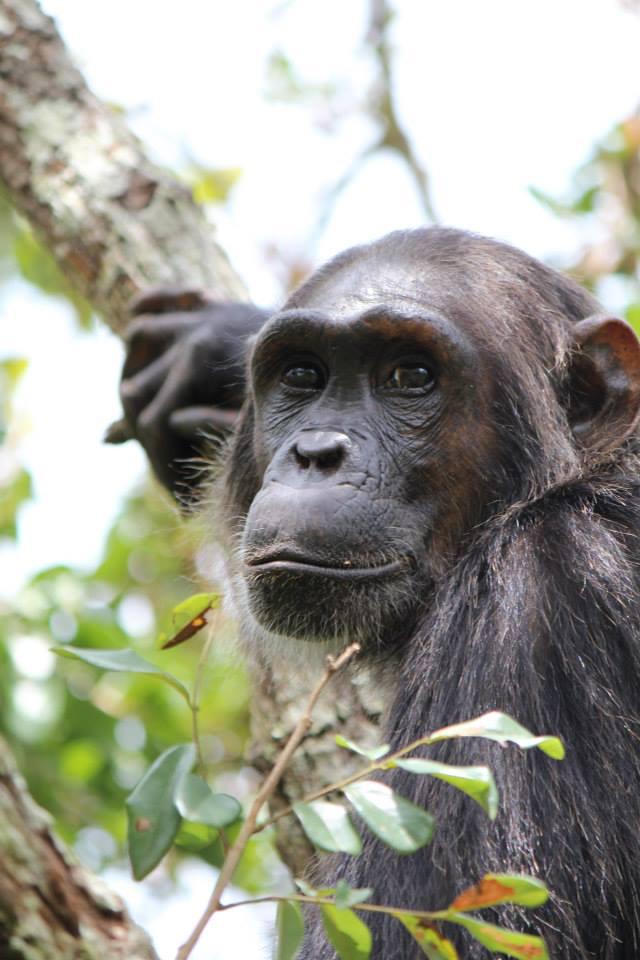
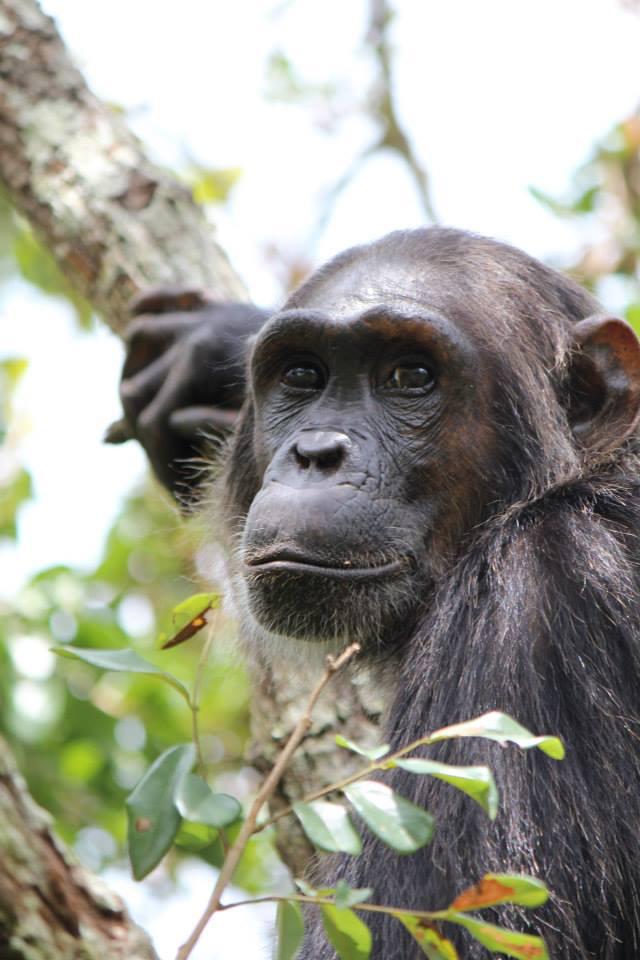
Credit: Photo courtesy of Kara Walker, Duke University.
DURHAM, N.C. — When it comes to hookups in the animal world, casual sex is common among chimpanzees. In our closest animal relatives both males and females mate with multiple partners. But when taking the plunge into parenthood, they're more selective than it seems.
A study appearing online Jan. 11 in the journal Royal Society Open Science reveals that chimps are more likely to reproduce with mates whose genetic makeup most differs from their own.
Many animals avoid breeding with parents, siblings and other close relatives, said first author Kara Walker, a postdoctoral associate in evolutionary anthropology at Duke University. But chimpanzees are unusual in that even among nonrelatives and virtual strangers they can tell genetically similar mates from more distant ones.
The researchers aren't sure yet exactly how they discriminate, but it might be a best guess based on appearance, smell or sound, said senior author Anne Pusey, professor of evolutionary anthropology at Duke.
Researchers took DNA samples from the feces of roughly 150 adult chimpanzees in Gombe National Park, Tanzania, and analyzed eight to 11 variable sites across the genome. From these, they were able to estimate the genetic similarity between every possible male-female pair.
In chimpanzees, as in other animals, only some sexual encounters lead to offspring. When the researchers compared pairs that produced infants with those that didn't, they found that females conceived with sires that were less similar to them than the average male.
Chimps are somehow able to distinguish degrees of genetic similarity among unfamiliar mates many steps removed from them in their family tree, the study shows.
In Gombe National Park, some females stay in the same group for life, but most move out as they reach adolescence, leaving their fathers and brothers behind to reproduce in a new group. These immigrant females, which have few or no male relatives in their community, showed even stronger preference for genetically dissimilar mates than the native females did.
Part of what's driving their mate choices, the researchers say, is inbreeding depression, which is when offspring inherit the same harmful version of a gene from both parents and genetic vulnerabilities that are normally masked become active.
Conception between parents and offspring or between siblings is rare in chimpanzees, but studies suggest that when it occurs, the infants that result are less likely to survive to maturity than their outbred counterparts.
Unlike humans, chimpanzees can't take genetic tests to help them find their perfect match.
Now the researchers are trying to figure out how chimpanzees recognize and favor mates whose DNA is more different from theirs, even among unfamiliar partners. The animals do more than simply avoid mates they grew up with and are therefore likely to be related to, the study shows.
In addition to whatever means they are using to distinguish relatedness, they could also rely on timing, being pickier about their sexual partners during the part of a female's cycle when she is most likely to conceive. Processes that take place after mating may also play a role, such as a female unconsciously choosing some males' sperm over others, or influencing the fertilized egg's implanting or the fate of the embryo, Walker said.
###
This research was supported by the Jane Goodall Institute, the National Science Foundation (DBS-9021946, SBR-9319909, BCS-0452315, IOS-LTREB-1052693 and DGE-1106401) and the National Institutes of Health (R01 AI 058715, R01 AI 120810, P30 AI 045008 and R00 HD 057992).
CITATION: "Chimpanzees Breed with Genetically Dissimilar Mates," Kara Walker, Rebecca Rudicell, Yingying Li, Beatrice Hahn, Emily Wroblewski and Anne Pusey. Royal Society Open Science, Jan. 11, 2017. http://dx.doi.org/10.1098/rsos.160422
Media Contact
Robin Ann Smith
[email protected]
919-681-8057
@DukeU
http://www.duke.edu