

• HOME
  • NEWS
  • EXPLORE
    • CAREER
      • Companies
      • Jobs
    • EVENTS
    • iGEM
      • News
      • Team
    • PHOTOS
    • VIDEO
    • WIKI
  • BLOG
  • COMMUNITY
    • FACEBOOK
    • INSTAGRAM
    • TWITTER
Saturday, August 1, 2026
BIOENGINEER.ORG
No Result
View All Result
  • Login
  • HOME
  • NEWS
  • EXPLORE
    • CAREER
      • Companies
      • Jobs
        • Lecturer
        • PhD Studentship
        • Postdoc
        • Research Assistant
    • EVENTS
    • iGEM
      • News
      • Team
    • PHOTOS
    • VIDEO
    • WIKI
  • BLOG
  • COMMUNITY
    • FACEBOOK
    • INSTAGRAM
    • TWITTER
  • HOME
  • NEWS
  • EXPLORE
    • CAREER
      • Companies
      • Jobs
        • Lecturer
        • PhD Studentship
        • Postdoc
        • Research Assistant
    • EVENTS
    • iGEM
      • News
      • Team
    • PHOTOS
    • VIDEO
    • WIKI
  • BLOG
  • COMMUNITY
    • FACEBOOK
    • INSTAGRAM
    • TWITTER
No Result
View All Result
Bioengineer.org
No Result
View All Result
Home NEWS Science News Biology

Genetic diversity helps protect against disease

Bioengineer by Bioengineer
May 23, 2018
in Biology
Reading Time: 2 mins read
0
Share on FacebookShare on TwitterShare on LinkedinShare on RedditShare on Telegram
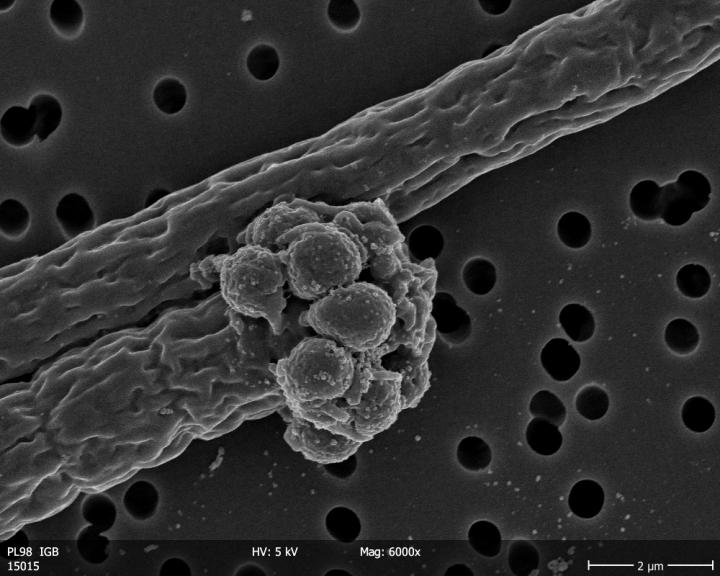
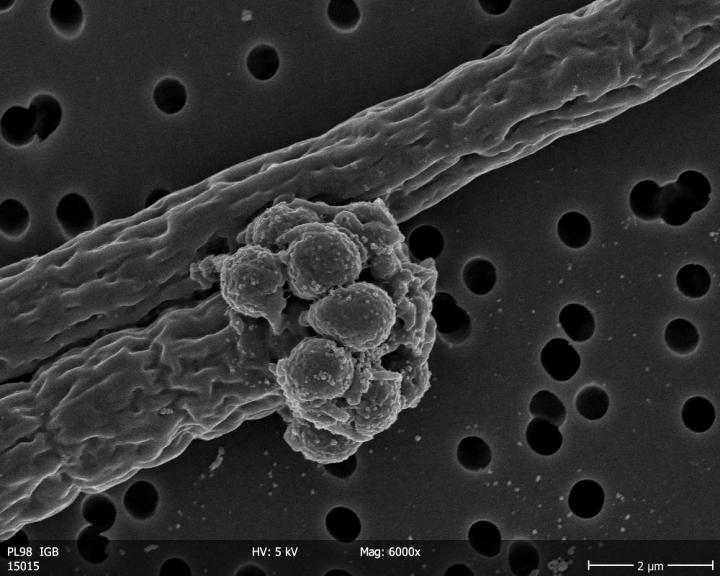
IMAGE

Credit: Reingard Roßberg / IGB

So much for survival of the fittest – diversity is the key: a team of researchers from the Leibniz-Institute of Freshwater Ecology and Inland Fisheries (IGB) has succeeded in demonstrating experimentally that genetic diversity makes populations more resistant to disease.

Why is it that animal and plant species throughout the world have different genetic variants within their particular species, even though it is supposed to be the "fittest" gene pool that survives? According to a common theory in evolutionary biology, it is to enable the species to respond more effectively to changes in the environment, such as the occurrence of disease. However, experimental evidence to support this theory is very difficult to obtain: After all, it is virtually impossible to observe how evolutionary trends develop in most animal and plant species – their generation times are simply too long.

Evolutionary change in real time

A team led by IGB researcher and evolutionary ecologist Dr. Ramsy Agha has now investigated the evolution of the fungal parasite Rhizophydium megarrhizum. This parasite infects the cyanobacterium species Planktothrix, which is prevalent in many freshwaters. The team exposed the parasite to host populations whose individuals were genetically identical to each other, and alternatively to populations comprised of different genetic variants. Since the fungus multiplies rapidly, roughly once a day, the scientists monitored its performance for a total period of 200 days. "We wanted to observe evolutionary change in real time and under controlled conditions, to find out if and how quickly parasites adapt to genetically homogenous and diverse hosts," explained Ramsy Agha.

The scientists permitted the adaptation of Rhizophydium megarrhizum, but kept the host populations in an evolutionary standstill. "We were able to show that the fungi adapt to genetically homogenous hosts very quickly, that is within just three months," reported Agha. This adaptation is reflected in the fact that the parasites managed to adhere to the hosts and overcome their defence mechanisms more quickly, and were therefore able to reproduce more rapidly.

Genetic diversity in the host population slows down adaptation of parasites

If, on the other hand, the cyanobacteria were genetically diverse, these effects did not occur. The parasite failed to adapt, and the state of the disease remained unchanged. Genetic diversity in cyanobacteria evidently slows down the adaptation of the parasite, increasing their resistance to disease.

"Our findings are also significant for ecosystem research in general, because they help us to explain why a high degree of diversity in populations may be valuable for their preservation," said Agha. He and his team want to investigate next what happens when not only the parasite, but also the host population is permitted to adapt to changed conditions. The researchers hope to gain further insights into how disease – generally perceived as a negative phenomenon – is a crucial natural process that promotes and preserves biological diversity.

###

Media Contact

Ramsy Agha
[email protected]
49-306-418-1745

http://www.fv-berlin.de

Original Source

http://www.igb-berlin.de/en/news/genetic-diversity-helps-protect-against-disease http://dx.doi.org/10.3389/fmicb.2018.00921


Share14Tweet8Share2ShareShareShare2

Related Posts

Scientists reveal how muscles preserve cells responsible for repair

Scientists reveal how muscles preserve cells responsible for repair

August 1, 2026
Extracellular Vesicles May Help Weather Cytokine Storms

Extracellular Vesicles May Help Weather Cytokine Storms

July 31, 2026

Insilico Medicine launches the industry’s first Drug Discovery and Development (DDD) benchmark as a service, to evaluate frontier AI and foundation models on real-world science

July 31, 2026

Cemiplimab and fianlimab with neoadjuvant chemotherapy in early-stage high-risk -negative breast cancer

July 30, 2026
Please login to join discussion

POPULAR NEWS

  • C2ORF68 stabilizes SIVA1, boosting BCL-2 and preventing apoptosis in gallbladder cancer

    29 shares
    Share 12 Tweet 7
  • Meta-analysis finds combined fortification boosts zinc, iron, and protein in rice grain

    29 shares
    Share 12 Tweet 7
  • Study compares two Crimean-Congo hemorrhagic fever virus isolates in IFNAR-deficient mice

    29 shares
    Share 12 Tweet 7
  • Kidney Inflammation and Red Blood Cell Framework Predicts Parkinson’s Risk and Progression

    29 shares
    Share 12 Tweet 7

About

We bring you the latest biotechnology news from best research centers and universities around the world. Check our website.

Follow us

Recent News

C2ORF68 stabilizes SIVA1, boosting BCL-2 and preventing apoptosis in gallbladder cancer

Meta-analysis finds combined fortification boosts zinc, iron, and protein in rice grain

Study compares two Crimean-Congo hemorrhagic fever virus isolates in IFNAR-deficient mice

Subscribe to Blog via Email

Enter your email address to subscribe to this blog and receive notifications of new posts by email.

Join 85 other subscribers
  • Contact Us

Bioengineer.org © Copyright 2023 All Rights Reserved.

Welcome Back!

Login to your account below

Forgotten Password?

Retrieve your password

Please enter your username or email address to reset your password.

Log In
No Result
View All Result
  • Homepages
    • Home Page 1
    • Home Page 2
  • News
  • National
  • Business
  • Health
  • Lifestyle
  • Science

Bioengineer.org © Copyright 2023 All Rights Reserved.
