Credit: Jay Chen/Oak Ridge National Laboratory, U.S. Dept. of Energy
OAK RIDGE, Tenn., Oct. 18, 2018–Scientists studying a valuable, but vulnerable, species of poplar have identified the genetic mechanism responsible for the species' inability to resist a pervasive and deadly disease. Their finding, published in the Proceedings of the National Academy of Sciences, could lead to more successful hybrid poplar varieties for increased biofuels and forestry production and protect native trees against infection.
A research team–jointly led by the Department of Energy's Oak Ridge National Laboratory and Oregon State University in partnership with the DOE Joint Genome Institute and the University of Georgia–analyzed the genetic response of purebred black cottonwood poplars infected by a pathogen known as Septoria.
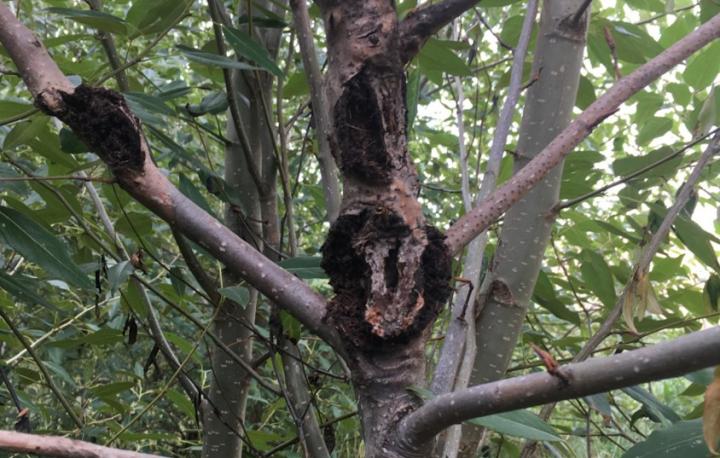
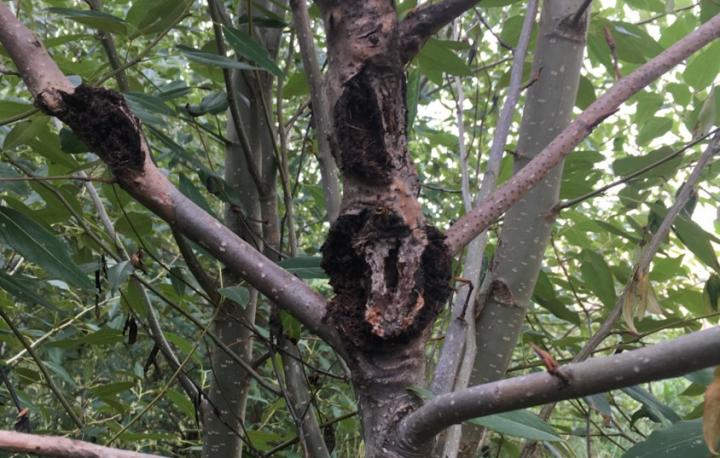
Septoria causes untreatable cankers, or wounds, on the surface of the trunk and branches and kills trees early in the growing cycle.
"Since the 1900s, industry has tried to grow hybrid varieties of poplar–including those made by crossing eastern cottonwood and black cottonwood–to produce a faster-growing tree, and they have been puzzled by the early death of hybridized poplars grown in many parts of the United States," said Wellington Muchero, the study's lead author with the Center for Bioenergy Innovation at ORNL.
Hybrid varieties are economically valuable because they can grow up to three times faster than the pure species. If the hybridized poplars survive, they could dramatically increase production of high-value, bio-derived materials, biofuels and forestry products such as pulp and paper, lumber and veneer.
Black cottonwood poplars grow natively in river systems across the Pacific Northwest region of the United States where Septoria is not yet a threat.
"What our study revealed is a double whammy for black cottonwoods," said Muchero, a specialist in plant microbe interfaces. "Since the pathogen is not prevalent in its native region, these trees have allowed their genetic resistance mechanisms to fall apart with no consequence."
"Surprisingly, we found that a gene that causes susceptibility is widely prevalent across the species range," said Jared M. LeBoldus, senior author and assistant professor of forest pathology at Oregon State University. "This degraded resistance and maintained susceptibility could be detrimental to the ecosystem if Septoria is introduced in the Pacific Northwest."
To map the genetic behavior of black cottonwood, Oregon State scientists assessed more than 3,000 individual black cottonwoods using a combination of digital imagery and measurements of disease severity for susceptibility to Septoria canker.
ORNL scientists used computational resources coupled with genome sequencing and profiling of more than a thousand genomes provided by DOE Joint Genome Institute that helped identify the resistance and susceptibility gene in each individual black cottonwood. The team then searched for links between a dataset of 28 million known mutations and the poplars' genetic profiles to verify which trees lined up with those that were predicted to be resistant or susceptible to Septoria.
"Out of those billions of computations, we found mutations that are consistently correlated with either resistance or susceptibility to the disease," Muchero said. "At ORNL, we can show that our results hold up in real-world field conditions and that most black cottonwoods from the West Coast cannot tolerate the Septoria pathogen."
Yet, the results also identified individual trees that are resistant to the disease and can be used to develop resistant hybrids for commercial production, as well as inform intervention strategies to protect Pacific Northwest ecosystems from the spread of Septoria.
Muchero and LeBoldus said this research supports a challenge issued by an ad hoc committee of the National Academies of Sciences, Engineering and Medicine to investigate the potential for biotechnology to address forest health.
"Genetic studies can help scientists and forestry experts prepare for a situation when a pathogen enters an ecosystem with little warning and deploy methods to inoculate and potentially save the at-risk species from being wiped out," they added.
###
Co-authors of the paper titled, "Association mapping, transcriptomics, and transient expression identify candidate genes mediating plant-pathogen interactions in a species of forest tree," include Wellington Muchero, Jin-Gui Chen, Jin Zhang, Yongil Yang, Priya Ranjan and Sara Jawdy of ORNL; Jerry Tuskan of ORNL and the DOE Joint Genome Institute; Kelsey L. Sondreli, Alexandra J. Weisberg and Jeff H. Chang of Oregon State University; Jared M. LeBoldus of Oregon State and North Dakota State University; Breeanna R. Urbanowicz, Jeong-Yeh Yang and Kelley W. Moremen of University of Georgia, Athens; Vasanth Singan, Erika Lindquist and Kerrie Barry of the DOE JGI; Jeremy Schmutz of the DOE JGI and HudsonAlpha Institute for Biotechnology; and Robert S. Brueggeman, Juan Franco-Coronado and Nivi Abraham of North Dakota State.
The research was funded by DOE Office of Science in part through DOE's Center for Bioenergy Innovation at ORNL.
The DNA sequencing was conducted by the DOE Joint Genome Institute, a DOE Office of Science User Facility.
This study also leveraged the Oak Ridge Leadership Computing Facility, a DOE Office of Science User Facility, and the Complex Carbohydrate Research Center, University of Georgia.
UT-Battelle manages ORNL for DOE's Office of Science. The Office of Science is the single largest supporter of basic research in the physical sciences in the United States, and is working to address some of the most pressing challenges of our time. For more information, please visit http://science.energy.gov/.
Media Contact
Sara Shoemaker
[email protected]
865-576-9219
@ORNL
http://www.ornl.gov
Original Source
https://www.ornl.gov/news/genetic-behavior-reveals-cause-death-poplars-essential-ecosystems-industry http://dx.doi.org/10.1073/pnas.1804428115