• HOME
  • NEWS
  • EXPLORE
    • CAREER
      • Companies
      • Jobs
    • EVENTS
    • iGEM
      • News
      • Team
    • PHOTOS
    • VIDEO
    • WIKI
  • BLOG
  • COMMUNITY
    • FACEBOOK
    • INSTAGRAM
    • TWITTER
Saturday, June 13, 2026
BIOENGINEER.ORG
No Result
View All Result
  • Login
  • HOME
  • NEWS
  • EXPLORE
    • CAREER
      • Companies
      • Jobs
        • Lecturer
        • PhD Studentship
        • Postdoc
        • Research Assistant
    • EVENTS
    • iGEM
      • News
      • Team
    • PHOTOS
    • VIDEO
    • WIKI
  • BLOG
  • COMMUNITY
    • FACEBOOK
    • INSTAGRAM
    • TWITTER
  • HOME
  • NEWS
  • EXPLORE
    • CAREER
      • Companies
      • Jobs
        • Lecturer
        • PhD Studentship
        • Postdoc
        • Research Assistant
    • EVENTS
    • iGEM
      • News
      • Team
    • PHOTOS
    • VIDEO
    • WIKI
  • BLOG
  • COMMUNITY
    • FACEBOOK
    • INSTAGRAM
    • TWITTER
No Result
View All Result
Bioengineer.org
No Result
View All Result
Home NEWS Science News Biology

Genes for learning and memory are 650 million years old, study shows

Bioengineer by Bioengineer
July 14, 2023
in Biology
Reading Time: 2 mins read
0
Dr Roberto Feuda
Share on FacebookShare on TwitterShare on LinkedinShare on RedditShare on Telegram

A team of scientists led by researchers from the University of Leicester have discovered that the genes required for learning, memory, aggression and other complex behaviours originated around 650 million years ago.
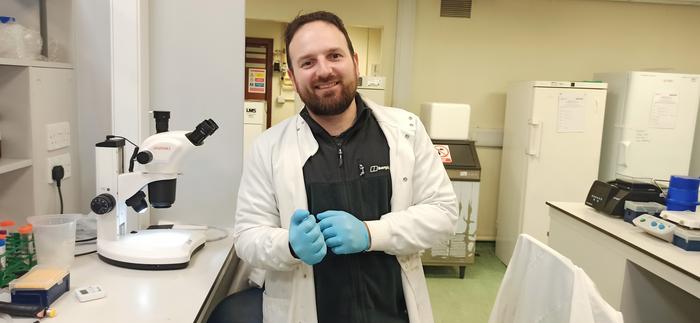
Dr Roberto Feuda

Credit: University of Leicester

A team of scientists led by researchers from the University of Leicester have discovered that the genes required for learning, memory, aggression and other complex behaviours originated around 650 million years ago.

The findings led by Dr Roberto Feuda, from the Neurogenetic group in the Department of Genetics and Genome Biology and other colleagues from the University of Leicester and the University of Fribourg (Switzerland), have now been published in Nature Communications.

Dr Feuda said: “We’ve known for a long time that monoamines like serotonin, dopamine and adrenaline act as neuromodulators in the nervous system, playing a role in complex behaviour and functions like learning and memory, as well as processes such as sleep and feeding.

“However, less certain was the origin of the genes required for the production, detection, and degradation of these monoamines. Using the computational methods, we reconstructed the evolutionary history of these genes and show that most of the genes involved in monoamine production, modulation, and reception originated in the bilaterian stem group.

“This finding has profound implications on the evolutionary origin of complex behaviours such as those modulated by monoamines we observe in humans and other animals.”

The authors suggest that this new way to modulate neuronal circuits might have played a role in the Cambrian Explosion – known as the Big Bang – which gave rise to the largest diversification of life for most major animal groups alive today by providing flexibility of the neural circuits to facilitate the interaction with the environment.

Dr Feuda added: “This discovery will open new important research avenues that will clarify the origin of complex behaviours and if the same neurons modulate reward, addiction, aggression, feeding, and sleep.”


Journal

Nature Communications

DOI

10.1038/s41467-023-39030-2

Method of Research

News article

Subject of Research

Animals

Article Title

The monoaminergic system is a bilaterian innovation

Article Publication Date

6-Jun-2023

Share12Tweet8Share2ShareShareShare2

Related Posts

Breakthrough Non-Invasive Prenatal Test Matches Invasive Methods in Accuracy, Offering Enhanced Safety and Reduced Costs — Biology

Breakthrough Non-Invasive Prenatal Test Matches Invasive Methods in Accuracy, Offering Enhanced Safety and Reduced Costs

June 12, 2026
Identifying Retinal Cell Subgroups May Boost Success of Cell Transplants — Biology

Identifying Retinal Cell Subgroups May Boost Success of Cell Transplants

June 12, 2026

New Study Uncovers How the Brain Revises Its Predictions

June 12, 2026

Decoding Ebola Persistence in Human Brain Organoids

June 12, 2026

POPULAR NEWS

  • ESMO 2025: mRNA COVID Vaccines Enhance Efficacy of Cancer Immunotherapy

    324 shares
    Share 130 Tweet 81
  • Saying Goodbye to PGY-6: Pediatric Fellowship Realities

    98 shares
    Share 39 Tweet 25
  • Multi-Hospital Study Reveals Long Covid Burden Is Twice as High as Current Estimates

    90 shares
    Share 36 Tweet 22
  • Common Food Preservatives Associated with Elevated Blood Pressure and Increased Heart Disease Risk

    58 shares
    Share 23 Tweet 15

About

We bring you the latest biotechnology news from best research centers and universities around the world. Check our website.

Follow us

Recent News

Unseen Vision Loss: Danish Seniors’ Hidden Struggles

Precision Ablation Targets Metastatic Cancer via Rewired Signaling

Long-Term Outcomes of Endoscopic Resection in Gastric Adenocarcinoma

Subscribe to Blog via Email

Enter your email address to subscribe to this blog and receive notifications of new posts by email.

Join 82 other subscribers
  • Contact Us

Bioengineer.org © Copyright 2023 All Rights Reserved.

Welcome Back!

Login to your account below

Forgotten Password?

Retrieve your password

Please enter your username or email address to reset your password.

Log In
No Result
View All Result
  • Homepages
    • Home Page 1
    • Home Page 2
  • News
  • National
  • Business
  • Health
  • Lifestyle
  • Science

Bioengineer.org © Copyright 2023 All Rights Reserved.