Active genes do not form clusters and share resources during early development in the fruit fly, according to a new study by New York University and Princeton researchers published in the journal Current Biology.
Credit: Rushlow Lab, NYU
Active genes do not form clusters and share resources during early development in the fruit fly, according to a new study by New York University and Princeton researchers published in the journal Current Biology.
“The study changes the way we think about how the molecular machinery functions in basic cellular mechanisms during the development of organisms,” said Christine Rushlow, NYU professor of biology and the study’s senior author.
The nucleus is the portion of the cell containing the vast majority of genetic information—including the complex jumble of long cables of DNA that make up the genome—in order to determine the behavior of that organism. Genes stored in the sequence of DNA encode not just the protein sequence required to express the trait associated with that gene, but also the information for when that protein sequence should be manufactured.
“The nucleus is an elaborate switchboard—the connection point for the vast array of information about the state of the cell’s environment, which will be processed and responded to by a defined set of expressed protein products. Within this framework, our study asked if there exists cooperation between these hundreds of logic gates making individual decisions about when to manufacture their respective proteins,” said Peter Whitney, a PhD student in NYU’s Department of Biology and one of the study’s authors.
Within the environment of the nucleus, it would make sense that genes regulated by the same type of information would be concentrated in close proximity so that they might share resources, potentially lowering the energetic cost of regulation. Several previous experiments have shown a level of organization in the nucleus where genes occupy discrete domains. However, many of these studies use biochemical methods to define domains, rather than actually observing the physical position of the active genes within the nucleus.
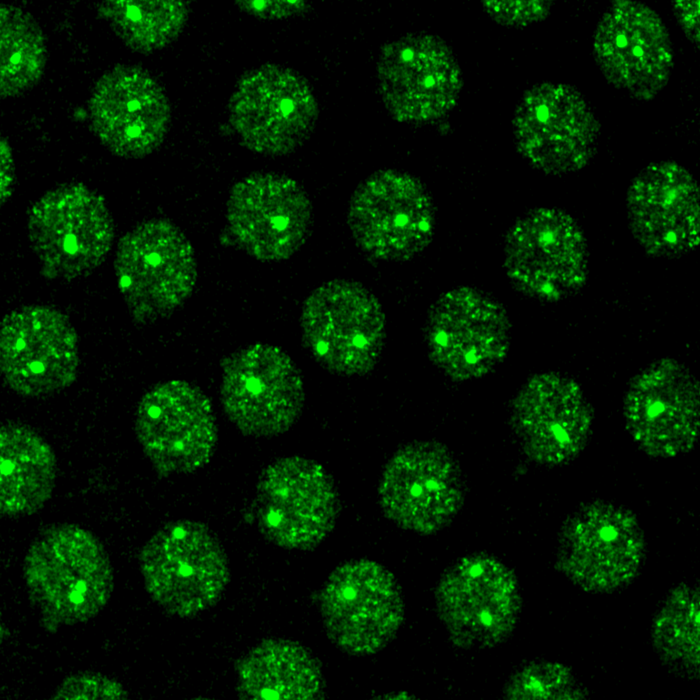
In the Current Biology study, the researchers demonstrated that they could accurately identify the physical position of the active genes using a microscopy imaging procedure and fruit flies, a model organism commonly used in genetic and molecular research. The researchers examined how a fertilized fruit fly egg develops into a fully formed organism, a process that requires the activity of sets of genes, which become progressively activated during embryonic development.
Focusing on the earliest set of genes appearing in 90-minute-old fruit fly embryos, the researchers observed how a protein called Zelda regulates the genes’ transcription by recruiting the enzyme RNA Polymerase II (Pol-II). Using high resolution microscopy and antibody staining, they visualized Pol-II at sites of nascent transcription on chromosomes.
By observing the positions of many genes using this method, they asked the question: Are genes found in clusters? The answer was no.
“We hypothesized that genes might share pools of Pol-II in regulatory hubs when they come into close proximity,” said Rushlow. “However, our data indicate that this is not the case, and genes in close proximity each have their own Pol-II pool. This was surprising, as it goes against conventional wisdom and appears to directly contradict results from other methods.”
The researchers performed a series of follow-up experiments to test the notion of functional clustering, such as looking for gene expression changes when genes were found in close proximity, or signs of resources being shared among the genes visualized. Once again, they did not find evidence of clustering.
In contrast to the idea that genes are spatially clustered and share transcriptional resources—what one might call a “collectivist” model—the authors conclude that the data support an “individualist” model of gene control at early genome activation in fruit flies.
###
In addition to Rushlow and Whitney, study authors include Shao-Kuei Huang of NYU and Sayantan Dutta and Stanislav Shvartsman of Princeton University. This research was supported by grants from the National Science Foundation (BCS-1221723) and the National Institutes of Health (RO1GM63024, RO1GM134204, T32HD7520).
Journal
Current Biology
DOI
10.1016/j.cub.2021.09.027
Article Title
Spatial organization of transcribing loci during early genome activation in Drosophila
Article Publication Date
5-Oct-2021