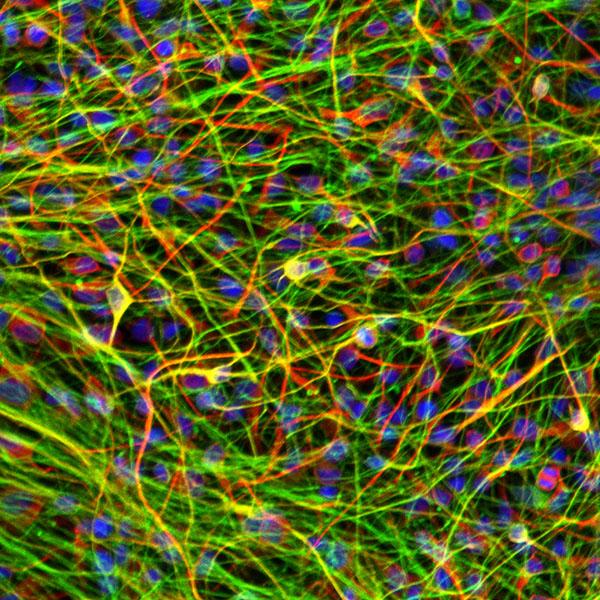
Credit: (Photo by Laura Stertz, PhD/UTHealth)
Using human-induced pluripotent stem cells engineered from a single family’s blood samples, a gene signaling pathway linked to a higher risk for developing schizophrenia was discovered by scientists at The University of Texas Health Science Center at Houston (UTHealth). The research was published in a recent issue of Neuropsychopharmacology.
The signaling pathway researchers pinpointed is called phosphoinositide 3-kinase/glycogen synthase kinase 3 (PI3K/GSK3). Among the differentially expressed genes along the pathway was one called serum-glucocorticoid kinase 1 (SGK1), an inhibitor of GSK3 beta, which has been associated with schizophrenia.
“We believe this has direct implications for the treatment of patients,” said senior author Consuelo Walss-Bass, PhD, professor in the Louis A. Faillace, MD, Department of Psychiatry and Behavioral Sciences at McGovern Medical School at UTHealth. “There is a new antipsychotic that just received approval from the Food and Drug Administration that directly targets the pathway we identified as dysregulated in neurons from the patients, and several other antipsychotics also target this pathway. This could help pinpoint who may respond better to treatments.”
Researchers led by Walss-Bass and first author, postdoctoral research fellow Laura Stertz, PhD, used blood samples from adult members of a large family with multiple individuals affected by schizophrenia. Through human-induced pluripotent stem cell (hiPSC) technology, the blood cells were reprogrammed into stem cells, which were then directed to become brain neurons. Those neurons could be studied in a virtual biopsy and compared to neurons engineered from individuals who did not have schizophrenia, but came from the same family from a homogenous population in the Central Valley of Costa Rica.
“Mental health research has lagged behind because we don’t know what is happening biologically. We are diagnosing people based on what they are telling us,” Walss-Bass said. “Even postmortem, the brain tissue in mental health disorders looks perfectly fine. In Alzheimer’s disease, you can see a difference compared to controls. But not in psychiatric disorders. Now by studying virtual brain biopsies, we can tell what is happening biologically.”
Among the differentially expressed genes the researchers saw in the virtual biopsies were five that have previously been identified as schizophrenia candidate genes by genome-wide association studies.
Among the genes associated with the PI3K/GSK3 pathway was SGK1, which inhibits GSK3 activity. Those alterations are linked to whether a person has a higher risk of developing schizophrenia.
“We were able to find significant, meaningful differences with a small control group,” Walss-Bass said. “Neurons of patients with schizophrenia had alterations in the signaling pathway. This research may help to understand how or why some antipsychotics targeting GSK3 work and also to develop other target-specific medications.”
Walss-Bass said identifying patients with specific biological pathway markers could identify them as the best candidates for medications, creating the personal pharmacology that is needed to treat psychiatric disorders.
###
The study was supported by an award from The University of Texas System (UT BRAIN), and a Brain and Behavior Research Foundation Young Investigator Award to Stertz.
UTHealth co-authors were Gabriel R. Fries, PhD; Emily Mendez; Laura Smith Callahan, PhD; Ying Liu, PhD; and Zhongming Zhao, PhD. Fries is an assistant professor in the Faillace Department of Psychiatry and Behavioral Sciences. Smith Callahan and Liu are assistant and associate professor, respectively, in the Vivian L. Smith Department of Neurosurgery at McGovern Medical School. Zhou is a professor with UTHealth School of Biomedical Informatics and UTHealth School of Public Health. Walss-Bass, Fries, Liu, and Smith Callahan are members, and Mendez is an MD/PhD student, with The University of Texas MD Anderson Cancer Center UTHealth Graduate School of Biomedical Sciences.
Media Contact
Deborah Mann Lake
[email protected]
Original Source
https:/