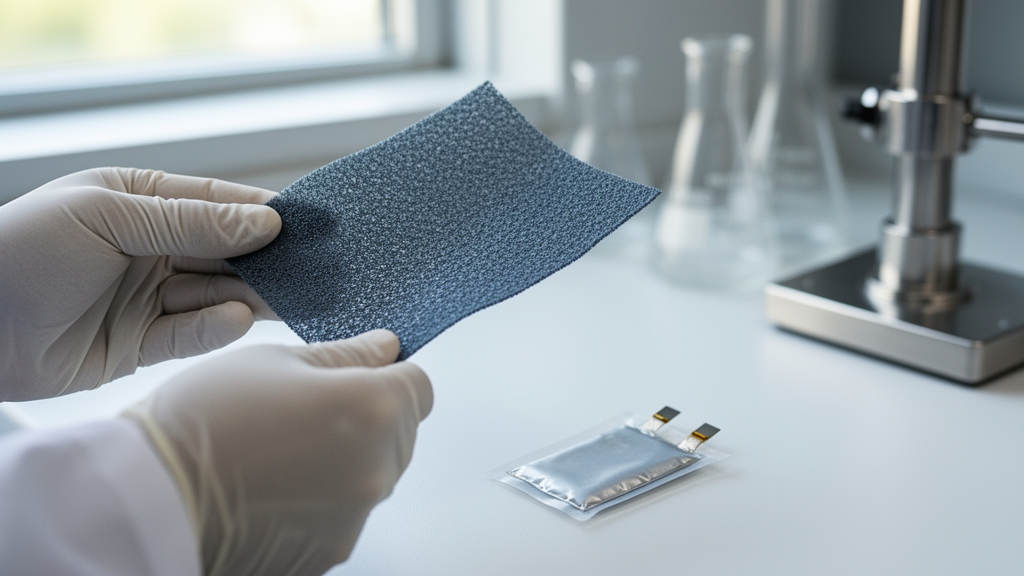
Supercapacitors promise rapid charging and long cycle life, but their reliance on liquid electrolytes has long been a weak point: volatile solvents, leakage risks, and packaging headaches have limited where these devices can go. A team at Universiti Malaya in Malaysia now reports a composite solid polymer electrolyte built around an iron-based metal-organic framework that could help change that. Writing in the journal Ionics, Nurbashirah Abd Razak, Siti Rohana Majid, and Siti Nadiah Abdul Halim describe a flexible conducting sheet made from phytagel, a naturally derived polysaccharide, doped with potassium chloride salt, glycerol, and the metal-organic framework MIL-101(Fe). The combination delivers an ionic conductivity of 1.10 millisiemens per centimeter at room temperature, a figure that places the material among the more competitive solid electrolytes reported for supercapacitor applications.
The choice of phytagel as the polymer host is central to the design. Phytagel, a gelling agent commonly used in plant biology laboratories, forms stable hydrogel networks through polysaccharide chains that can coordinate metal ions and host dissolved salts. In an electrolyte, the polymer matrix must do two things at once: provide mechanical integrity so the electrolyte can be handled as a free-standing sheet, and allow ions to move through it quickly enough to sustain high currents. Pure polymer electrolytes typically struggle with the second requirement, because ion transport in a solid polymer is slow compared with transport through a liquid. The Malaysian team addressed this by adding glycerol as a plasticizer, a small molecule that inserts itself between polymer chains, loosening the network and creating more pathways for potassium ions to hop through the material.
The more intriguing ingredient, however, is MIL-101(Fe), a porous iron-based metal-organic framework. Metal-organic frameworks, or MOFs, are crystalline lattices in which metal nodes are linked by organic ligands into structures riddled with nanoscale pores. First described in the 1990s, MOFs have become famous for gas storage and separation, but in recent years researchers have increasingly explored them as ion conductors. The idea is elegant: the ordered pores of a MOF can act as ion highways, while the framework’s metal nodes and ligand functional groups can interact with dissolved salt ions, helping to separate them from their counterions and speed their migration. In this study, the MIL-101(Fe) particles were dispersed throughout the phytagel-glycerol-salt matrix, creating a composite in which the framework and the polymer work together rather than in isolation.
The experimental characterization relied on standard tools of electrolyte science. Fourier-transform infrared spectroscopy, or FTIR, revealed shifts in the vibrational bands of the phytagel backbone, indicating direct interactions between the polymer’s functional groups and the MOF surface as well as the dissolved potassium and chloride ions. X-ray diffraction, or XRD, was used to track the degree of crystallinity and amorphous character in the films, since amorphous regions in a polymer generally favor ion mobility while excessive crystallinity blocks it. Electrochemical impedance spectroscopy then quantified how readily ions moved through each formulation. The team compared pristine MOF-containing films, films with MOF and salt, and the complete four-component system, and found that the full composite outperformed both simpler versions. The polymer-MOF interaction, they conclude, is what unlocks the highest conductivity, rather than any single ingredient acting alone.
To demonstrate that the material can function in a real device, the researchers assembled a two-electrode coin cell using the KCl/MIL-101(Fe)/phytagel/glycerol electrolyte. After 1000 charge-discharge cycles, the cell retained a specific capacitance of approximately 80 farads per gram, delivered an energy density of about 0.8 watt-hours per kilogram, and sustained a power density of roughly 22 watts per kilogram, all at room temperature. Perhaps most notably, the coulombic efficiency, a measure of how much charge put into the cell comes back out, reached about 98 percent. High coulombic efficiency over many cycles is a key indicator that an electrolyte is electrochemically stable and that parasitic side reactions are minimal, which is essential for any energy storage device intended to last thousands of cycles.
The performance numbers, while modest compared with the best liquid-electrolyte supercapacitors, are significant for a fully solid system. Energy density and power density trade off against each other in any storage device, a relationship often visualized in Ragone plots, and supercapacitors sit firmly on the high-power, lower-energy side of that landscape. What the Malaysian results suggest is that a solid electrolyte can be engineered to sit comfortably within that regime without sacrificing safety or mechanical robustness. Because the electrolyte is a self-supporting sheet, it eliminates the need for separators and liquid containment, simplifying device architecture and opening the door to flexible and wearable formats where leakage would be catastrophic.
The authors propose a mechanistic picture for why the MOF helps so much, drawing on the concepts of through-bond and through-space ion transport. In through-bond pathways, ions move by hopping between coordinating sites along the framework’s metal nodes and ligands, essentially following a molecular ladder built into the crystal. In through-space pathways, ions travel through the open pores and channels of the framework, assisted by the solvent-like environment that glycerol provides inside those channels. Both mechanisms have been supported by prior work on MOF-based electrolytes, including studies of biomimetic ionic channels in lithium-ion systems and cross-linked MOF chains that afford continuous ion transport in solid batteries. In the phytagel composite, the framework appears to act as a dispersed network of ion-conducting domains embedded in the polymer, multiplying the available transport routes.
The broader context makes the work timely. Solid-state electrolytes are one of the most active frontiers in energy storage research, driven by the safety limitations of flammable liquid electrolytes in batteries and the packaging constraints of conventional supercapacitors. Composite solid polymer electrolytes, which blend a polymer host with inorganic or framework fillers, have emerged as a pragmatic middle path: they combine the processability and flexibility of polymers with the conductivity and stability of inorganic phases. Iron-based MOFs such as MIL-101(Fe) are particularly attractive fillers because iron is abundant, inexpensive, and relatively benign, in contrast to cobalt or rare-earth alternatives. The same material family has already been studied as an electrode material in lithium batteries and as a supercapacitor electrode in its own right, so integrating it into the electrolyte side of a device represents a natural extension of an established chemistry.
There remain hurdles between a laboratory coin cell and commercial devices. The energy density reported here is far below what lithium-ion batteries achieve, so supercapacitors built this way would serve applications where bursts of power matter more than total stored energy, such as regenerative braking, grid frequency regulation, and backup power for portable electronics. Cycle life beyond 1000 cycles, performance at elevated temperatures, and compatibility with high-voltage electrode materials all need further study. The authors also note that data supporting the study are available from the corresponding author upon reasonable request, and the work was supported by Universiti Malaya research funding. Still, the demonstration that a humble laboratory gelling agent can be married to a designer porous framework to produce a robust, highly conductive solid electrolyte is a reminder that breakthroughs in energy storage often come from unexpected combinations of everyday materials and precision-engineered ones.
For the field of solid-state supercapacitors, the phytagel-MOF composite adds a new and unusually sustainable entry to the palette of available electrolytes. Biopolymer hosts reduce reliance on petrochemical feedstocks, potassium chloride is cheap and non-toxic, and glycerol is a byproduct of biodiesel production. If subsequent work can push the conductivity higher, extend cycle life, and scale the sheet-casting process to larger areas, the humble conducting sheet described in Ionics could find its way into the flexible electronics and renewable energy systems where safe, fast, and durable energy storage is most urgently needed.
Subject of Research: Composite solid polymer electrolytes based on phytagel and the iron-based metal-organic framework MIL-101(Fe) for supercapacitor applications
Article Title: Phytagel-doped MIL-101(Fe) composite conducting sheets for supercapacitor applications
Article References: Abd Razak, N., Majid, S. R., & Abdul Halim, S. N. (2026). Phytagel-doped MIL-101(Fe) composite conducting sheets for supercapacitor applications. Ionics. https://doi.org/10.1007/s11581-026-07482-3
Image Credits: AI Generated
DOI: 10.1007/s11581-026-07482-3
Keywords: metal-organic framework, MIL-101(Fe), phytagel, composite solid polymer electrolyte, supercapacitor, ionic conductivity, glycerol plasticizer, potassium chloride, energy storage, solid-state electrolyte, biopolymer, electrochemical impedance spectroscopy
News Source: Denise Maddox. (October 9, 2026). Gel-Derived MOF Composite Sheets Push Solid Supercapacitor Electrolytes Forward. Scienmag.