Researchers led by Ying Wang and Jinhui Wang examined two as-cast Mg–Gd–Zn–Zr alloys, one containing 1 weight percent gadolinium and the other 5 weight percent, and found that raising the gadolinium content improved yield strength, ultimate tensile strength and elongation all at the same time.
Increasing gadolinium from 1 to 5 weight percent lifted the yield strength from 92 to 110 megapascals, the ultimate tensile strength from 186 to 208 megapascals, and elongation from 14.79 to 26.31 percent. Normally, adding more solute atoms coarsens the grains and weakens a metal, and that is exactly what happened here: the average grain size grew from 62.81 to 109.65 micrometers. Yet the alloy with the larger grains was both stronger and far more plastic, which points to microstructural features doing the heavy lifting rather than fine grains alone.
Those features are lamellar 14H-LPSO phases, long-period stacking ordered structures that form inside the grains, together with (MgZn)3Gd phases that cluster along the grain boundaries. The higher gadolinium content promoted the formation of both. In tensile testing, the low-gadolinium alloy, called VZ10K, developed cracks that predominantly started near its grain boundaries, the classic signature of a metal whose boundaries cannot absorb much strain before failing. The high-gadolinium alloy, VZ50K, behaved differently: cracks initiated more often inside the grains, and stress concentration at the boundaries dropped noticeably.
The study explains this shift through the way the lamellar LPSO phases deform. Rather than acting as rigid obstacles that trigger premature cracking, the lamellae accommodated plastic deformation by crushing, bending and kinking. Between the lamellae, dislocation channels formed and helped disperse local stress concentration, spreading strain through the microstructure instead of letting it pile up at a single weak spot.
The second half of the story takes place at the atomic scale. Using density functional theory calculations, the team showed that gadolinium segregation to grain boundaries induces significant charge redistribution near those boundaries. This changes the local electronic interactions and the bonding environment between gadolinium atoms and their neighboring magnesium atoms. In other words, the strengthening effect of gadolinium segregation on grain boundaries originates from the regulation of local electronic structure and bonding states, which enhances grain-boundary cohesion more effectively at higher gadolinium enrichment levels.
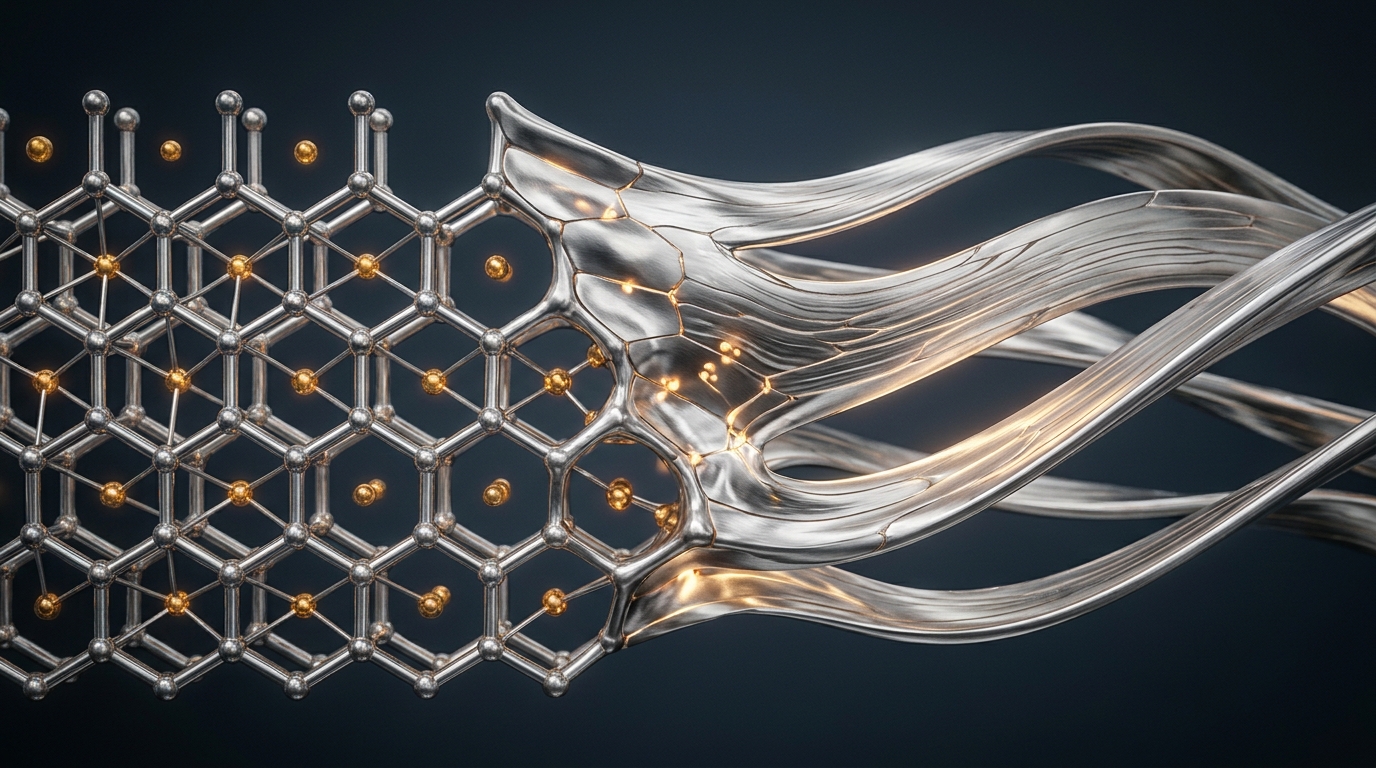
The LPSO lamellae handle deformation inside the grains, dissipating strain through kinking and channeling dislocations, while segregated gadolinium atoms reinforce the boundaries from the electronic level up.
The work was performed on as-cast alloys, so the properties reported here reflect the as-solidified microstructure rather than heat-treated or wrought material, and the mechanical data come from the two compositions studied.
Subject of Research: How lamellar 14H-LPSO phases and grain-boundary gadolinium segregation jointly improve the strength and plasticity of as-cast Mg–Gd–Zn–Zr magnesium alloys
Article Title: Synergistic roles of lamellar 14H-LPSO phases and grain-boundary Gd segregation in the strength–plasticity balance of as-cast Mg–Gd–Zn–Zr alloys
Article References: Wang, Y., Kang, J., Ren, Q., Liu, Y., Jin, P., Luan, S., & Wang, J. (2026). Synergistic roles of lamellar 14H-LPSO phases and grain-boundary Gd segregation in the strength–plasticity balance of as-cast Mg–Gd–Zn–Zr alloys. Journal of Materials Science. https://doi.org/10.1007/s10853-026-14023-w
Image Credits: AI Generated
DOI: 10.1007/s10853-026-14023-w
Keywords: magnesium alloys, gadolinium, LPSO phases, grain boundaries, density functional theory, tensile strength, plasticity, segregation, as-cast alloys, lightweight materials, Synergistic, roles
News Source: Neil Sanderson. (November 4, 2026). Gd-Rich Magnesium Alloy Gains Strength and Stretchiness at Once. Scienmag.