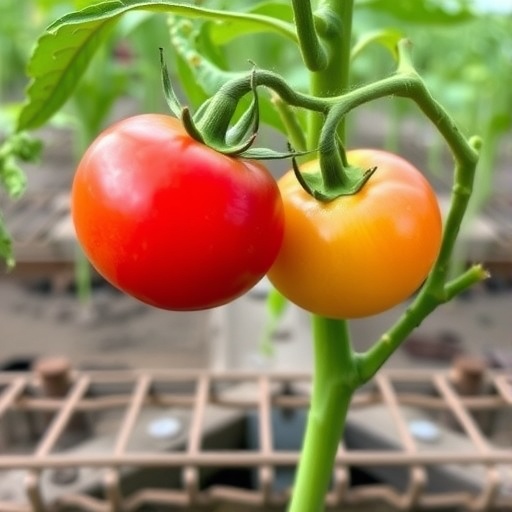
A small molecule with a reputation rooted in sustainable chemistry may be about to acquire a new identity in agriculture. Researchers in China report that γ-valerolactone, a volatile organic compound associated with the beneficial bacterium Stutzerimonas stutzeri NRCB010, can significantly accelerate the growth of tomato seedlings. In experiments conducted under both hydroponic and greenhouse conditions, the compound improved seedling development at carefully defined concentrations while triggering extensive changes in gene activity and plant hormone composition. The findings suggest that γ-valerolactone could become more than an industrial solvent or bio-based chemical intermediate: it may represent a new class of plant biostimulant capable of influencing growth from inside the plant’s molecular control systems.
The study focuses on Solanum lycopersicum, the cultivated tomato, a crop whose early development strongly influences later productivity and resilience. Seedlings must rapidly establish roots, expand leaves, and build photosynthetic capacity before they can support vigorous growth. Conventional agriculture often relies on mineral fertilizers to supply nutrients, but excessive dependence on synthetic inputs can contribute to environmental pollution, soil degradation, and rising production costs. Biostimulants offer a different strategy. Rather than acting primarily as nutrient sources, they stimulate natural physiological processes, helping plants use resources more efficiently or regulate development more effectively. γ-Valerolactone is especially intriguing because it is a volatile organic compound produced by a microorganism previously linked to tomato growth promotion under sterile laboratory conditions.
The bacterium behind this discovery, S. stutzeri NRCB010, belongs to a group of microorganisms capable of interacting closely with plant roots and their surrounding chemical environment. Plants and microbes communicate through a complex exchange of metabolites, including volatile compounds that can travel through air spaces or soil pores. Earlier work from the research group identified volatile substances produced by NRCB010 that enhanced bacterial colonization and promoted tomato seedling growth. The new study isolates γ-valerolactone from that microbial context and tests whether the compound itself can reproduce part of the growth-promoting effect. This distinction is important: if a single microbial metabolite can stimulate plants, it could potentially be developed into a standardized agricultural product that is easier to formulate, transport, and apply than a living microbial inoculant.
The researchers tested a range of γ-valerolactone concentrations in two growing environments. The most effective dose depended on the cultivation system. In hydroponic experiments, where roots develop in a nutrient solution without soil, the optimum concentration was 100 milligrams per liter. Under greenhouse conditions, the best result was observed at 250 milligrams per liter. This difference highlights a central challenge in developing plant biostimulants: the response to a compound is shaped not only by dose but also by the plant’s environment. In hydroponics, the molecule is delivered directly through water and remains within a relatively controlled chemical system. In a greenhouse, factors such as substrate interactions, volatilization, microbial activity, temperature, and root-zone chemistry may alter how much compound reaches the plant. The results also reinforce the principle that biostimulants frequently follow a dose-dependent curve, in which an effective low or moderate concentration can produce benefits while a higher dose may be less useful or potentially inhibitory.
The most striking biochemical changes involved auxin-related compounds and gibberellic acid. Auxin is a major plant hormone governing cell division, cell expansion, root formation, vascular development, and the directional growth response known as tropism. The study found increased levels of IAA-aspartate and IAA-glutamate, conjugated forms of indole-3-acetic acid, the principal natural auxin in plants. Auxin conjugates are often viewed as storage, transport, or regulatory forms that help plants control the amount of active hormone available in cells. γ-Valerolactone also increased indole-3-acetamide, indole-3-acetonitrile, and indole-3-butyric acid, compounds connected to auxin biosynthesis, metabolism, or auxin-like activity. Together, these changes point to a broad reorganization of the plant’s auxin network rather than a simple increase in one hormone.
Gibberellic acid 3, commonly called GA3, also increased in leaves, stems, and roots following treatment. Gibberellins are hormones that promote cell elongation, influence seed germination, regulate developmental transitions, and contribute to stem growth. Their interaction with auxin is especially significant. Auxin can alter the expression of genes involved in gibberellin metabolism and transport, while gibberellins can modify the cellular growth responses initiated by auxin. The simultaneous elevation of multiple auxin-related metabolites and GA3 offers a plausible explanation for the stronger seedling growth observed in the experiments. It suggests that γ-valerolactone may not function as a conventional fertilizer supplying building materials. Instead, it may act as a chemical signal that shifts the plant toward an active developmental state, in which roots and shoots expand more efficiently.
To investigate the molecular response in greater detail, the researchers used transcriptomic analysis. A transcriptome is the complete collection of RNA molecules produced by cells under a particular condition. Because RNA transcripts reflect which genes are actively being used, comparing transcriptomes can reveal how a plant responds to a treatment before all visible changes become apparent. Tomato seedlings exposed to γ-valerolactone for six hours showed more upregulated differentially expressed genes than downregulated genes. In other words, the early response was dominated by increased activity in genes whose expression changed significantly relative to untreated plants. After 24 hours, the pattern reversed, with more genes downregulated than upregulated. This time-dependent transition suggests that the compound initiates a rapid activation phase followed by a regulatory or adjustment phase as the plant rebalances its internal systems.
The changing transcriptional pattern may reflect the difference between signaling and stabilization. Shortly after exposure, plants often activate genes involved in perception, hormone signaling, metabolism, transport, and stress adjustment. These early responses can prepare cells for altered growth and energy use. As the treatment continues, some of those pathways may be dampened to prevent excessive activity or metabolic imbalance. The researchers’ pathway analysis indicated that γ-valerolactone-associated gene changes involved photosynthesis, phytohormone signaling, and secondary-metabolite biosynthesis. Photosynthesis is central to seedling development because it converts light energy into chemical energy and carbon compounds needed to build new tissues. If γ-valerolactone enhances the expression or coordination of photosynthesis-related genes, it could help seedlings generate the energy and carbon skeletons required for accelerated growth. Changes in secondary metabolism may simultaneously influence antioxidant protection, structural compounds, and chemical defenses.
The findings place γ-valerolactone within a growing movement to identify biologically inspired alternatives to resource-intensive agricultural inputs. The compound itself is already known in green chemistry as a renewable, versatile liquid that can be produced from biomass-derived levulinic acid. Its connection to microbial metabolism adds another layer of sustainability, suggesting a potential route in which beneficial bacteria, fermentation systems, or bio-based chemical processes generate the active ingredient. Yet the study does not establish that γ-valerolactone is ready for immediate field deployment. The experiments examined tomato seedlings, not mature plants or harvested fruit, and the reported benefits were measured under hydroponic and greenhouse conditions. Further work will need to determine how the compound behaves in soil, how long its effects last, whether it influences flowering and yield, and whether repeated applications affect plant health or microbial communities. Dose optimization will also be essential, because a concentration that stimulates growth in one environment may perform differently in another.
Even with those limitations, the study offers a compelling molecular explanation for a phenomenon that began with a soil-associated bacterium. γ-Valerolactone appears to influence tomato development through a combination of hormone remodeling and gene-expression changes, with auxin-related metabolites and GA3 rising across roots, stems, and leaves. The early transcriptomic response suggests rapid activation of growth-linked and photosynthetic programs, followed by a more restrained pattern after 24 hours. This layered response is characteristic of sophisticated plant signaling, in which a single external molecule can affect metabolism, development, and communication between tissues. If future research confirms its effectiveness beyond controlled conditions, γ-valerolactone could become a prototype for precision biostimulants: small, environmentally compatible molecules designed not merely to feed crops, but to tune the biological programs that help them grow.
Subject of Research: γ-Valerolactone as a plant biostimulant for promoting tomato seedling growth through transcriptomic and plant hormone changes
Article Title: γ-Valerolactone promotes Solanum lycopersicum seedling growth through transcriptomic and plant hormone changes
Article References: Ren, F., Shen, H., Chen, W. et al. “γ-Valerolactone promotes Solanum lycopersicum seedling growth through transcriptomic and plant hormone changes.” Plant Molecular Biology 116, Article 35 (2026). https://doi.org/10.1007/s11103-026-01699-6
Image Credits: AI Generated
DOI: 10.1007/s11103-026-01699-6
Keywords: Biostimulant, growth promotion, plant hormone, Solanum lycopersicum, transcriptome, γ-valerolactone
Tags: bio-based chemicals in crop growthenvironmental benefits of biostimulantsgamma-valerolactone plant biostimulantgene expression changes in plantsgreenhouse tomato cultivationhormone regulation in tomato seedlingshydroponic plant growth stimulantsorganic compounds boosting plant developmentplant hormone modulation for early developmentplant molecular control systemssustainable agriculture solutionsTomato seedling growth enhancement