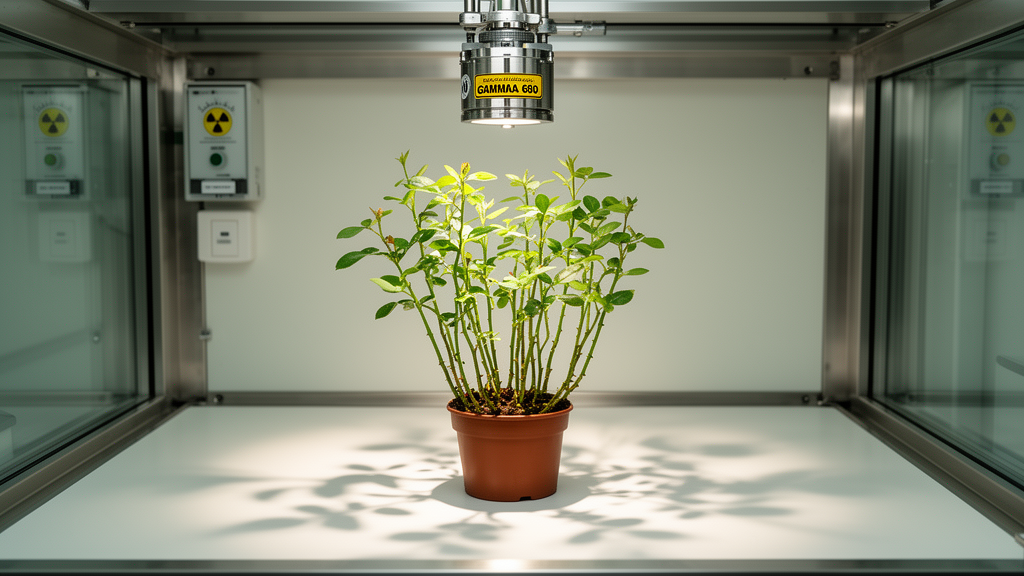
Gamma irradiation at approximately 40–50 Gy emerged as a preliminary range for further mutant-induction and screening studies using vegetative cuttings of the damask rose ‘Meymand’, according to a controlled dose-response experiment. Researchers exposed cuttings to 11 irradiation levels from 0 to 100 Gy and found that survival declined as the dose increased, while separate growth estimates indicated that irradiation reduced leaf area and biomass before survival reached its midpoint. Together, the results identified a middle dose range for additional investigation rather than a universally optimal treatment.
The study used a completely randomized design with three replicates per treatment, with irradiation dose as the main experimental factor. The investigators measured cutting survival, growth and morphological characteristics. All cuttings in the untreated control survived.
Survival was 90.00% at 10 Gy and 74.28% at 20 Gy. Across intermediate doses from 30 to 60 Gy, survival ranged from 50.00% to 67.64%. At 70 Gy, survival fell to 34.28%, and at 80 Gy it was 8.57%.
No cuttings survived the 90- or 100-Gy treatments. For the survival analysis, the researchers selected a complementary log-log binomial dose-response model. This model estimated LD25 at 30.50 Gy, LD50 at 51.69 Gy and LD75 at 68.40 Gy.
These modeled estimates describe different positions along the observed dose-response pattern. The LD50 estimate lies just above 50 Gy, consistent with the measured transition from survival rates of 50.00% to 67.64% at intermediate doses to 34.28% survival at 70 Gy. The model therefore provides a quantitative framework for comparing survival outcomes across the tested dose range.
The researchers also estimated GR50 values for three growth measurements: 37.88 Gy for leaf area, 28.48 Gy for fresh weight and 26.45 Gy for dry weight. These were the doses associated with 50% growth reduction in the respective measures. Fresh and dry weight reached that reduction at lower doses than leaf area, indicating that the measured biomass indicators responded earlier than the leaf-area estimate.
The combined LD50 and GR50 estimates led the authors to propose a preliminary dose range of about 40–50 Gy for subsequent mutant-induction and screening studies in ‘Meymand’ cuttings. The experiment was confined to vegetative cuttings from one damask rose cultivar, and the supplied findings concern survival, growth and morphological responses under the tested conditions. The reported dose range is therefore a starting point for further study, not a final treatment protocol.
The supplied abstract does not report outcomes for individual mutant phenotypes, so it cannot establish what variation, if any, was produced in surviving plants.
Subject of Research: Gamma-irradiation dose optimization for mutation breeding in damask rose cuttings
Article Title: Gamma irradiation dose optimization in vegetative cuttings of damask rose ‘Meymand’ based on LD50 and GR50 for initiating mutation breeding programs
Article References: Mousavi, Z., Karami, A., & Ghasemi-Soloklui, A. A. (2026). Gamma irradiation dose optimization in vegetative cuttings of damask rose ‘Meymand’ based on LD50 and GR50 for initiating mutation breeding programs. BMC Plant Biology. https://doi.org/10.1186/s12870-026-09877-w
Image Credits: AI Generated
DOI: 10.1186/s12870-026-09877-w
Keywords: gamma irradiation, damask rose, Rosa damascena, vegetative cuttings, mutation breeding, dose response, LD50, GR50, plant survival, growth reduction, Gamma, irradiation
News Source: Alan Morgan. (October 26, 2026). Gamma Irradiation Narrows Preliminary Dose Range for ‘Meymand’ Rose Cuttings. Scienmag.