

• HOME
  • NEWS
  • EXPLORE
    • CAREER
      • Companies
      • Jobs
    • EVENTS
    • iGEM
      • News
      • Team
    • PHOTOS
    • VIDEO
    • WIKI
  • BLOG
  • COMMUNITY
    • FACEBOOK
    • INSTAGRAM
    • TWITTER
Saturday, May 23, 2026
BIOENGINEER.ORG
No Result
View All Result
  • Login
  • HOME
  • NEWS
  • EXPLORE
    • CAREER
      • Companies
      • Jobs
        • Lecturer
        • PhD Studentship
        • Postdoc
        • Research Assistant
    • EVENTS
    • iGEM
      • News
      • Team
    • PHOTOS
    • VIDEO
    • WIKI
  • BLOG
  • COMMUNITY
    • FACEBOOK
    • INSTAGRAM
    • TWITTER
  • HOME
  • NEWS
  • EXPLORE
    • CAREER
      • Companies
      • Jobs
        • Lecturer
        • PhD Studentship
        • Postdoc
        • Research Assistant
    • EVENTS
    • iGEM
      • News
      • Team
    • PHOTOS
    • VIDEO
    • WIKI
  • BLOG
  • COMMUNITY
    • FACEBOOK
    • INSTAGRAM
    • TWITTER
No Result
View All Result
Bioengineer.org
No Result
View All Result
Home NEWS Science News Biology

Game-changing finding pushes 3D-printing to the molecular limit

Bioengineer by Bioengineer
June 19, 2018
in Biology
Reading Time: 2 mins read
0
Share on FacebookShare on TwitterShare on LinkedinShare on RedditShare on Telegram
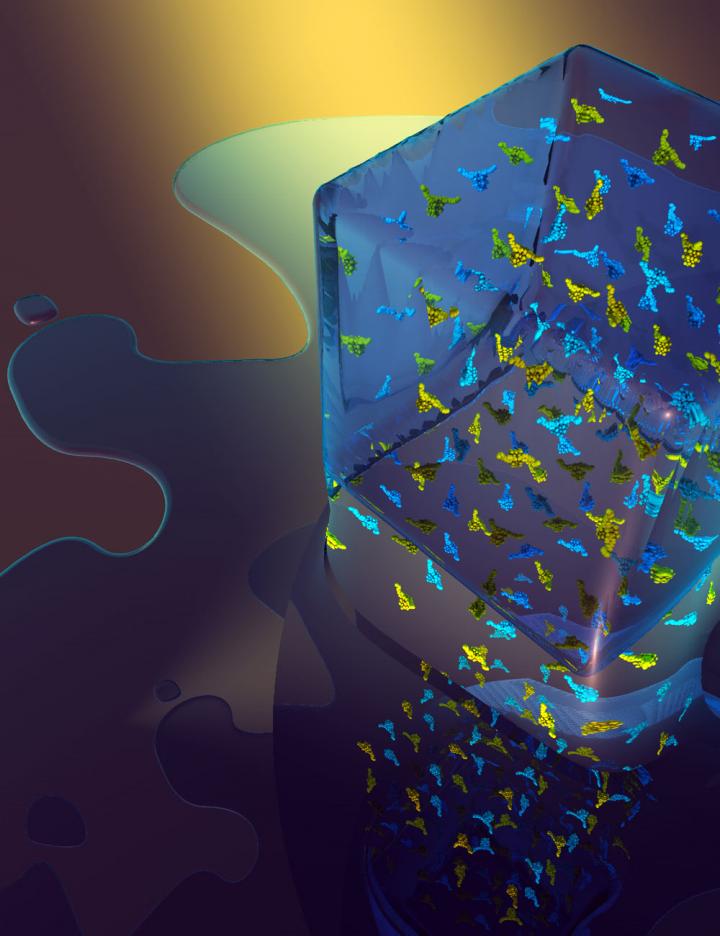
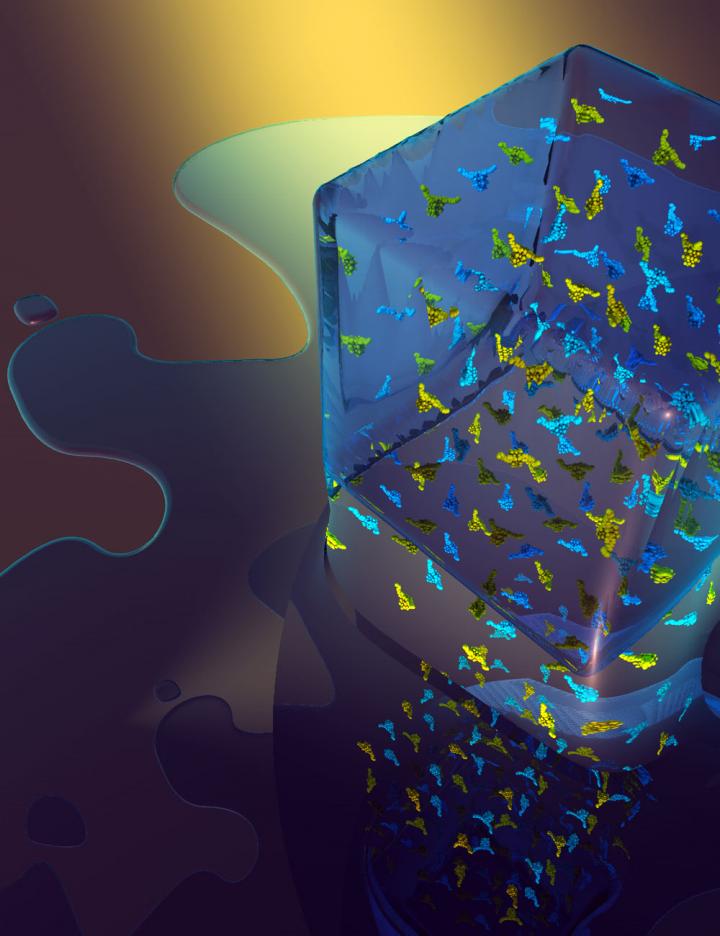
IMAGE

Credit: Victor Sans Sangorrin

The research, led by Dr Victor Sans Sangorrin from the Faculty of Engineering and Dr Graham Newton from the School of Chemistry, is published in the academic journal, Advanced Materials.

"This bottom-up approach to device fabrication will push the boundaries of additive manufacturing like never before. Using a unique integrated design approach, we have demonstrated functional synergy between photochromic molecules and polymers in a fully 3D-printed device. Our approach expands the toolbox of advanced materials available to engineers developing devices for real-world problems," explains Dr Sans.

To demonstrate their concept, the team developed a photoactive molecule that changes from colourless to blue when irradiated with light. The colour change can then be reversed by exposure to oxygen from the air.

The researchers then 3D-printed composite materials by combining the photoactive molecules with a tailor-made polymer, yielding a new material that can store information reversibly.

Dr Newton, said: "We can now take any molecules that change properties upon exposure to light and print them into composites with almost any shape or size. In theory, it would be possible to reversibly encode something quite complex like a QR code or a barcode, and then wipe the material clean, almost like cleaning a whiteboard with an eraser. While our devices currently operate using colour changes, this approach could be used to develop materials for energy storage and electronics."

###

The research is supported by the Leverhulme Trust, the German Academic Exchange service (DAAD) and the University of Nottingham.

More information is available from Dr. Victor Sans Sangorrin on [email protected] or 0115 7484949 or Emma Lowry, Media Relations Manager (Faculty of Engineering), University of Nottingham on [email protected] or 0115 8467156.

Media Contact

Emma Lowry
[email protected]
07-958-171-723
@UoNPressOffice

http://www.nottingham.ac.uk

Original Source

https://www.nottingham.ac.uk/News/pressreleases/2018/June/Game-changing-finding-pushes-3D-printing-to-the-molecular-limit.aspx http://dx.doi.org/10.1002/adma.201800159


Share14Tweet8Share2ShareShareShare2

Related Posts

Rising Sightings of Blue and Fin Whales in the South East Atlantic — Biology

Rising Sightings of Blue and Fin Whales in the South East Atlantic

May 23, 2026
New Maps Reveal How European Landscapes Can Simultaneously Promote Climate Action and Biodiversity Conservation — Biology

New Maps Reveal How European Landscapes Can Simultaneously Promote Climate Action and Biodiversity Conservation

May 22, 2026

University of Cincinnati Structural Biologists Achieve World First in Visualizing Crucial Cell Protein

May 22, 2026

Reducing Fertilizer Use Through Strategic Scientific Partnerships

May 22, 2026
Please login to join discussion

POPULAR NEWS

  • blank

    New Study Reveals Plants Can Detect the Sound of Rain

    734 shares
    Share 293 Tweet 183
  • ESMO 2025: mRNA COVID Vaccines Enhance Efficacy of Cancer Immunotherapy

    311 shares
    Share 124 Tweet 78
  • Research Indicates Potential Connection Between Prenatal Medication Exposure and Elevated Autism Risk

    847 shares
    Share 339 Tweet 212
  • Common Food Preservatives Associated with Elevated Blood Pressure and Increased Heart Disease Risk

    55 shares
    Share 22 Tweet 14

About

We bring you the latest biotechnology news from best research centers and universities around the world. Check our website.

Follow us

Recent News

Nomogram Predicts Early Outcomes in Childhood Aplastic Anemia

Assessing Osteoporotic Pelvis Fracture Score Feasibility

Eco-Friendly Pomegranate Peel Carbon Removes Amoxicillin

Subscribe to Blog via Email

Enter your email address to subscribe to this blog and receive notifications of new posts by email.

Join 83 other subscribers
  • Contact Us

Bioengineer.org © Copyright 2023 All Rights Reserved.

Welcome Back!

Login to your account below

Forgotten Password?

Retrieve your password

Please enter your username or email address to reset your password.

Log In
No Result
View All Result
  • Homepages
    • Home Page 1
    • Home Page 2
  • News
  • National
  • Business
  • Health
  • Lifestyle
  • Science

Bioengineer.org © Copyright 2023 All Rights Reserved.
