• HOME
  • NEWS
  • EXPLORE
    • CAREER
      • Companies
      • Jobs
    • EVENTS
    • iGEM
      • News
      • Team
    • PHOTOS
    • VIDEO
    • WIKI
  • BLOG
  • COMMUNITY
    • FACEBOOK
    • INSTAGRAM
    • TWITTER
Saturday, May 23, 2026
BIOENGINEER.ORG
No Result
View All Result
  • Login
  • HOME
  • NEWS
  • EXPLORE
    • CAREER
      • Companies
      • Jobs
        • Lecturer
        • PhD Studentship
        • Postdoc
        • Research Assistant
    • EVENTS
    • iGEM
      • News
      • Team
    • PHOTOS
    • VIDEO
    • WIKI
  • BLOG
  • COMMUNITY
    • FACEBOOK
    • INSTAGRAM
    • TWITTER
  • HOME
  • NEWS
  • EXPLORE
    • CAREER
      • Companies
      • Jobs
        • Lecturer
        • PhD Studentship
        • Postdoc
        • Research Assistant
    • EVENTS
    • iGEM
      • News
      • Team
    • PHOTOS
    • VIDEO
    • WIKI
  • BLOG
  • COMMUNITY
    • FACEBOOK
    • INSTAGRAM
    • TWITTER
No Result
View All Result
Bioengineer.org
No Result
View All Result
Home NEWS Science News Chemistry

Galactic cosmic rays affect Titan’s atmosphere

Bioengineer by Bioengineer
February 14, 2020
in Chemistry
Reading Time: 3 mins read
0
IMAGE
Share on FacebookShare on TwitterShare on LinkedinShare on RedditShare on Telegram

IMAGE

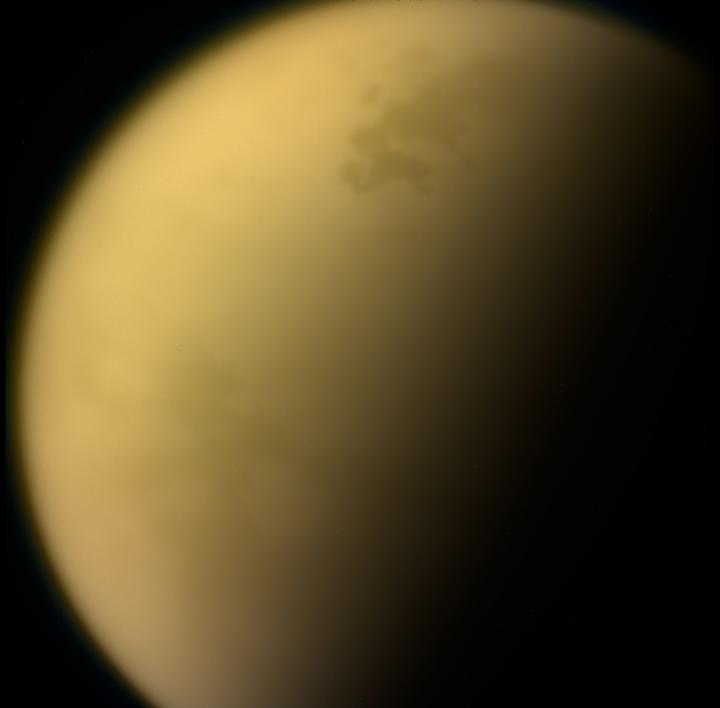
Credit: NASA/JPL-Caltech/Space Science Institute


Planetary scientists using the Atacama Large Millimeter/submillimeter Array (ALMA) revealed the secrets of the atmosphere of Titan, the largest moon of Saturn. The team found a chemical footprint in Titan’s atmosphere indicating that cosmic rays coming from outside the Solar System affect the chemical reactions involved in the formation of nitrogen-bearing organic molecules. This is the first observational confirmation of such processes, and impacts the understanding of the intriguing environment of Titan.

Titan is attracting much interest because of its unique atmosphere with a number of organic molecules that form a pre-biotic environment.

Takahiro Iino, a scientist at the University of Tokyo, and his team used ALMA to reveal the chemical processes in Titan’s atmosphere. They found faint but firm signals of acetonitrile (CH3CN) and its rare isotopomer CH3C15N in the ALMA data.

“We found that the abundance of 14N in acetonitrile is higher than those in other nitrogen bearing species such as HCN and HC3N,” says Iino. “It well matches the recent computer simulation of chemical processes with high energy cosmic rays.”

There are two important players in the chemical processes of the atmosphere; ultraviolet (UV) light from the Sun and cosmic rays coming from outside the Solar System. In the upper atmosphere, UV light selectively destroys nitrogen molecules containing 15N because the UV light with the specific wavelength that interacts with 14N14N is easily absorbed at that altitude. Thus, nitrogen-bearing species produced at that altitude tend to exhibit a high 15N abundance. On the other hand, cosmic rays penetrate deeper and interact with nitrogen molecules containing 14N. As a result, there is a difference in the abundance of molecules with 14N and 15N. The team revealed that acetonitrile in the stratosphere is more abundant in 14N than those of other previously measured nitrogen-bearing molecules.

“We suppose that galactic cosmic rays play an important role in the atmospheres of other solar system bodies,” says Hideo Sagawa, an associate professor at Kyoto Sangyo University and a member of the research team. “The process could be universal, so understanding the role of cosmic rays in Titan is crucial in overall planetary science.”

Titan is one of the most popular objects in ALMA observations. The data obtained with ALMA needs to be calibrated to remove fluctuations due to variations of on-site weather and mechanical glitches. For referencing, the observatory staff often points the telescope at bright sources, such as Titan, from time to time in science observations. Therefore, a large amount of Titan data is stored in the ALMA Science Archive. Iino and his team have dug into the archive and re-analyzed the Titan data and found subtle fingerprints of very tiny amounts of CH3C15N.

###

The research team members are:

Takahiro Iino (The University of Tokyo), Hideo Sagawa (Kyoto Sangyo University) and Takashi Tsukagoshi (National Astronomical Observatory of Japan).

Media Contact
Dr. Masaaki Hiramatsu
[email protected]

Original Source

https://alma-telescope.jp/en/news/press/titan-202002

Related Journal Article

http://dx.doi.org/10.3847/1538-4357/ab66b0

Tags: AstronomyAstrophysicsPlanets/MoonsSpace/Planetary Science
Share12Tweet8Share2ShareShareShare2

Related Posts

Study Reveals How Valproate Affects Early Brain Development: Insights into the Antiepileptic Drug’s Impact — Chemistry

Study Reveals How Valproate Affects Early Brain Development: Insights into the Antiepileptic Drug’s Impact

May 22, 2026
Sustainable Chemistry: Iron Replaces Noble Metals in Catalytic Reactions — Chemistry

Sustainable Chemistry: Iron Replaces Noble Metals in Catalytic Reactions

May 22, 2026

Advancing Thin-Film Device Manufacturing with Imaging Ellipsometry for Enhanced Process Control

May 22, 2026

Simple Adjustment in 3D Printing Enhances Fit of Dental Crowns

May 22, 2026
Please login to join discussion

POPULAR NEWS

  • blank

    New Study Reveals Plants Can Detect the Sound of Rain

    734 shares
    Share 293 Tweet 183
  • ESMO 2025: mRNA COVID Vaccines Enhance Efficacy of Cancer Immunotherapy

    311 shares
    Share 124 Tweet 78
  • Research Indicates Potential Connection Between Prenatal Medication Exposure and Elevated Autism Risk

    847 shares
    Share 339 Tweet 212
  • Common Food Preservatives Associated with Elevated Blood Pressure and Increased Heart Disease Risk

    55 shares
    Share 22 Tweet 14

About

We bring you the latest biotechnology news from best research centers and universities around the world. Check our website.

Follow us

Recent News

Assessing Osteoporotic Pelvis Fracture Score Feasibility

Eco-Friendly Pomegranate Peel Carbon Removes Amoxicillin

CD5L Protein Shields Kidneys by Reducing Oxidative Stress

Subscribe to Blog via Email

Enter your email address to subscribe to this blog and receive notifications of new posts by email.

Join 83 other subscribers
  • Contact Us

Bioengineer.org © Copyright 2023 All Rights Reserved.

Welcome Back!

Login to your account below

Forgotten Password?

Retrieve your password

Please enter your username or email address to reset your password.

Log In
No Result
View All Result
  • Homepages
    • Home Page 1
    • Home Page 2
  • News
  • National
  • Business
  • Health
  • Lifestyle
  • Science

Bioengineer.org © Copyright 2023 All Rights Reserved.