In a groundbreaking study set to redefine our understanding of cancer metabolism, researchers have uncovered a novel molecular mechanism that fuels the relentless progression of clear cell renal cell carcinoma (ccRCC), the most common and deadly form of kidney cancer. The study, recently published in Cell Death Discovery, reveals the pivotal role of the enzyme FUT8 in reprogramming cellular metabolism through a unique post-translational modification process, enhancing tumor growth and malignancy.
Clear cell renal cell carcinoma has long posed a formidable challenge to oncologists due to its aggressive nature and resistance to conventional therapies. Despite advances in targeted treatments and immunotherapies, the molecular intricacies that underpin ccRCC progression remain incompletely understood. This latest research provides critical insights into how metabolic shifts within cancer cells are orchestrated to support unchecked proliferation and survival.
Central to this groundbreaking discovery is FUT8 (fucosyltransferase 8), an enzyme known primarily for its function in adding fucose sugars to glycoproteins—a modification known as core fucosylation. The research team led by Guo, Jiang, Wang, and colleagues has now demonstrated that FUT8’s influence extends far beyond glycosylation. They reveal its unexpected capacity to reprogram glycolytic metabolism, the process by which cancer cells convert glucose into energy and building blocks necessary for growth.
This metabolic reprogramming pivots around PKM2 (pyruvate kinase M2), a key glycolytic enzyme known to play a crucial role in cancer metabolism. Under normal physiological conditions, PKM2 regulates the final step of glycolysis, balancing energy production with anabolic processes. However, the research uncovers that FUT8 promotes an unusual biochemical modification—lactylation—on PKM2, dramatically altering its function and driving tumor cell metabolism towards favoring cancer progression.
Lactylation, a recently discovered post-translational modification, involves the addition of lactate-derived lactyl groups to lysine residues on proteins. While initially characterized in histones affecting gene expression, this study extends the concept by showing lactylation’s impact on metabolic enzymes, unveiling a new layer of regulatory complexity. In ccRCC cells, PKM2 lactylation enhances enzymatic activity and stability, fostering an environment ripe for accelerated glycolysis and tumor growth.
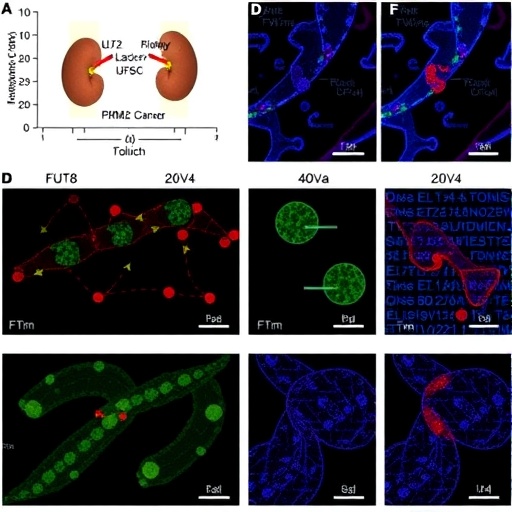
Employing an array of cutting-edge techniques including mass spectrometry, metabolic flux analysis, and in vivo tumor models, the researchers delineated the biochemical pathway by which FUT8 exerts this effect. They observed elevated FUT8 expression in ccRCC patient samples correlating with increased PKM2 lactylation levels, glycolytic gene signatures, and poor clinical prognosis. Functional experiments confirmed that silencing FUT8 diminished PKM2 lactylation, impairing glycolytic flux and slowing tumor progression.
Importantly, the study delineates a feed-forward loop wherein elevated FUT8 expression enhances the metabolic switch toward glycolysis, generating abundant lactate, which in turn facilitates further lactylation of PKM2. This self-reinforcing circuit creates a metabolic state that supports rapid tumor expansion and resistance to metabolic stress. Interrupting this loop offers a tantalizing therapeutic opportunity.
Current ccRCC treatments targeting vascular growth factors or immune checkpoints have limitations, often leading to relapse or resistance. The identification of the FUT8-PKM2-lactylation axis opens new avenues for metabolic intervention. By specifically targeting FUT8 enzymatic activity or interfering with PKM2 lactylation, it might be possible to disrupt cancer’s energy supply line, sensitizing tumors to existing therapies or halting progression.
The study also underscores the increasing significance of metabolic post-translational modifications as critical regulators of cancer biology. Beyond phosphorylation and acetylation, the role of novel modifications such as lactylation is emerging as a key contributor to the metabolic plasticity that characterizes aggressive tumors. These findings pivot future research towards exploring lactylation-centric therapeutic strategies.
Moreover, the researchers highlight that FUT8’s role may not be confined to ccRCC. Given the prevalence of metabolic reprogramming across multiple cancer types, FUT8-mediated lactylation could represent a broader oncogenic mechanism. Future studies are anticipated to investigate the role of this pathway in other malignancies, potentially expanding the clinical impact of these findings.
This research also opens questions about the interplay between tumor metabolism and the tumor microenvironment. Lactate has long been recognized as an immunosuppressive metabolite within the tumor milieu. By driving PKM2 lactylation, FUT8 may indirectly modulate immune evasion strategies, compounding the challenges of anti-cancer immunity. Understanding these interactions could inform combination therapies that address both tumor metabolism and immune modulation.
In conclusion, the discovery of FUT8’s ability to reprogram glycolytic metabolism through PKM2 lactylation unveils a sophisticated mechanism that fuels ccRCC progression. This work not only advances our molecular understanding of kidney cancer but also lays the foundation for the development of innovative metabolic therapies. As metabolic targeting gains traction in oncology, such studies are invaluable for charting new paths towards more effective, durable cancer treatments.
The implications of this research resonate far beyond the laboratory. By illuminating the metabolic underpinnings of ccRCC, this study offers hope for patients battling this aggressive cancer. Future translational efforts aimed at harnessing these insights could ultimately transform the clinical landscape, converting cancer’s metabolic vulnerabilities into therapeutic triumphs.
Subject of Research: The molecular mechanisms by which FUT8 reprograms glycolytic metabolism and promotes PKM2 lactylation to drive the progression of clear cell renal cell carcinoma.
Article Title: FUT8 reprograms glycolytic metabolism to promote PKM2 lactylation and drive clear cell renal cell carcinoma progression.
Article References:
Guo, Z., Jiang, H., Wang, X. et al. FUT8 reprograms glycolytic metabolism to promote PKM2 lactylation and drive clear cell renal cell carcinoma progression. Cell Death Discov. (2026). https://doi.org/10.1038/s41420-026-03013-1
Image Credits: AI Generated
DOI: https://doi.org/10.1038/s41420-026-03013-1
Tags: cancer cell energy metabolismclear cell renal cell carcinoma metabolismcore fucosylation in tumor progressionFUT8 enzyme role in kidney cancerFUT8 mediated tumor growthglycolytic metabolism in cancer cellsmetabolic reprogramming in ccRCCmetabolic shifts in renal cell carcinomanovel molecular mechanisms in cancerPKM2 lactylation in cancer metabolismpost-translational modifications in cancertargeted therapies for kidney cancer