Researchers at the UPV/EHU-University of the Basque Country and Colorado State University (USA) have developed a class of biorenewable, biodegradable plastics that are an improvement on existing ones and promote the circular economy
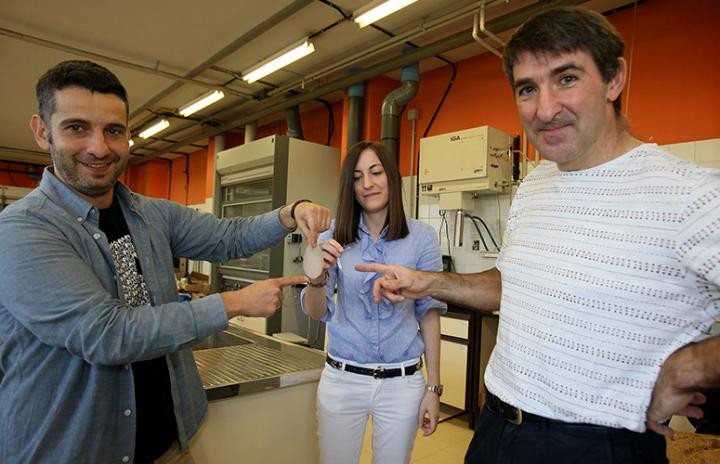
Credit: Photo: Nagore Iraola. UPV/EHU
The researchers Haritz Sardón, Ainara Sangroniz and Agustin Etxeberria at the UPV/EHU’s Faculty of Chemistry, together with the researchers Eugene Y.-X. Chen, Jian-Bo Zhu and Xiaoyan Tang at Colorado State University (USA), have designed fully recyclable packaging materials that promote the circular economy for plastic packaging materials where design and production fully comply with requirements pertaining to reuse, repair and recycling. Their study has been published recently in Nature Communications and constitutes a step forward in solving the problem of plastic.
“Containers are needed to ensure the quality and safety of food,” stressed the researcher Haritz Sardón. “Containers protect the product from external agents and the requirements they generally have to meet are good mechanical properties (high ductility) and low permeability to gases and vapours, in other words, good barrier properties. In the packaging sector plastics are the most widely used materials owing to their good physical properties, lightness and low cost. Yet the lack of suitable recycling systems plus their non-degradable nature have led to their build-up in the environment, generating a huge problem.”
In the quest to solve this problem, biodegradable materials have aroused great interest. In the right conditions these polymers degrade to form carbon dioxide, water, biomass, etc. “Poly(lactic acid) is among the most promising biodegradable polymers. Yet its high rigidity plus its low barrier character mean that this material is inadequate for replacing commercial materials,” he explained.
That accounts for the recent growth in the importance of chemical recycling. “Once materials of this type reach the end of their useful service life,” the UPV/EHU researcher went on, “they can be recycled chemically and the original monomer or new monomers can be obtained. The monomer can be re-used to synthesise the material again. That avoids the generation of plastic waste.”
“This work explores two chemically recyclable homopolymers: poly(gamma-butyrolactone), which displays suitable mechanical properties, but high permeability to various gases and vapours. By contrast, poly(trans-hexahydrophthalide) displays the opposite properties: it is very rigid and has low permeability. So we opted to develop copolymers by combining both compounds/monomers. By varying their composition it was possible to synthesise materials with suitable mechanical and barrier properties that are better than biodegradable polymers and similar to commercial materials currently used in packaging,” he concluded.
###
About the authors
Agustin Etxeberria is a tenured UPV/EHU lecturer, Haritz Sardon is an assistant UPV/EHU lecturer and Ainara Sangroniz is a PhD student at the UPV/EHU in the Department of Polymer Science and Technology.
Bibliographical reference
A. Sangroniz, J.-B. Zhu, X. Tang, A. Etxeberria, E.Y.-X. Chen, H. Sardon, Packaging materials with desired mechanical and barrier properties and full chemical recyclability. Nature Communications, 2019, 10, 3559. DOI: https:/
Media Contact
Matxalen Sotillo
[email protected]
34-688-673-770
Original Source
https:/
Related Journal Article
http://dx.