


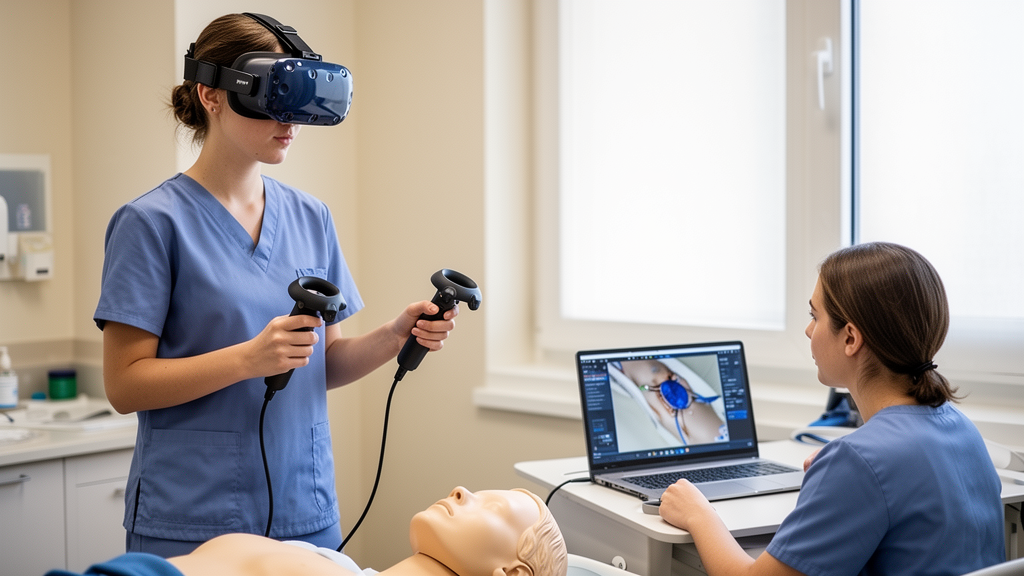
Medical students who practised emergency medicine scenarios in fully immersive virtual reality, using a head-mounted display, performed no better than classmates who completed the identical scenarios on a laptop, according to a new counterbalanced crossover study from UNSW Sydney published in Advances in Simulation. The study, which compared the two VR modalities head to head in third-year undergraduate medical students, found that performance scores did not significantly differ between the head-mounted display and laptop conditions, even though students rated the immersive version as more realistic.
The research addressed a growing question in medical education: virtual reality is increasingly used to teach clinical reasoning and patient management, but it has remained unclear whether higher levels of immersion actually improve learning outcomes. To test this, the team used two emergency department scenarios developed by Oxford Medical Simulation, aligned to the curriculum and identical across both conditions. Ninety-one third-year undergraduate medical students enrolled, with eighty completing both sessions. Each student attempted each scenario twice, receiving immediate feedback and a faculty debriefing after every attempt, in both a fully immersive modality delivered through a head-mounted display and a partially immersive modality delivered on a laptop.
The primary outcomes were objective performance scores generated by the simulation platform’s standardised scoring rubric, which meant that learning was measured by the same instrument in both groups rather than by examiner judgement. Performance improved significantly from the first to the second attempt in both modalities, showing that students learned from repeated practice regardless of how immersive the simulation was. However, the between-modality comparison showed no statistically significant difference in performance scores, with a reported p value of .069 and an effect size of d = 0.21, a small difference that did not reach significance.
Secondary outcomes covered self-reported confidence and learner experience. Confidence in technical and non-technical skills increased in both modalities, and again there were no between-modality differences. Student preference was split: 55% of participants favoured laptop-based simulation while 45% favoured the head-mounted display, a near-even divide that suggests the more immersive technology did not translate into a clearly preferred learning experience.
Qualitative analysis of survey responses identified three themes: immersion versus usability, technical and physical constraints, and educational value. Students in both groups reported that virtual reality was valuable for developing clinical reasoning skills in a safe environment, indicating that both delivery formats were seen as educationally worthwhile even though they differed in hardware and presence.
The authors’ conclusion is carefully qualified. For the scenarios and outcomes examined, head-mounted display simulation was associated with higher perceived realism but no detectable additional benefit in measured performance or self-reported confidence compared with laptop-based simulation. Importantly, the study was not designed to test equivalence, so the absence of a significant difference should not be read as proof that the two modalities are identical in effect. The researchers suggest that laptop-based simulation may offer a more scalable option for medical schools, and that the conditions under which greater presence adds educational benefit require further research.
The study is open access and was published on 8 October 2026, with the shared early version subject to further edits before the final Version of Record. Its crossover design, in which the same students completed both modalities, strengthens the comparison by holding individual ability constant, and the use of the platform’s standardised rubric provides a consistent, objective measure of performance across conditions.
Subject of Research: Comparing fully immersive and laptop-based virtual reality for training clinical reasoning and patient management in undergraduate medical students
Article Title: Immersive versus partially immersive virtual reality for training clinical reasoning and patient management in undergraduate medical education
Article References: Taylor, B., Michalski, S. C., Beacroft, T., & Torda, A. (2026). Immersive versus partially immersive virtual reality for training clinical reasoning and patient management in undergraduate medical education. Advances in Simulation. https://doi.org/10.1186/s41077-026-00496-x
Image Credits: AI Generated
DOI: 10.1186/s41077-026-00496-x
Keywords: virtual reality, medical education, clinical reasoning, patient management, simulation, head-mounted display, emergency medicine, undergraduate students, crossover study, UNSW Sydney, learning outcomes, immersion
News Source: Courtney Benton. (October 28, 2026). Fully immersive VR adds no measurable learning gain over laptop simulation in medical training trial. Scienmag.



