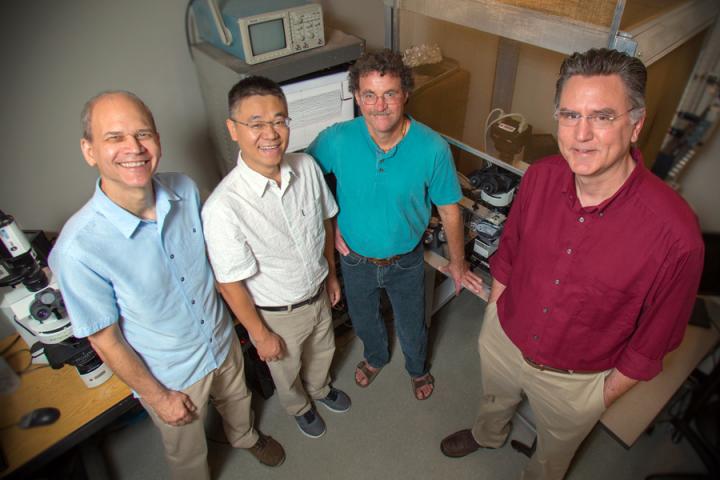
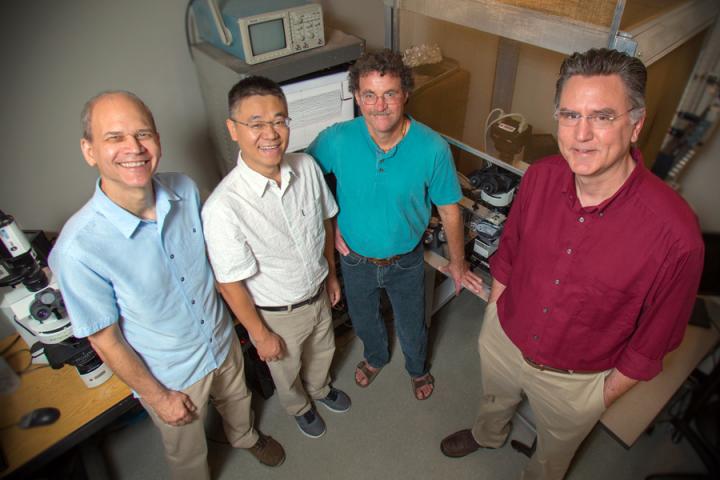
Credit: (Photo: FSU Photography Services)
TALLAHASSEE, Fla. — The term "birdbrain" has been part of our lexicon for about a century to describe someone's intellect, or lack of it, presumably because birds have really small brains. But, in fact, the way songbirds learn to sing is similar to how humans learn speech.
A unique interdisciplinary team of Florida State University researchers is leading the way among scientists worldwide to understand the question of how the male zebra finch learns its songs. Now, with the help of an $800,000 grant from the National Science Foundation, they are moving ahead with research to answer that question.
"Birdsong is a very good model for us to understand how the human brain works in terms of vocalization and how we learn speech," said Wei Wu, associate professor of statistics. "It's a perfect model."
The research team is figuring out how that model works. They are decoding how electrical impulses surge across neural networks, just like an electrical circuit, and translate into behavior such as birdsong or possibly a person's speech.
"If you can understand how a bird's brain can learn, then you can start to understand what goes wrong when people or animals have difficulty learning something," said FSU Professor of Psychology Rick Hyson. "You can't fix something unless you know how it works."
Few research universities in the world host a comparable collection of brainpower cracking the neural code to vocal learning. Hyson is an electrophysiologist, Wu delivers expertise in statistics and data visualization, Richard Bertram is a biomathematician and Frank Johnson is a neuroanatomist and behavior specialist. They are joined by graduate students in FSU's neuroscience and biomathematics programs.
"If we were at different places, we wouldn't be doing this research," said Johnson, professor of psychology and director of FSU's Interdisciplinary Program in Neuroscience. "If you look across the world of neuroscience, there are lots of people churning out data. But very few groups take the next step of converting that data into the language of mathematics where it actually becomes something you can do things with."
Bertram speaks that language fluently as he uses math to construct a virtual world of the brain. The team gathers pieces of data from experiments and loads those disparate facts into Bertram's mathematical models. The equations help reveal how those pieces work together across the whole brain, making it possible for a bird to sing a song.
"There are so many neurons interacting with each other, billions of them, and it's a real mess to disentangle," Bertram said. "We have to make that huge jump from a single neuron up to the behavior and using mathematical models helps bridge the two."
Their research has led them on a fascinating journey into the infinitesimal universe of neuron cells. Hyson, as the group's electrophysiologist, has the intriguing job of recording electrical impulses racing across a single neuron: How do ions flow in and out of the cell, how fast are they moving, how is the constellation of cells interconnected.
The team is making progress on understanding mysteries of the brain. Their research has helped identify the location in the brain that stores the actual memory of a song, and they've gained insights into how neural networks cause certain behaviors. But even after years of study and breakthroughs, there's still a lot of work to do.
"We found out where to look," Hyson said, but inevitably another question arises. "We think we get an answer, but suddenly we're saying, 'Now we gotta figure out other questions than where to look.'"
Their research journey is illuminating the path to understanding how the finch's brain learns and how learning itself can rewire neural networks across several important nodes, all of which have specific counterparts in the human brain.
"The most fascinating thing about the brain is its capacity to change," Hyson said. "We've learned from this project how a brain can learn new things. Then, eventually, maybe you can better understand some human disabilities. That would be one tangible outcome, if we dream about possibilities."
Their research also offers invaluable opportunities for graduate students.
"Our students get such broad training," Hyson said. "Typically, students work with one faculty member, but our students learn from all of us. They come out of the program extremely well trained."
The student training, Johnson added, prepares the next generation of scientists to advance this research.
"When I teach students, then they know what I know. To go forward, the new generation must actually be better. I'm proud to say many of them are not just better; they're way better. Scientific progress only works if each successive generation is better."
###
Media Contact
Dave Heller
[email protected]
850-644-4030
@floridastate
http://www.fsu.edu
Original Source
http://news.fsu.edu/news/2017/07/28/fsu-researchers-listen-birdsong-unlock-mysteries-brain/