Credit: Caroline McNiel/National MagLab
TALLAHASSEE, Fla. — Thank goodness for the Earth’s crust: It is, after all, that solid, outermost layer of our planet that supports everything above it.
But much of what happens below that layer remains a mystery, including the fate of sections of crust that vanish back into the Earth. Now, a team of geochemists based at the Florida State University-headquartered National High Magnetic Field Laboratory has uncovered key clues about where those rocks have been hiding.
The researchers provided fresh evidence that, while most of the Earth’s crust is relatively new, a small percentage is actually made up of ancient chunks that had sunk long ago back into the mantle then later resurfaced. They also found, based on the amount of that “recycled” crust, that the planet has been churning out crust consistently since its formation 4.5 billion years ago — a picture that contradicts prevailing theories.
Their research is published in the journal Science Advances.
“Like salmon returning to their spawning grounds, some oceanic crust returns to its breeding ground, the volcanic ridges where fresh crust is born,” said co-author Munir Humayun, a MagLab geochemist and professor at Florida State’s Department of Earth, Ocean and Atmospheric Science (EOAS). “We used a new technique to show that this process is essentially a closed loop, and that recycled crust is distributed unevenly along ridges.”
In addition to Humayun, the research team included MagLab postdoctoral researcher Shuying Yang, lead author on the paper, and MagLab Geochemistry Group Director and EOAS Chair Vincent Salters.
The Earth’s oceanic crust is formed when mantle rock melts near fissures between tectonic plates along undersea volcanic ridges, yielding basalt. As new crust is made, it pushes the older crust away from the ridge toward continents, like a super slow conveyer belt. Eventually, it reaches areas called subduction zones, where it is forced under another plate and swallowed back into the Earth.
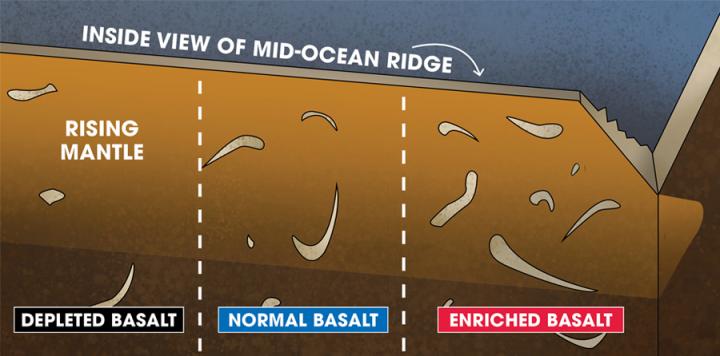
Scientists have long theorized about what happens to subducted crust after being reabsorbed into the hot, high-pressure environment of the planet’s mantle. It might sink deeper into the mantle and settle there, or rise back to the surface in plumes, or swirl through the mantle, like strands of chocolate through a yellow marble cake. Some of that “chocolate” might eventually rise up, re-melt at mid-ocean ridges, and form new rock for yet another millions-year-long tour of duty on the sea floor.
This new evidence supports the “marble cake” theory.
Scientists had already seen clues supporting the theory. Some basalts collected from mid-ocean ridges, called enriched basalts, have a higher percentage of certain elements that tend to seep from the mantle into the melt from which basalt is formed; others, called depleted basalts, had much lower levels.
To shed more light on the mystery of the disappearing crust, the team chemically analyzed 500 samples of basalt collected from 30 regions of ocean ridges. Some were enriched, some were depleted and some were in between.
Early on, the team discovered that the relative proportions of germanium and silicon were lower in melts of recycled crust than in the “virgin” basalt emerging from melted mantle rock. So they developed a new technique that used that ratio to identify a distinct chemical fingerprint for subducted crust.
They devised a precise method of measuring that ratio using a mass spectrometer at the MagLab. Then they crunched the numbers to see how these ratios differed among the 30 regions sampled, expecting to see variations that would shed light on their origins.
At first the analysis revealed nothing of note. Concerned, Yang, a doctoral candidate at the time, consulted with her adviser. Humayun suggested looking at the problem from a wider angle: Rather than compare basalts of different regions, they could compare enriched and depleted basalts.
After quickly re-crunching the data, Yang was thrilled to see clear differences among those groups of basalts.
“I was very happy,” recalled Yang, lead author on the paper. “I thought, ‘I will be able to graduate!'”
The team had detected lower germanium-to-silicon ratios in enriched basalts — the chemical fingerprint for recycled crust — across all the regions they sampled, pointing to its marble cake-like spread throughout the mantle. Essentially, they solved the mystery of the vanishing crust.
It was a lesson in missing the forest for the trees, Humayun said.
“Sometimes you’re looking too closely, with your nose in the data, and you can’t see the patterns,” he said. “Then you step back and you go, ‘Whoa!'”
Digging deeper into the patterns they found, the scientists unearthed more secrets. Based on the amounts of enriched basalts detected on global mid-ocean ridges, the team was able to calculate that about 5 to 6 percent of the Earth’s mantle is made of recycled crust, a figure that sheds new light on the planet’s history as a crust factory. Scientists had known the Earth cranks out crust at the rate of a few inches a year. But has it done so consistently throughout its entire history?
Their analysis, Humayun said, indicates that, “The rates of crust formation can’t have been radically different from what they are today, which is not what anybody expected.”
###
The MagLab is funded by the National Science Foundation and the State of Florida. It is headquartered at Florida State University with additional locations at University of Florida and Los Alamos National Laboratory.
Media Contact
Kristen Coyne
[email protected]
Related Journal Article
http://dx.