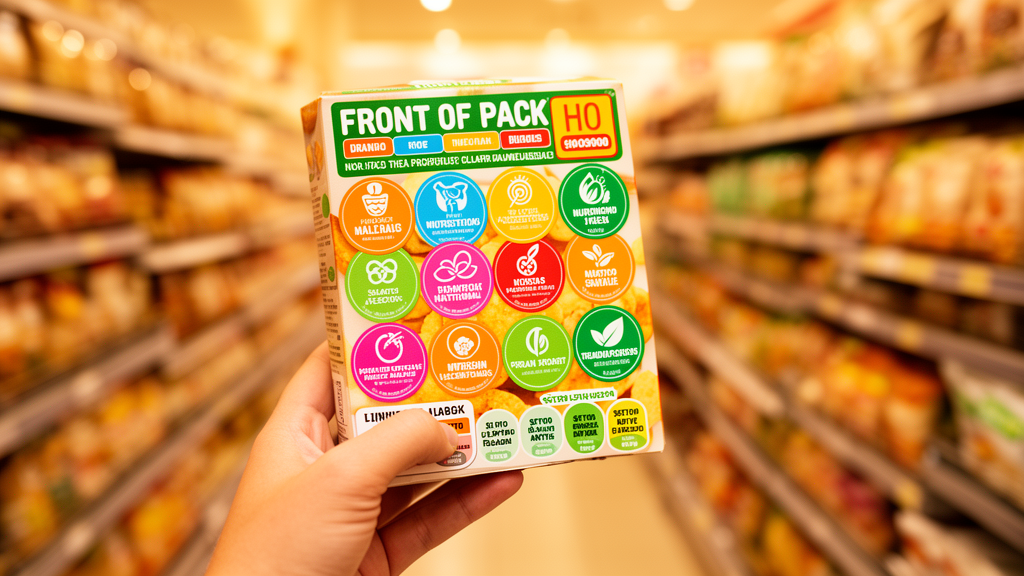
A stroll down any supermarket aisle reveals a wall of confident messaging: sugar free, low sodium, no artificial flavours, organic, high fibre, fortified with vitamins. These on-package claims have become one of the most powerful marketing tools in the food industry, and a new analysis published in Nature Food suggests that consumers should treat them with considerably more caution. Drawing on nearly 146,000 newly launched US food and beverage products, researchers at Cornell University and the University of Kentucky found that claims on packaging are, at best, imperfect signals of a product’s overall nutritional quality, and at worst actively misleading indicators of healthfulness.
The study, led by Pei Zhou of Cornell’s Charles H. Dyson School of Applied Economics and Management, together with Yuqing Zheng, Harry M. Kaiser and Miguel I. Gómez, is among the most comprehensive attempts to date to test whether packaging claims actually track with nutritional quality. The team used the Mintel Global New Products Database to capture every packaged food and beverage product launched in the United States between 2015 and 2024, spanning beverages and ten categories of processed consumer packaged goods. Rather than judging products on a single nutrient, they scored each item with the United Kingdom nutrient profiling model, a composite measure that balances components the model aims to limit, such as energy, saturated fat, total sugar and sodium, against components it aims to encourage, including fibre, protein and the share of fruit, vegetables and nuts.
The technical logic of the nutrient profiling model matters here. Each product receives points per 100 grams for the nutrients to limit, the so-called A points, and subtracts points for the nutrients to encourage, the C points, yielding a nutrient profile score in which higher numbers indicate worse overall quality. Products exceeding a threshold of four points for foods or one point for beverages are classified as less healthy. This framework, developed by the UK Food Standards Agency in 2004 and 2005, is used in real regulatory contexts, including advertising restrictions aimed at children, which makes it a policy-relevant benchmark rather than an arbitrary yardstick.
The sheer prevalence of claims is striking. More than half of all new products carried at least one of the four claim types examined, peaking at 61.1 percent in 2019 and 2020 before easing to 54.5 percent in 2024. Natural claims, which include organic, GMO free and whole grain labels, were the most common, followed by Minus claims such as low calorie or no added sugar, then Plus claims like added fibre or vitamin fortification. Functional claims, which tout physiological benefits such as cardiovascular support or probiotics, remained comparatively rare. Yet despite this flood of positive messaging, roughly two-thirds of all newly launched products were classified as less healthy under the nutrient profiling model, a coexistence the authors describe as revealing a fundamental gap between marketing salience and nutritional substance.
When the researchers compared products with and without each claim, the picture was inconsistent in ways that should trouble both regulators and shoppers. For foods, most claims were aligned with better nutrient profile scores, with one glaring exception: products boasting low, no or reduced trans fat actually scored worse overall than comparable products without the claim. In dairy and egg products, this discrepancy reflected lower protein alongside higher saturated fat, energy and sodium, while in meals and side dishes it was driven by elevated sodium and saturated fat. In other words, removing one notorious fat appears to have been accompanied by substitutions that eroded the overall nutritional profile.
Beverages told an even more troubling story. Four Minus claims showed significant discrepancies: low, no or reduced calorie, sugar free, low sodium and low saturated fat. Products carrying sodium claims in carbonated soft drinks, flavoured still drinks and ready-to-drink coffees and teas had worse overall scores than their unclaimed counterparts, and the component analysis identified the culprit: higher total sugar. Similarly, in flavoured still drinks, reductions in saturated fat were offset by increased sugar. The pattern suggests two complementary mechanisms at work. The first is reformulation trade-off, where cutting a targeted nutrient prompts changes elsewhere in the recipe that are less favourable. The second is selective signalling, where a claim truthfully highlights one improvement while remaining silent about the rest of the product’s composition.
Perhaps the most sobering finding concerns products whose claims were aligned with better scores. Even among these, many still exceeded the thresholds for classification as less healthy. A relative improvement within a category does not necessarily move a product below the regulatory cut-off, meaning a shopper comparing two items may reasonably choose the one with the claim, yet both may fall short of any meaningful standard of healthfulness. The authors note limited exceptions, such as vitamin and mineral fortification, added fibre and probiotic or prebiotic claims, which more often coincided with products clearing the nutrient profiling bar.
These results dovetail with a well-documented cognitive phenomenon known as the health halo effect, in which a favourable impression in one domain spills over into unrelated judgements. Earlier experimental work has shown that low-fat labels can increase consumption, that organic labels bias calorie estimates downward, and that natural labels inflate perceived quality, particularly among less experienced consumers. The new study adds a market-level dimension to this psychology: the claims that most strongly trigger halo effects, especially natural claims, also showed consistent within-category discrepancies, meaning products carrying them were often nutritionally worse than similar products without them. Because natural claims are not strictly defined within US regulatory frameworks, unlike nutrient content and structure and function claims overseen by the Food and Drug Administration, they operate with particular freedom.
Importantly, the researchers emphasize that none of these patterns implies regulatory violations. A claim that complies with FDA requirements is accurate about the specific attribute it addresses, but accuracy about one nutrient is not a complete or balanced representation of overall quality. The findings instead expose a structural limitation of attribute-based labelling: by design, such claims illuminate a single dimension while leaving the multidimensional profile in shadow. This matters for policy because current US dietary guidance, including the Dietary Guidelines for Americans 2025 to 2030 and the FDA’s sodium reduction initiative, targets individual nutrients in isolation. The evidence that sodium reductions in beverages coincide with higher sugar suggests that single-nutrient strategies may not translate into genuine improvements in dietary quality.
The international contrast is instructive. Interpretive labelling systems such as traffic light labels and Nutri-Score in Europe provide summary indicators of overall nutritional quality and have been linked to improved consumer choices and product reformulation, while Chile and Mexico have gone further with mandatory warning labels and restrictions on which products may carry claims at all. In the United States, survey evidence indicates that 83 percent of consumers read food labels and 78 percent prioritize health claims, yet only 16 percent find such claims highly trustworthy. Recent FDA moves, including the updated definition of the Healthy claim, which uses food-group criteria and limits on added sugars, sodium and saturated fat, and a proposed front-of-package Nutrition Info system, represent steps toward profile-based approaches. The authors caution that their analysis is observational, covers newly launched products rather than the full food supply, and does not directly measure consumer responses, leaving room for future work linking claims to purchasing behaviour. Still, the central conclusion stands: a claim on the front of a package is a signal about one attribute, not a verdict on the whole, and shoppers who read it as the latter may be buying less health than the label implies.
Subject of Research: The alignment between on-package nutrition claims and overall nutritional quality of newly launched US food and beverage products
Article Title: On-package claims are imperfect signals of overall nutritional quality
Article References: Zhou, P., Zheng, Y., Kaiser, H. M., & Gómez, M. I. (2026). On-package claims are imperfect signals of overall nutritional quality. Nature Food. https://doi.org/10.1038/s43016-026-01435-9
Image Credits: AI Generated
DOI: 10.1038/s43016-026-01435-9
Keywords: nutrition labelling, on-package claims, nutrient profiling model, health halo effect, food policy, Nature Food, consumer behaviour, food marketing, front-of-pack labelling, reformulation, added sugar, public health
News Source: Daisy Hatcher. (October 8, 2026). Front-of-Pack Nutrition Claims Often Mislead on Overall Food Healthfulness. Scienmag.