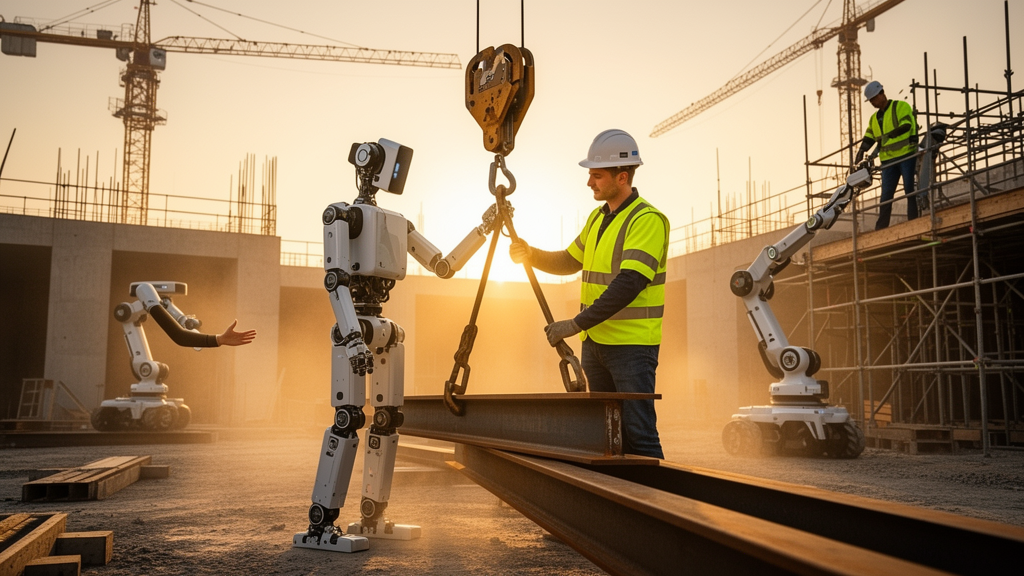
Robots on construction sites have spent a decade edging away from the role of power tool and toward something more like a colleague. A systematic review published in Architectural Intelligence on 21 August 2026 traces that shift in detail, analyzing 110 peer-reviewed studies of human–robot collaboration (HRC) in architecture, engineering, fabrication, and construction published between 2013 and 2024. Its central contribution is a six-level classification of collaboration, running from manual control, where the human retains every decision, through supervised autonomy, collaborative control, and adaptive collaboration, up to fully autonomous systems and, finally, collective human–robot collaboration involving multiple coordinated robots.
The review, authored by Tahmures Ghiyasi and Ali Ghazvinian, argues that the distinction matters because construction is not a factory. Buildings are typically one-off structures with limited prototyping opportunities, and sites present material irregularities, spatial constraints, and evolving design conditions that defeat conventional automation designed for controlled manufacturing settings. HRC frameworks attempt to reconcile human cognitive adaptability with robotic precision, combining human judgment about unpredictable conditions with the consistency and endurance of machines. The authors searched Google Scholar, Scopus, Cumin-CAD, Web of Science, and ResearchGate, screening 273 initial publications down to 110 that explicitly addressed human–robot collaboration in construction.
At the foundational level, manual control, robots act as sophisticated extensions of human labor with all decision-making retained by the operator. One seminal example cited in the review is an object-aware augmented reality system for bricklaying developed by Mitterberger and colleagues in 2020, which used marker-less object detection and visual-inertial tracking to give bricklayers dynamic optical guidance during the construction of a fair-faced brickwork facade for a winery in Greece. A second project applied computer vision and augmented reality to bamboo construction, scanning irregular natural components and guiding manual assembly so that human operators could adapt to each element’s unique properties. The authors note that manual systems require limited infrastructural investment and preserve craft expertise, but their throughput depends on skilled operators, creating a scalability bottleneck as projects grow larger and more complex.
Supervised autonomy, the second level, marks what the review calls a decisive shift from robots as directly operated tools to semi-autonomous partners. The LightVault project by Parascho and colleagues in 2020 is the flagship demonstration: two cooperative robotic arms constructed a 3.6 by 6.5-meter glass brick vault of 338 individual units, autonomously handling sequential placement, collision-avoiding path planning, and real-time adjustments to fabrication tolerances, while human supervisors ensured structural integrity and made sequencing decisions requiring contextual awareness. The review also highlights a 3D-printed sand formwork system from 2017 that achieved up to 70 percent material savings in concrete slab construction, a reversible timber beam system following circular economy principles, and a transportable robotic platform named TIM that extended supervised autonomy from the laboratory to real construction sites. Reinforcement learning for robotic timber joint assembly appears here as an early signal of the adaptive capabilities to come.
Collaborative control, the third level, distributes decision-making across the human–robot partnership through continuous bidirectional communication. The Pop-Up Factory project of 2019 used mixed-reality overlays to create a shared cognitive workspace for co-fabricating foam-block assemblies, with human operators adjusting design parameters on the fly while robots performed repetitive cutting and placement. The iHRC system for timber prefabrication translated robotic capabilities into spatial gestures and visual affordances, allowing skilled builders to direct robotic units through embodied interaction without specialized programming. Across these examples, augmented and mixed reality function as the essential communication substrate, with spatially registered overlays and holographic feedback creating a unified perceptual frame in which both human intentions and robotic computations are visible to both partners, enabling timely and targeted intervention rather than reactive correction.
Adaptive collaboration, the fourth level, goes further: robots move beyond predefined instructions and adjust their behavior autonomously based on sensor feedback, environmental conditions, and human interventions. The review catalogs a range of enabling technologies, including cooperative timber dowel assembly with in-place drilling that automatically compensates for positional inaccuracies, force-adaptive hot-wire cutting that modifies parameters in real time according to material resistance, and a Layer-by-Layer Pick-and-Place system using depth sensors and multi-objective optimization to support turn-taking collaboration in masonry construction, reconstructing as-built geometry after each layer and accommodating human modifications. An Interactive Robotic Plastering system employs computer vision and reinforcement learning to adjust spraying patterns based on surface deviations, while other work lets robots modify handover positions based on human ergonomic assessments. This level also extends to multi-robot coordination, with mobile robots dynamically redistributing assembly responsibilities based on their individual capabilities and positions.
Fully autonomous systems, the fifth level, execute entire construction workflows with minimal human intervention. The review points to an automatic bricklaying system deployed on rural Chinese construction sites that autonomously assessed brick quality and adapted placement strategies to material inconsistencies, a compound fabrication platform integrating additive, formative, and subtractive processes within a single autonomous workflow, autonomous fabrication of five-meter-tall bio-composite architectural elements from cellulose-chitin composites, and the In Situ Fabricator, a mobile robot combining real-time localization, obstacle avoidance, and quality verification to construct undulating brick walls independently. A two-arm scaffold-free system for catenary arches, in which one robot positions blocks while the other provides stabilization through real-time force feedback, demonstrates construction methods the authors describe as fundamentally impossible through human labor or collaborative workflows alone. The advantages concentrate in scalability, efficiency, and safety in hazardous contexts, but limitations persist in unstructured, dynamic environments where variability, obstacles, and human interactions challenge robot perception and decision-making.
Collective human–robot collaboration, the sixth and final level, draws on swarm robotics principles in which multiple robots coordinate as distributed systems with emergent intelligence rather than centralized control. Examples include mobile robots autonomously selecting filament manipulation tasks that optimize system-wide efficiency, a maypole braiding system in which robots continuously broadcast positions and trajectories to prevent collisions while maintaining structural tension, and an Improv-Structure project in which two robots use LiDAR scanning to capture evolving geometry during bamboo assembly, adapting their sequence in response to human design decisions. A multi-robot timber interlocking system achieved 2-millimeter alignment accuracy through integrated cameras and real-time trajectory adjustments. The review also cites a 12-ton autonomous excavator constructing dry stone walls with a reported 41 percent reduction in embodied carbon emissions compared to reinforced concrete, and a two-robot system managing a 300-square-meter hydroponic garden through computer vision.
The bibliometric picture underlying these categories shows a field accelerating rapidly. Between 2013 and 2016, the corpus averaged fewer than five publications per year, concentrated at the manual control and supervised autonomy levels. Annual output roughly doubled around 2017 to 2018, coinciding with the commercial availability of collaborative robot platforms and the integration of computer vision into fabrication workflows, and from 2020 onward annual counts exceeded fifteen papers. The first substantive contributions at the fully autonomous and collective levels appeared only in the post-2020 period, and they remain a small fraction of total output. Keyword co-occurrence analysis identified three thematic clusters—fabrication technologies and materials, sensing and adaptive systems, and human factors and interaction modalities—while keywords related to swarm robotics and multi-agent systems remained relatively isolated from the main network, confirming the emergent status of collective research.
The review’s most sobering finding concerns the distance between laboratory and building site. Most reviewed projects operate at pavilion or laboratory scale, with pre-sorted materials, stable environmental conditions, modest structural loads, and known workspace envelopes. Transitioning to real sites introduces compounding challenges: reliable power distribution, network connectivity, calibrated coordinate systems across large evolving workspaces, dust infiltration, mechanical vibration, thermal drift, and physical shocks that defeat robots tuned for climate-controlled laboratories. Unit economics currently favor repetitive, high-volume operations over the geometrically complex assemblies that characterize much of the reviewed work. Levels 1 and 2 are judged nearest to practical deployment, Levels 3 and 4 show promise for partially controlled prefabrication environments, and Levels 5 and 6 remain furthest from scalable practice, requiring breakthroughs in perception, fault-tolerant coordination, and regulatory approval. The authors argue that future progress depends on integrating collaborative robotics into construction workflows, democratizing the technology through intuitive interfaces and affordable hardware, and establishing robust frameworks for safety, training, and regulation—sustained interdisciplinary collaboration among architects, engineers, robotics experts, and social scientists to close the gap between experimental success and scalable application.
Subject of Research: A systematic review of human–robot collaboration levels in architectural fabrication and construction
Article Title: Tool to teammate: a systematic review on human–robot collaboration in architectural fabrication
Article References: Ghiyasi, T., & Ghazvinian, A. (2026). Tool to teammate: a systematic review on human–robot collaboration in architectural fabrication. Architectural Intelligence, 5(1), Article 26. https://doi.org/10.1007/s44223-026-00121-x
Image Credits: AI Generated
DOI: 10.1007/s44223-026-00121-x
Keywords: human-robot collaboration, construction robotics, architectural fabrication, systematic review, autonomy, collaborative control, swarm robotics, digital fabrication, augmented reality, supervised autonomy, construction automation, Tool
News Source: Denise Maddox. (October 28, 2026). From robot tools to robot teammates: six levels of human–robot collaboration in construction. Scienmag.