The Qiongzhusi Formation shale, a target of intense interest because of its vast shale gas potential, fails at the drill site in ways that are ultimately dictated by processes occurring at scales thousands of times smaller than a core sample. A new study published in Scientific Reports connects those scales directly, combining laboratory testing with theoretical modeling to trace how the mechanical behavior of individual mineral grains controls the macroscopic failure of the rock.
The research team began by characterizing the mineral composition of Qiongzhusi Formation shale using X-ray diffraction. That compositional baseline already pointed to a mechanically distinctive rock: the analysis revealed that these shales combine high hardness with high brittleness, a pairing with direct consequences for how the formation fractures during extraction operations.
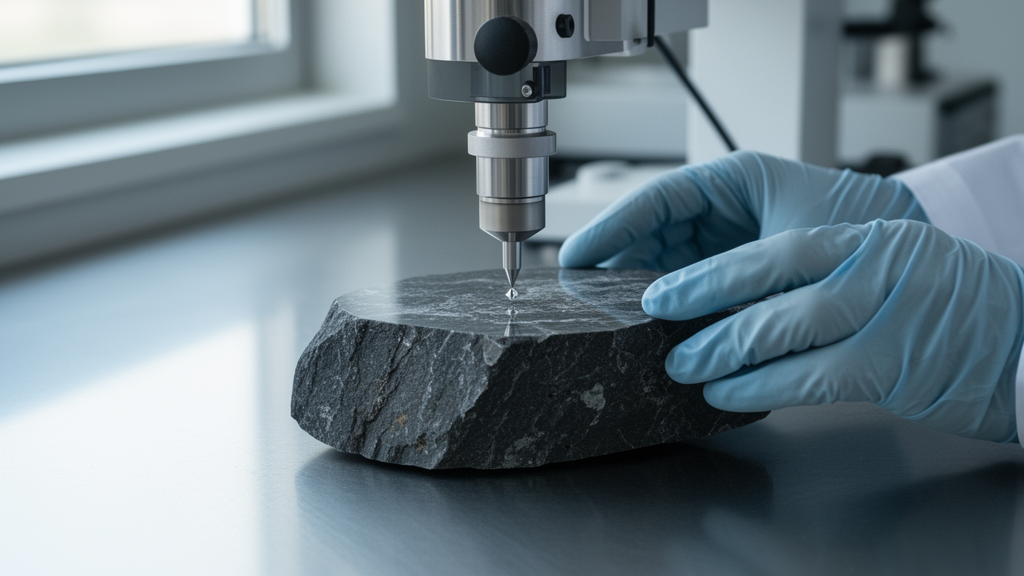
To probe the building blocks of that behavior, the researchers turned to nanoindentation, a technique that presses a microscopic tip into individual mineral phases to measure hardness and elastic modulus at near-grain scale. The indentation curves recorded for different minerals varied significantly. Framework minerals such as quartz displayed strong brittle energy storage characteristics, absorbing elastic strain energy that can be released suddenly in fracture. Muscovite, by contrast, exhibited an extremely high proportion of plastic work, deforming in a more ductile manner under the indenter.
Those contrasting signatures created a classification problem: with thousands of indentation points scattered across a heterogeneous rock surface, how can each measurement be assigned to the mineral that produced it? The study’s answer is a new method. The authors proposed a Gaussian probability-based mineral deconvolution classification approach that sorts nanoindentation datasets into mineral groups according to their mechanical properties rather than relying solely on visual identification of indentation sites.
According to the results reported in the paper, this Gaussian probability-based deconvolution method effectively classifies minerals within nanoindentation datasets based on their mechanical fingerprints. That capability matters because statistically robust mineral-scale property datasets are the raw material for any credible upscaling exercise, and misclassified points would propagate errors into the rock-scale model.
The upscaling step relied on the Mori-Tanaka method, a micromechanical homogenization technique that combines the properties and proportions of individual mineral phases to predict the effective elastic behavior of the composite rock. Using this framework, the team correlated the macro-scale and micro-scale mechanical properties of the Qiongzhusi Formation shale, closing the loop between indentation measurements and bulk rock response.
The cross-scale correlation produced two findings with practical weight. First, the macroscopic elastic modulus of the shale proved significantly sensitive to changes in muscovite content, meaning that shifts in the abundance of this compliant, plastic-deforming mica measurably alter the stiffness of the rock as a whole. Second, increases in quartz content significantly enhanced the mechanical properties of the Qiongzhusi Formation shale, consistent with quartz’s role as a rigid, energy-storing framework mineral identified in the nanoindentation results.
Together, the XRD, nanoindentation, deconvolution, and Mori-Tanaka components form a multiscale analysis pipeline: composition determines which minerals are present, indentation quantifies how each mineral behaves mechanically, the Gaussian deconvolution assigns measurements to phases, and homogenization translates phase behavior into rock-scale stiffness. The study’s authors frame this pipeline as a way to reveal the mechanical response mechanisms of minerals and rocks under complex environmental conditions.
That framing extends beyond the laboratory. By integrating environmental geology with sustainable development needs, the authors argue, multiscale analysis techniques can expand their application prospects in shale gas exploration and development engineering, where predicting how the rock will fail, deform, and store elastic energy is central to both resource recovery and subsurface integrity.
For the Qiongzhusi Formation specifically, the message is compositional: a rock rich in quartz behaves as a stiff, brittle energy reservoir, while rising muscovite content softens its macroscopic modulus. Because the published version is an early-release, peer-reviewed accepted manuscript carrying a permanent DOI and subject to further edits before the final Version of Record, the quantitative details of the cross-scale correlations will be worth tracking as the final article appears.
Subject of Research: Multiscale mechanical behavior of the Qiongzhusi Formation shale
Article Title: Multiscale mechanical behavior of the Qiongzhusi Formation shale
Article References: Peng, H., Wang, C., Li, Z., Liu, Y., Chen, Y., Jia, S., Wang, Q., & Lv, Z. (2026). Multiscale mechanical behavior of the Qiongzhusi Formation shale. Scientific Reports. https://doi.org/10.1038/s41598-026-77151-y
Image Credits: AI Generated
DOI: 10.1038/s41598-026-77151-y
Keywords: Qiongzhusi Formation, shale, nanoindentation, X-ray diffraction, Gaussian deconvolution, Mori-Tanaka method, elastic modulus, quartz, muscovite, shale gas, multiscale mechanics, brittleness
News Source: Denise Maddox. (October 25, 2026). From Nanoscale Indents to Rock Failure: Mapping Shale Mechanics Across Scales. Scienmag.