


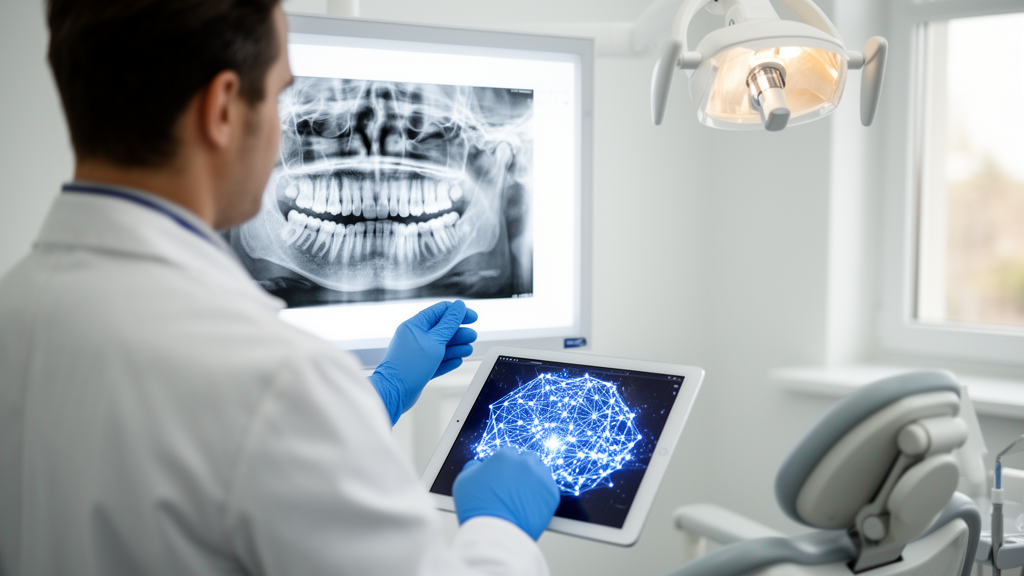
When a 54-year-old woman arrived at a Brazilian dental clinic with no complaints at all, a routine panoramic radiograph told a different story: a large, unilocular radiolucent lesion stretching through the posterior left region of her mandible, from the canine and premolar teeth all the way to the angle of the jaw, compromising the alveolar bone crest, the basal bone, and the region of the inferior alveolar nerve. The case, presented as part of the abstracts from the 34th Portuguese Dental Association Annual Meeting published in BMC Proceedings, illustrates a theme that runs through much of the collection: odontogenic cysts, which account for roughly 24 percent of oral and maxillofacial lesions, are frequently silent, discovered incidentally, and yet capable of significant bone destruction before they ever cause pain, paresthesia, or facial asymmetry.
What made this case technically notable was the stepwise strategy the clinicians chose. Rather than immediately excising the lesion, they began with a conservative decompression protocol: the cystic cavity was opened, its contents aspirated, the space irrigated with sterile saline, and a No. 1 Penrose drain inserted for decompression. That procedure was repeated every two weeks, with the drain changed at each session, for a full twelve months. Periodic radiographic examinations documented progressive regression of the cystic cavity, and histopathological analysis of the aspirated membrane confirmed a cystic lesion with no appearance of keratocyst. Only after a year of shrinkage did the team proceed to definitive enucleation and curettage. Postoperative follow-up with panoramic radiography at six months showed adequate bone healing, and computed tomography at one year confirmed reduction of the lesion with no signs of recurrence and no compromise of adjacent nerve structures. The authors argue that the conservative first phase reduced internal pressure, preserved mandibular bone, and minimized surgical risk, while cautioning that continuous long-term follow-up remains essential to confirm stability.
A second case from the same collection demonstrates why early diagnosis of these lesions matters so much. A 39-year-old man presented with paresthesia of the left lower lip and chin, first noticed in 2017, caused by a 40-millimeter dentigerous cyst associated with tooth 38 and involving the adjacent vital teeth 36 and 37. Dentigerous cysts are among the most common odontogenic entities, and odontogenic cysts overall represent approximately 10 to 15 percent of intraosseous lesions in the maxillofacial region, with a predominance in the mandible. The surgical team performed complete enucleation under general anesthesia with preservation of adjacent bone and dental structures, plus extraction of tooth 38. The neurological outcome was striking: total resolution of the paresthesia occurred approximately three months after removal, tracked through tactile sensitivity assessments and mapping. The patient was followed for five years, from April 2017 to February 2021, with periodic consultations and radiographs at 6, 12, and 24 months, showing no radiographic recurrence, no pathological fractures, and no root resorption. His own account, quoted in the abstract, captures the clinical stakes: before surgery he constantly felt tingling in his lip and feared losing sensation; three months later he had no symptoms and returned to normal activities without limitation.
Not every regenerative story ends cleanly, and one of the most technically instructive contributions is a case series of revitalization failures in immature permanent teeth. Pulp necrosis in immature teeth halts root development, leaving thin, short radicular dentin walls and an unfavorable crown-to-root ratio that increases susceptibility to fracture and infection. Revitalization, a regenerative endodontic procedure, aims to restore pulp vitality, promote continued root maturation, and resolve periapical pathology, in contrast to apexification, which induces apical closure without further root development. Three patients aged 8 to 11 years, with two maxillary central incisors and one maxillary second premolar affected by trauma or caries, underwent a two-visit revitalization protocol using mineral trioxide aggregate in two cases and Biodentine in one as cervical barriers. After a mean follow-up of ten years, all patients were asymptomatic, but clinical and radiographic assessments revealed variable degrees of root development, with one case exhibiting periapical pathology, tooth discoloration, and gingival inflammation, and two cases requiring secondary interventions. The series identified the solubility of cervical plug materials and intracanal calcification as potential contributors to failure, while noting that even in failure, revitalization preserved the teeth and maintained function, with apexification remaining a viable fallback.
Surgical microscopy featured prominently as well. A 41-year-old woman with moderate pain and a history of abscess associated with premolars 14 and 15, both treated nonsurgically years earlier, underwent endodontic retreatment that failed to resolve her symptoms within a month. Cone beam computed tomography revealed an extensive radiolucent lesion greater than 10 millimeters involving both premolar roots, and endodontic microsurgery with excisional biopsy followed. Histopathology identified an inflammatory radicular odontogenic cyst, and at one year the case showed favorable periapical healing and absence of symptoms. The authors’ reasoning is mechanistically plausible within their own report: large lesions often reflect long-standing infections with deeper bacterial invasion, and cystic transformation can justify treatment failure even when care follows recommended standards. A companion case applied the same microsurgical logic to dental trauma in a 13-year-old with an avulsed tooth 11 and an oblique root fracture of tooth 21. After apexification with mineral trioxide aggregate and a year of monitoring, a new CBCT scan showed resolution of one periapical lesion but persistent radiolucency at the apical fragment of tooth 21, prompting removal of that fragment, apical curettage, and biopsy, with a favorable clinical and radiographic outcome at one year.
Implant dentistry and bone regeneration formed another major cluster. A 68-year-old man with a previously failed simultaneous bone regeneration at the site of tooth 21 underwent guided bone regeneration using the Tenting Screw Technique, introduced by Reddy and colleagues in 2016 as an alternative to non-resorbable membranes or block grafts in selected cases. After removing an encapsulated xenograft, the surgeons placed two osteosynthesis screws, one vertical and one horizontal, to support the regenerative space, filled the defect with bovine xenograft, and covered it with a resorbable collagen membrane secured with tacks. Seven months later an implant was placed at site 21, followed three months after that by second-stage surgery and eventual prosthetic rehabilitation with a screw-retained zirconia crown. No postoperative complications occurred at any stage, and at 18 months the patient expressed high satisfaction with the esthetic result. In a related case series of five patients carrying 17 implants, palatal epithelized free gingival grafts raised mean keratinized mucosa width from 0.7 millimeters at baseline to 5.26 millimeters at 12 months and 5.08 millimeters at 72 months, with no mucosal mobility observed, no significant changes in plaque index, bleeding on probing, or pocket depth over six years, and patient satisfaction scores of 9 to 10 on a visual analog scale, though the authors themselves call for larger samples and longer follow-up.
The most aggressive lesion in the collection was an odontogenic myxoma, a rare benign tumor of ectomesenchymal origin with locally aggressive behavior, accounting for roughly 3 to 6 percent of odontogenic tumors and ranking third most common in the WHO classification. A 65-year-old woman presented with a five-month history of pain and swelling in the anterior mandible, approximately 4 centimeters across, with buccal and lingual expansion, mobility of the lower incisors and canines, and significant functional and psychosocial impact. Imaging showed a multilocular radiolucent lesion with poorly defined margins and root resorption, and incisional biopsy confirmed the diagnosis. Under general anesthesia the team performed a marginal mandibulectomy preserving the inferior mandibular border according to a virtual plan, placed a custom-made implant immediately, and loaded it with a fixed prosthesis in a single surgical procedure. Five months later the patient remained asymptomatic with no signs of recurrence, preserved lower lip sensitivity, and excellent functional and aesthetic integration of the prosthesis.
Beyond the operatory, the abstracts included population-level and laboratory work. A four-stage online Nominal Group Technique with 12 Portuguese stakeholders, run under ethics approval and data-protection registration, ranked priorities for maternal oral health across pre-conception, pregnancy, and postpartum: mandatory oral health screenings, expansion of dental voucher coverage through the Cheque Dentista program, oral health education within prenatal programs, inclusion of dentists in pregnancy care teams, and systematic oral health appointments at health centers. A pilot in silico study tested three large language model chatbots, ChatGPT-4o, Copilot, and Gemini 2.5Flash, against a specialist periodontist in classifying 30 anonymized Portuguese cases using the 2017 World Workshop system. The result was sobering: Cohen’s Kappa showed only slight agreement for each chatbot, with ChatGPT reaching statistical significance at kappa 0.14 while Copilot and Gemini did not, and Fleiss’ Kappa among all four evaluators was just 0.048, indicating minimal overall concordance and substantial diagnostic variability. The authors conclude that such models need considerable refinement before any population-level screening use.
Laboratory and forensic studies rounded out the program. An in vitro analysis of 165 Staphylococcus isolates from the oral cavity of 102 dental students found 78 percent of S. aureus and 82 percent of coagulase-negative staphylococci resistant to at least one antibiotic, with multidrug resistance in 25 percent and 19 percent respectively; no MRSA was detected, but 4 percent of CoNS isolates were cefoxitin-resistant, indicating methicillin resistance and underscoring the oral cavity as an under-recognized reservoir in antimicrobial resistance surveillance. A retrospective analysis of 463 clinical cases found antibiotics prescribed in 16.8 percent, with amoxicillin plus clavulanic acid dominating at 56.4 percent of prescriptions, diverging from guidelines that recommend amoxicillin alone. A systematic review of salivary biomarkers for oral cancer identified IL-6 and TNF-α rising with dysplasia grade, actin with sensitivity of 0.91 and specificity of 0.67, and several promising microRNAs, while noting that clinical validation remains early. And a survey of 300 dentists on teeth and restorative materials exposed to high temperatures found broad agreement with forensic literature, with the main divergence concerning the comparative resistance of enamel and dentin. Together, the collection offers a snapshot of a profession spanning molecular diagnostics, digital surgery, and public health, with each early-stage finding framed, appropriately, as a prompt for the larger studies that must follow.
Subject of Research: Dental and oral health research including odontogenic cyst management, regenerative endodontics, implant surgery, antimicrobial resistance, and diagnostic AI presented at the 34th Portuguese Dental Association Annual Meeting
Article Title: Abstracts from the 34th Portuguese Dental Association Annual Meeting
Article References: Abstracts from the 34th Portuguese Dental Association Annual Meeting. (2026). BMC Proceedings, 20(26), 31. https://doi.org/10.1186/s12919-026-00385-1 (Author names are not included in the publisher’s citation export.)
Image Credits: AI Generated
DOI: 10.1186/s12919-026-00385-1
Keywords: odontogenic cysts, dentigerous cyst, revitalization, endodontic microsurgery, guided bone regeneration, dental implants, odontogenic myxoma, periodontitis, antimicrobial resistance, salivary biomarkers, large language models, forensic dentistry
News Source: Ophelia Keating. (October 30, 2026). From Jaw Cysts to AI Diagnostics: New Dental Research Presented at Portuguese Meeting. Scienmag.



