


Dogs put the fun into learning vital social skills
Credit: UBC Okanagan
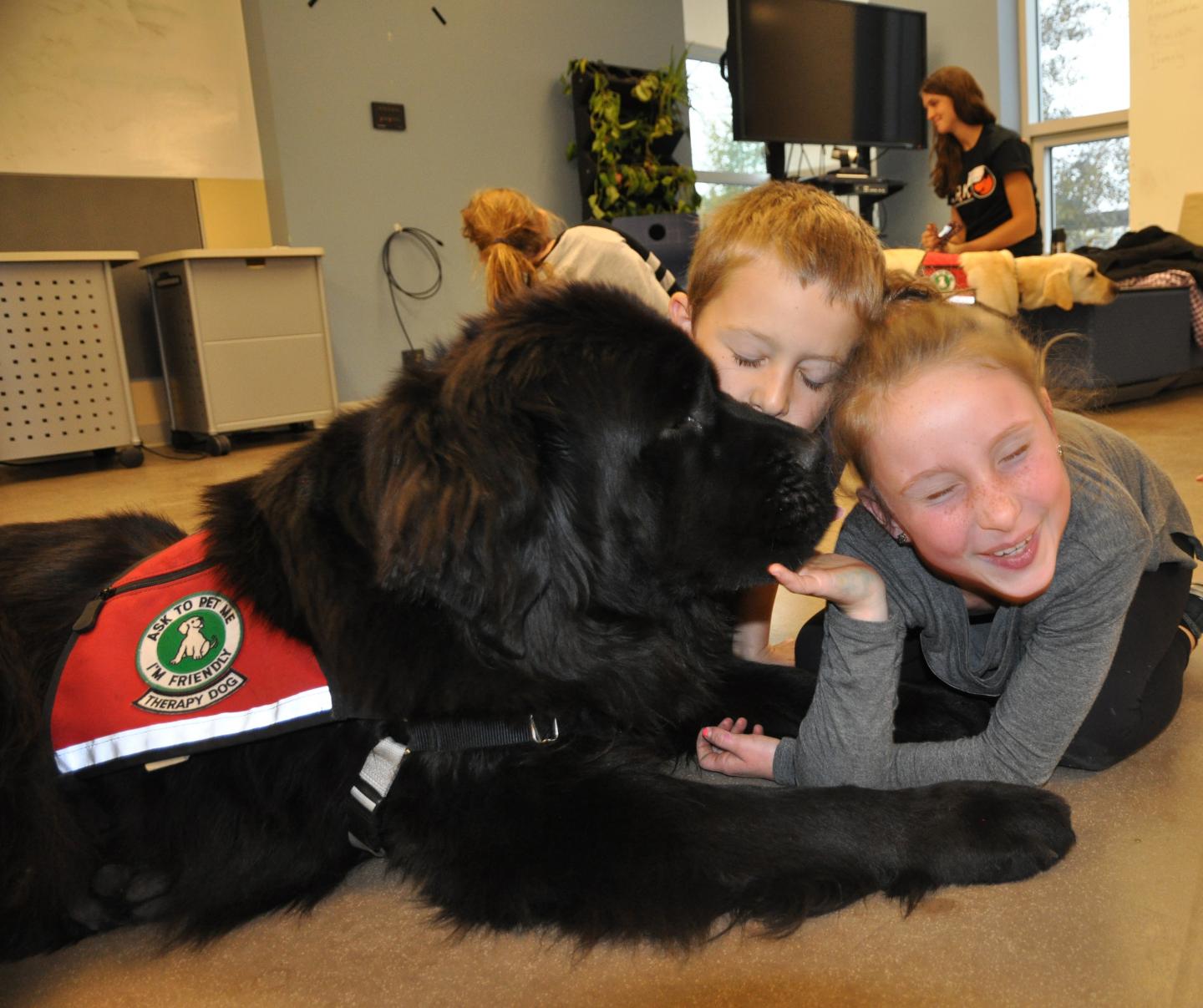
A new UBC Okanagan study finds children not only reap the benefits of working with therapy dogs-they enjoy it too.
“Dog lovers often have an assumption that canine-assisted interventions are going to be effective because other people are going to love dogs,” says Nicole Harris, who conducted this research while a master’s student in the School of Education. “While we do frequently see children improve in therapy dog programs, we didn’t have data to support that they enjoyed the time as well.”
Harris was the lead researcher in the study that explored how children reacted while participating in a social skill-training program with therapy dogs.
The research saw 22 children from the Okanagan Boys and Girls Club take part in a series of sessions to help them build their social skills. Over six weeks, the children were accompanied by therapy dogs from UBC Okanagan’s Building Academic Retention through K9s (BARK) program as they completed lessons.
Each week the children were taught a new skill, such as introducing themselves or giving directions to others. The children would first practice with their assigned therapy dog before running through the exercise with the rest of the group. In the final phase, the children –accompanied by their new furry friend and volunteer handler –would practice their new skills with university students located in the building.
“Therapy dogs are often able to reach children and facilitate their growth in surprising ways. We saw evidence of this in the social skills of children when they were paired with a therapy dog,” says Dr. John-Tyler Binfet, associate professor in the School of Education and director of BARK. “The dogs helped create a non-threatening climate while the children were learning these new skills. We saw the children practice and hone their social skills with and alongside the dogs.”
While the children were learning and practising their new skills, the research team collected data.
“Findings from our observations suggested that canine-assisted social and emotional learning initiatives can provide unique advantages,” says Harris. “Our team saw that by interacting with the therapy dogs, the children’s moods improved and their engagement in their lessons increased.”
In fact, 87 per cent of the team rated the children’s engagement level as very or extremely engaged during the sessions.
At the end of the six weeks, Harris interviewed eight children, aged 5 to 11 years old, who regularly attended the sessions. Each child indicated the social skill-training program was an enjoyable and positive experience and the dogs were a meaningful and essential part of the program.
One participant noticed that the children behaved better at the sessions than at their regular after-school care program, and they thought it was because the children liked being around the dogs.
Half of the children mentioned ways that they felt the dogs helped with their emotional well-being, with one participant crediting a dog with helping him “become more responsible and control his silliness.”
As a full-time elementary school teacher, Harris notes that schools have become increasingly important in helping students develop social and emotional skills, and this research could contribute to the development of future school-based or after-school programs.
“Dogs have the ability to provide many stress-reducing and confidence-boosting benefits to children,” says Harris. “It was really heartwarming to see the impact the program had on the kids.”
###
The research stemmed from the Building Confidence through K9s program, which was offered in partnership with the TELUS Thompson Okanagan Community Board.
The study was published in the Journal of Research in Childhood Education.
Media Contact
Patty Wellborn
[email protected]



