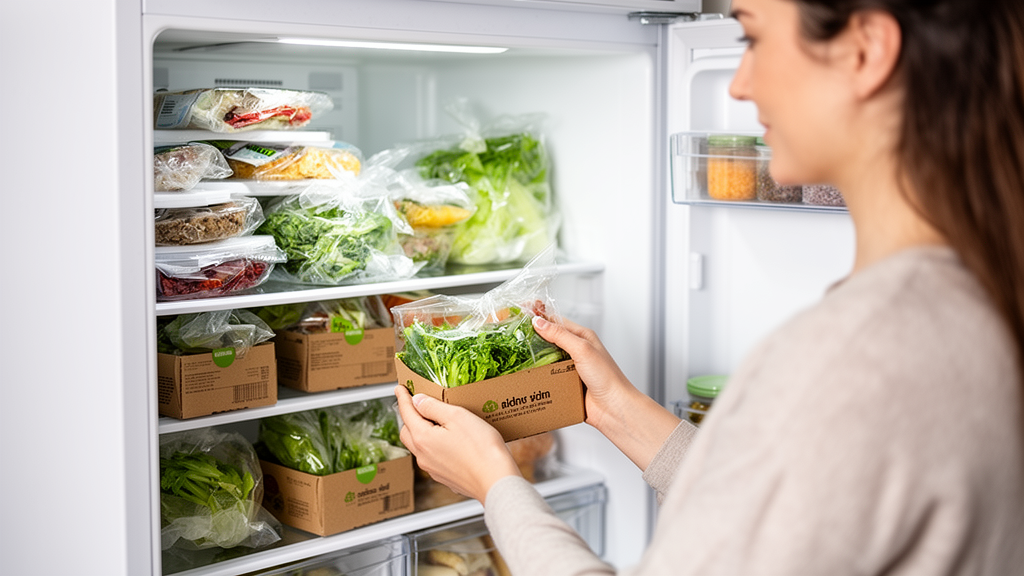
Household food waste is driven not merely by individual human conduct but also by the physical design of refrigerators and product packaging, according to an exploratory investigation conducted by researchers at Linköping University in Sweden. The study, published in the peer-reviewed journal Sustainability, concludes that conventional public information campaigns are insufficient to resolve the global problem of discarded groceries. Instead, the authors emphasize that both appliances and food packaging must be deliberately redesigned around the ways people actually behave in their daily domestic lives, rather than assuming consumers will adhere to ideal storage routines.
The scale of domestic food loss represents an urgent ecological concern. “One third of all food produced worldwide is wasted. In the Western world, most of the waste takes place in the shops or in households. It has a huge impact on the environment and climate,” explains study co-author Professor Renee Wever from the Division of Product Realisation at Linköping University.
To understand how domestic appliances and packaging interact with consumer routines, the researchers designed an exploratory case study involving 24 households spanning seven nations, including Sweden, Spain, South Africa, and Iran. The participating households submitted a total of 47 photographs documenting the interior state of their refrigerators on different occasions. Following the photographic collection, researchers conducted in-depth interviews exploring the participants’ refrigeration habits, grocery shopping methods, and food management routines. The research team was immediately struck by the remarkable visual similarity of the refrigerator contents across all participants, regardless of their country of origin, with bulk shopping and overfilled refrigerator compartments emerging as the standard pattern.
Overfilling refrigerators produced immediate practical consequences for household food preservation. When appliances were packed to capacity, visibility deteriorated sharply throughout the interior shelving. Participants consistently used whatever food items remained in plain sight, whereas items pushed into the back corners were easily forgotten until they decayed to the point where they had to be discarded. The accompanying interviews demonstrated that shoppers regularly relied on memory rather than physical inventories when purchasing groceries, a tendency that frequently generated unnecessary duplicate purchases and exacerbated overcrowding inside the appliance.
Throughout the study, convenience consistently took precedence over systematic organization when householders placed items inside their appliances. Groceries were not organized systematically according to optimal storage conditions, but were simply inserted wherever free space happened to be available. Food items that were consumed frequently were placed within immediate reach. Consequently, products such as milk were routinely stored in door bins, even though the door compartment represents a warmer zone of the refrigerator that is less suitable for preserving temperature-sensitive dairy items.
The researchers also discovered that once packaged goods were placed inside the refrigerator, the packaging frequently lost its intended function as an informative carrier. Packages were often bulky and awkward to stack, directly obscuring critical product labels, expiration dates, and optimal storage instructions, or rendering them impossible to read. Certain types of packaging consistently contributed to items being overlooked; for example, opaque brown paper bags used for fruits and vegetables frequently concealed their contents, leading householders to forget them entirely. Shoppers also rarely considered whether space was actually available before buying food, operating under the assumption that their refrigerators could accommodate indefinite amounts. As a result, the authors characterized the refrigerator as a “moral black hole.” As Babak Nemat, a postdoctoral fellow at LiU’s Division of Product Realisation, explained: “When people put goods in the fridge, they seem to think their responsibility is over. It’s now the responsibility of the fridge.”
Ultimately, the study concludes that household food waste must be addressed as a structural design challenge rather than exclusively as an educational or informational shortcoming. Curbing waste demands careful consideration of the three-way interplay among human behavior, packaging architecture, and appliance layout. For instance, packaging formats must be modified to function within cluttered, narrow refrigerator compartments, while refrigerators themselves must be designed to guide user behavior and promote correct item placement. The research team noted, however, that these findings must be interpreted with caution, given that the case study was exploratory in nature and evaluated a relatively small sample size.
Subject of Research: Influence of refrigerator and packaging design on household food waste
Article Title: Fridges and packaging contribute to food waste
Article References: Fridges and packaging contribute to food waste. Original publication (Bibliographic details unavailable.)
Image Credits: AI Generated
DOI: Not provided
Keywords: food waste, refrigerator design, packaging design, household behavior, food preservation, Linköping University, consumer habits, sustainable consumption, food spoilage, appliance design, grocery shopping, refrigerator organization, exploratory case study, Sustainability journal, environmental impact, dairy storage
News Source: Alan Morgan. (November 19, 2026). Fridges and Packaging Drive Household Food Waste, Case Study Concludes. Scienmag.