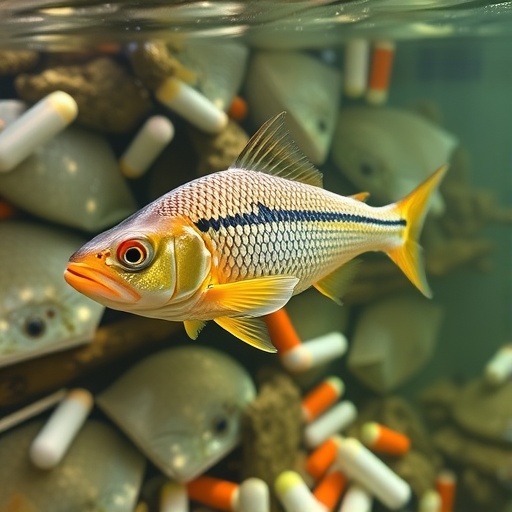
In a groundbreaking study led by researchers at the University of Waterloo, compelling evidence has emerged revealing that small fish inhabiting freshwater streams downstream of wastewater treatment plants are accumulating significant concentrations of antidepressants, opioids, and various substances of abuse. This startling discovery was made possible through the development and application of a novel, highly sensitive analytical method designed to detect and quantify these emerging contaminants in aquatic organisms with unprecedented precision. The results highlight the insidious and largely unrecognized ways in which human pharmaceutical and illicit drug consumption impacts aquatic ecosystems, raising urgent concerns about long-term ecological and physiological consequences.
The University of Waterloo team focused their investigation on a group of small fish species known as darters (Etheostoma spp.), which serve as sentinel species in urban watershed environments. These species, due to their ecological roles and sensitivity, provide critical insights into the bioaccumulation and environmental distribution of neuroactive compounds. By utilizing advanced chromatographic and mass spectrometry techniques, the researchers successfully detected the presence of potent central nervous system-active substances, including fentanyl, methadone, and venlafaxine, in the tissues of wild fish collected from rivers receiving treated wastewater effluents.
Prior to this study, scientific understanding of pharmaceutical and drug contamination in natural freshwater fish populations was limited, primarily confined to laboratory exposure scenarios or predictive modeling. This research represents the first direct empirical documentation confirming that these compounds not only persist in environmental waters post-treatment but also bioaccumulate within wild fish in Canadian rivers. These findings underscore the limitations of conventional wastewater treatment technologies, which are not engineered to effectively remove complex pharmaceutical molecules or illicit drug residues, therefore allowing their continual release into downstream ecosystems.
One of the most remarkable observations reported was the differential accumulation patterns between male and female fish. The research indicates that male darters exhibit higher tissue concentrations of certain neuroactive substances compared to females. This sex-specific bioaccumulation suggests that biological variables such as metabolic rate, detoxification pathways, and hormonal regulation strongly influence the uptake, distribution, and retention of these contaminants. Understanding these physiological differences is pivotal for accurate ecological risk assessments and for developing tailored conservation strategies.
The implications of these findings extend beyond mere contamination detection. Neuroactive pharmaceuticals and opioids have well-established effects on vertebrate neurological systems, potentially altering behavior, reproductive success, and developmental processes. Changes in fish behavior, such as impaired predator avoidance, altered social interactions, or disrupted spawning activities, could cascade through aquatic food webs, ultimately affecting ecosystem stability and biodiversity. The persistence of drugs like fentanyl and methadone in aquatic biota signals a new class of environmental pollutants requiring urgent scientific attention.
Dr. Mark Servos, who heads the research effort at Waterloo’s Department of Biology and Water Institute, emphasized the pervasiveness of pharmaceutical contamination, noting that even highly treated wastewater represents a significant source of exposure for aquatic organisms. This reality highlights an urgent need for investment in advanced treatment methods capable of targeting and removing these biologically active chemicals. Without such interventions, fish and other wildlife downstream of urban centers will remain at continual risk of pharmaceutical-induced physiological stress and ecological disruption.
This study also showcases the critical role of innovative analytical chemistry in environmental science. The novel detection techniques devised by the team enable unprecedented sensitivity in measuring trace concentrations of diverse drug compounds within complex biological matrices. This allows researchers and regulatory agencies to monitor aquatic ecosystems more effectively, improving early-warning capabilities for emerging contaminants that conventional methods might overlook. Such technological advancements are essential for advancing environmental monitoring and safeguarding aquatic health.
In addition to pharmaceuticals, the study raises alarm over illicit drug residues—products of human consumption that enter wastewater systems and evade removal. The presence of these substances in fish tissues points to a largely invisible pollutant pathway connecting human public health issues with environmental integrity. This intersection between pharmacology, epidemiology, and ecology represents an evolving frontier demanding integrated research approaches and holistic regulatory frameworks.
Looking ahead, the University of Waterloo researchers plan to deepen their investigations into how environmental variables such as water temperature, flow rates, and chemical mixtures influence the bioavailability and toxicity of pharmaceutical contaminants. Concurrently, comprehensive toxicological studies are underway to elucidate the precise neurophysiological and reproductive impacts these drugs exert on fish species in natural settings. Such work is vital for predicting population-level effects and informing mitigation strategies to preserve aquatic biodiversity.
Moreover, this research accentuates the socio-environmental dimensions of pharmaceutical pollution, highlighting how everyday human medical use and illicit drug consumption translate into unintended environmental consequences. This underscores the importance of responsible prescription practices, public awareness campaigns on drug disposal, and policy reforms aimed at improving wastewater treatment infrastructure. Collective human action is required to halt and reverse the influx of these novel contaminants into freshwater habitats.
The publication of this pioneering research in the journal Environmental Pollution marks a significant milestone in aquatic ecology and environmental toxicology. It opens new avenues for interdisciplinary collaborations among chemists, biologists, toxicologists, and environmental engineers, all united in the mission to understand and mitigate emerging chemical threats to aquatic ecosystems. As pharmaceutical and drug abuse contaminants continue to proliferate globally, studies like this serve as essential catalysts for rethinking environmental monitoring and protection in the 21st century.
Institutional support and media outreach efforts are underway to disseminate these findings broadly, emphasizing their relevance to water resource managers, conservationists, policymakers, and the general public. Only through informed and coordinated action can the detrimental impacts of these contaminants on freshwater fish and aquatic ecosystems at large be effectively addressed. This research challenges us to reconsider the unseen ways human activities shape environmental health and to develop sustainable solutions that balance medical needs with ecosystem preservation.
Subject of Research: Animals
Article Title: Darters (Etheostoma spp.) as indicators of antidepressant and drug of abuse exposure in an urban watershed
News Publication Date: 9-Mar-2026
Web References: https://www.sciencedirect.com/science/article/pii/S0269749126002885
References: Servos, M., Cárdenas-Soracá, D., et al. (2026). Darters (Etheostoma spp.) as indicators of antidepressant and drug of abuse exposure in an urban watershed. Environmental Pollution. https://doi.org/10.1016/j.envpol.2026.127918
Image Credits: University of Waterloo
Keywords: aquatic ecology, pharmaceuticals, antidepressants, opioids, environmental pollution, wastewater treatment, bioaccumulation, fish behavior, emerging contaminants, aquatic ecosystems, environmental toxicology, freshwater resources
Tags: antidepressants in freshwater speciesbioaccumulation of neuroactive drugs in fishdetection of fentanyl in wild fishecological effects of illicit drug residuesemerging contaminants in urban watershedsenvironmental impact of methadone in riversfreshwater fish opioid accumulationmass spectrometry analysis of aquatic pollutantsneuropharmaceutical pollution in freshwater habitatspharmaceutical contamination in aquatic ecosystemssentinel species for water quality monitoringwastewater treatment plant effluent impact