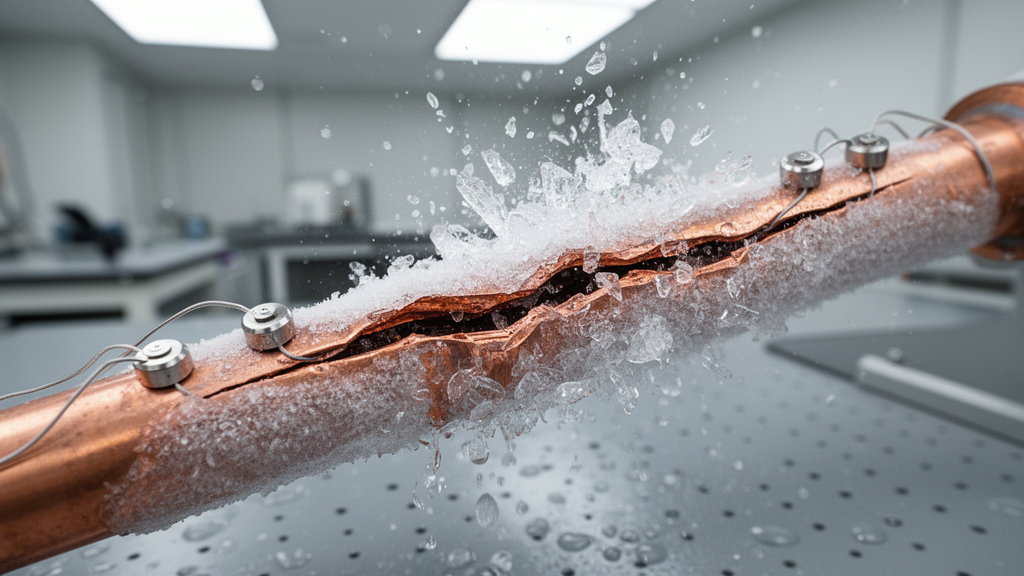
Vibration amplitude rises sharply to peak values at the exact moment a freezing pipe ruptures during artificial ground freezing, according to laboratory model tests.
Artificial ground freezing is an essential construction technique widely implemented across underground engineering operations. However, freezing pipe fractures pose severe hazards that can jeopardize overall construction safety, creating an operational need to reliably recognize fracture states through physical signal monitoring.
To investigate these fracture events under controlled conditions, the research team designed and conducted laboratory model tests using a self-designed model specimen. This experimental assembly was composed of steel pipe and frozen soil analog materials, allowing the investigators to systematically record the vibration signals generated during rupture events under diverse working conditions.
The primary objective of the investigation was to systematically analyze the propagation and attenuation patterns of rupture vibration signals under single-factor controlled conditions. This experimental framework focused quantitatively on how external confining pressure and internal fluid pressure individually alter key vibration characteristic parameters, specifically signal amplitude and dominant frequency, addressing an existing gap in single-factor parameter evaluation.
By examining these conditions, the study extended previous research to account for coupled influencing factors that had previously been overlooked, including external confining pressure, internal brine pressure, and the medium properties of the frozen soil. Within the tested scope, increasing the external confining pressure caused the dominant frequency of the rupture-induced vibration signals to follow a decreasing trend.
In contrast to the effects of external confining pressure, the dominant frequency of the vibration signals remained relatively stable with negligible variation as internal fluid pressure increased.
Subject of Research: Vibration signal characteristics of freezing pipe rupture under controlled pressure conditions
Article Title: Single-factor analysis of influencing laws for vibration signal characteristics of freezing pipes in artificial freezing construction
Article References: Xu, J., Chen, E., Wu, X., & Wang, Y. (2026). Single-factor analysis of influencing laws for vibration signal characteristics of freezing pipes in artificial freezing construction. Discover Applied Sciences. https://doi.org/10.1007/s42452-026-09801-9
Image Credits: AI Generated
DOI: 10.1007/s42452-026-09801-9
Keywords: artificial ground freezing, freezing pipes, pipe rupture, vibration signals, confining pressure, internal fluid pressure, vibration amplitude, dominant frequency, signal attenuation, underground engineering, model testing, frozen soil, brine pressure, fracture detection, propagation patterns, steel pipe, structural safety
News Source: Denise Maddox. (November 11, 2026). Freezing Pipe Ruptures Produce Sharp Vibration Peaks in Controlled Laboratory Tests. Scienmag.