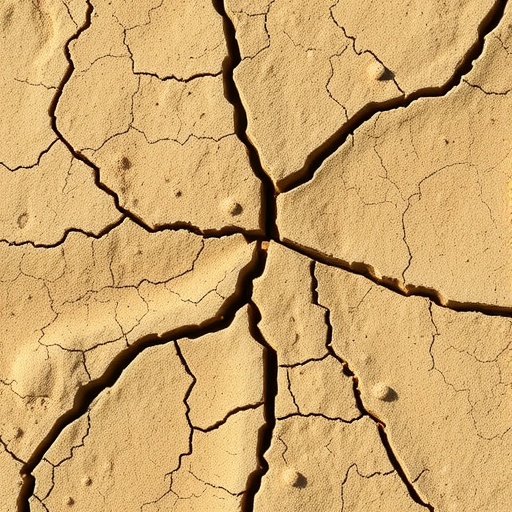
In a groundbreaking study that could reshape our understanding of rock mechanics and its implications for both natural and engineered systems, Ren, Shen, Yun, and colleagues have unveiled critical insights into the damage and failure mechanisms of freeze-thaw filled fractured sandstone subjected to uniaxial compression. Their research, published in Scientific Reports in 2026, probes the intricate interplay between freeze-thaw cycles and mechanical stress on fractured sandstone—a geological material ubiquitous in many parts of the world and vital for construction, mining, and environmental engineering applications.
The phenomenon of freeze-thaw weathering has long been recognized as a major agent of rock disintegration, yet the underlying mechanisms at a microscale level remain incompletely understood, particularly when fractures are already present. Freeze-thaw cycles occur when water within rock pores and fractures freezes, expands, and subsequently thaws repeatedly, inducing expansion stresses that can incrementally degrade rock integrity. However, when these fractured rocks are subjected to uniaxial compressive stresses, typical in underground excavations, infrastructure foundations, and natural slopes, the combined effect on damage accumulation and failure progression invites deeper scrutiny.
Ren and colleagues designed an elaborate experimental methodology to simulate the freeze-thaw process in sandstone specimens with pre-existing fractures, subsequently applying uniaxial compressive loads until failure. Their approach meticulously replicated environmental conditions and fracture characteristics commonly observed in natural settings, thereby enhancing the ecological validity of their findings. The sandstone samples were saturated, subjected to multiple freeze-thaw cycles to induce frost damage, then tested to failure under controlled loading rates.
One of the pivotal discoveries of this study is the pronounced acceleration in damage accumulation within the sandstone post freeze-thaw cycling. Compared with intact or non-frosted specimens, the freeze-thaw fractured samples exhibited significantly reduced peak strength values, signaling a marked degradation in load-bearing capacity. The microstructural observations revealed that the repeated freeze-thaw cycles promoted the development of microcracks and enlarged pre-existing fracture apertures, which acted as stress concentrators during subsequent compression.
Mechanistically, the research elucidates how the freeze-thaw cycles induce volumetric expansion of water-to-ice transformation within the fractures. This process generates tensile stresses perpendicular to fracture surfaces, exacerbating crack propagation and coalescence. Upon thawing, residual voids remain, which reduce effective contact areas across fracture surfaces and weaken frictional resistance, thereby progressively undermining the mechanical stability of the rock under uniaxial compression.
Advanced imaging and acoustic emission monitoring utilized by the researchers furnished a real-time depiction of damage evolution during loading. Notably, acoustic emission events spiked dramatically at specific stress thresholds, coinciding with the initiation and propagation of microcracks. This temporal relationship affirms that freeze-thaw induced damage significantly lowers the stress threshold required for crack growth and macro-failure, hence transforming the sandstone’s failure mode from more ductile behavior toward brittle fracture.
The study also reports intriguing changes in failure patterns driven by freeze-thaw effects. While unweathered fractured sandstone tended to fail along predictable fracture planes or through gradual crushing, the freeze-thaw treated specimens frequently exhibited complex, multi-fracture propagation networks and abrupt rupture events. Such chaotic failure modes pose substantial challenges for predicting rock stability in freeze-thaw prone climates, emphasizing the need for revised risk assessment frameworks.
From an engineering perspective, these discoveries hold profound implications. Structures founded on or excavated within fractured sandstone formations subject to freeze-thaw cycles may experience unforeseen strength reductions and unpredictable failure modes, jeopardizing safety and longevity. The conventional design paradigms—which often assume static rock properties—may require substantial re-evaluation to incorporate the dynamic damage processes elucidated by Ren et al., including the need for enhanced monitoring and preventive reinforcement techniques.
Environmental and planetary geosciences also stand to benefit. Understanding freeze-thaw damage mechanisms aids in modeling slope stability under periglacial conditions and predicting landscape evolution. Moreover, insights from this research could be extrapolated to extraterrestrial geology, where freeze-thaw processes in fractured regolith or rock on Mars or icy moons might affect the mechanical behavior of planetary surfaces.
Furthermore, the experimental framework established in this study serves as a benchmark for future investigations into coupled thermo-hydro-mechanical processes in fractured rock masses. By combining high-fidelity environmental simulations with detailed mechanical testing and acoustic monitoring, Ren and colleagues have set a new standard for interdisciplinary rock mechanics research.
As climate change intensifies freeze-thaw cycle frequency and magnitude in vulnerable regions, the urgency to comprehend their impact on subsurface engineering and natural hazards grows. This research is timely and vital, providing a foundational understanding that engineers, geologists, and policymakers can harness to anticipate and mitigate risks associated with freeze-thaw influenced rock damage and failure.
The comprehensive nature of the study invites further extension into varied rock types, fracture geometries, and loading conditions, potentially exploring anisotropic stress fields or cyclic loading scenarios that better mimic real-world circumstances. Such expansions will undoubtedly refine predictive models and enhance the resilience of infrastructure interacting with fractured rock environments.
In summary, the experimental work of Ren et al. sheds new light on the fragile balance between natural weathering phenomena and mechanical stresses within fractured sandstone. Their meticulous quantification of the degradation processes initiated by freeze-thaw cycles and subsequent compression not only advances geomechanics theory but also carries tangible, actionable implications for engineering design and environmental risk management.
The resonance of this research extends beyond purely academic circles, poised to influence construction standards, mining practices, natural hazard assessments, and planetary exploration strategies. As the interplay between environmental weathering and mechanical forces gains prominence in global scientific dialogue, studies like this one provide the critical evidence base necessary to push boundaries and innovate safer, more adaptive technologies.
Going forward, interdisciplinary collaboration leveraging geotechnical engineering, geophysics, climatology, and material science will be essential to unravel the complexities highlighted here further. The fusion of experimental insights with numerical modeling and field observations promises to accelerate our capacity to safeguard built and natural environments resilient to freeze-thaw fatigue.
Ren, Shen, Yun, and their team’s experimental study catalyzes a paradigm shift in how we perceive rock failure under coupled environmental and mechanical forcings. It is a compelling testament to the power of rigorous scientific inquiry to deepen our comprehension of Earth’s dynamic processes and improve humanity’s stewardship of critical geological resources.
Subject of Research: Damage and failure mechanisms of freeze-thaw filled fractured sandstone under uniaxial compression
Article Title: Experimental study on the damage and failure mechanism of freeze-thaw filled fractured sandstone under uniaxial compression
Article References:
Ren, J., Shen, Y., Yun, M. et al. Experimental study on the damage and failure mechanism of freeze-thaw filled fractured sandstone under uniaxial compression. Sci Rep (2026). https://doi.org/10.1038/s41598-026-48551-x
Image Credits: AI Generated
Tags: damage accumulation in fractured rocksenvironmental engineering rock stabilityexperimental simulation of freeze-thaw effectsfailure mechanisms in fractured sandstonefractured sandstone uniaxial compressionfreeze-thaw cycles on sandstone strengthfreeze-thaw impacts on construction materialsfreeze-thaw induced rock disintegrationfreeze-thaw weathering mechanismsmechanical stress effects on sandstonemicroscale rock degradation processesmining rock mechanics under freeze-thaw