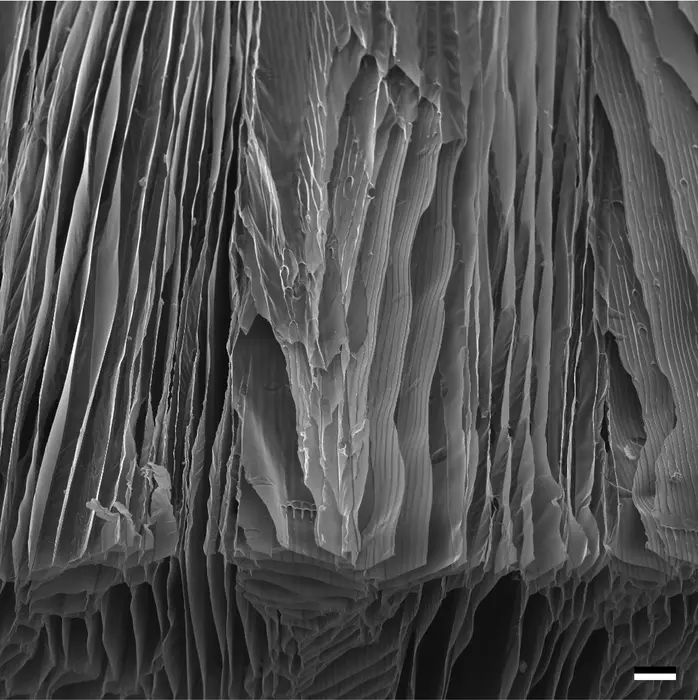
“We were delighted when the world-renowned journal Nature offered us the opportunity to prepare a Nature Reviews Methods Primer with instructions and an overview of the process,” says materials scientist Prof. Ulrike Wegst (Northeastern University, Boston, MA, USA and TU Berlin). “Together with tomoscopy experts Dr. Francisco García-Moreno und Dr. Paul Kamm (both HZB and TU Berlin), Dr Kaiyang Yin (now Humboldt Research Fellow at the University of Freiburg) and I had just performed first in situ experiments and discovered new ice crystal growth and templating phenomena. It therefore appeared timely to combine in our Freeze Casting guide for Nature Reviews Methods Primers (impact factor 39.8), experimental methods of freeze casting with techniques for process and materials analysis”.
Credit: Kaiyang Yin / University of Freiburg
“We were delighted when the world-renowned journal Nature offered us the opportunity to prepare a Nature Reviews Methods Primer with instructions and an overview of the process,” says materials scientist Prof. Ulrike Wegst (Northeastern University, Boston, MA, USA and TU Berlin). “Together with tomoscopy experts Dr. Francisco García-Moreno und Dr. Paul Kamm (both HZB and TU Berlin), Dr Kaiyang Yin (now Humboldt Research Fellow at the University of Freiburg) and I had just performed first in situ experiments and discovered new ice crystal growth and templating phenomena. It therefore appeared timely to combine in our Freeze Casting guide for Nature Reviews Methods Primers (impact factor 39.8), experimental methods of freeze casting with techniques for process and materials analysis”.
Observing the process with X-Ray tomoscopy
Following an introduction to the various batch and continuous freeze casting processes, and a brief outline of lyophilization (freeze drying), the Primer provides an overview on the many characterization techniques for the analysis of the complex, hierarchical material architectures and material properties. Highlighted are the unique capabilities and strengths of X-ray tomoscopy, which permits to analyse crystal growth and the dynamics of structure formation in all classes of materials (polymers, ceramics, metals, and their composites) during solidification in real time and 3D. “This is particularly attractive when we wish to quantify anisotropic crystal growth, such as that in aqueous solutions and slurries, in which crystals extend in the different crystal directions at different velocities”, says García-Moreno.
From tissue scaffolds to porous electrodes
The freeze-casting process was developed more than 40 years ago for the production of tissue scaffolds. It soon became apparent that freeze-cast materials, due to their highly porous structure, could integrate well with host tissues and support healing processes. Today, freeze-cast materials are widely used not only in biomedicine but also in engineering, from innovative catalysts to highly porous electrodes for batteries or fuel cells. A wide variety of solvents, solutes and particles can be used to create the desired structures, shapes and functionalities.
How does freeze casting work?
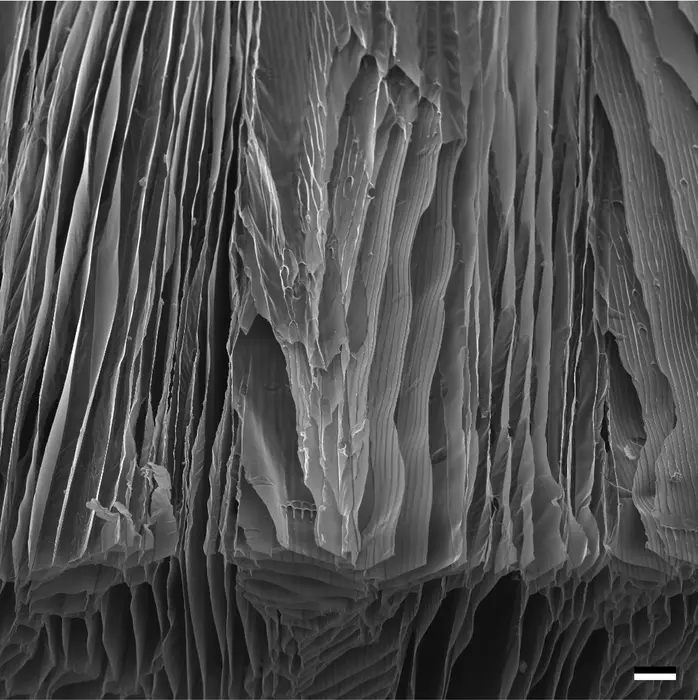
First, a substance is dissolved or suspended in a solvent, here water, and placed in a mold. Then a well-defined cooling rate is applied to the copper mold bottom to directionally solidify the sample. Upon solidification, a phase separation into a pure solvent, here ice, and a solute and particles occurs, with the ice templating the solute/particle phase. Once the sample has been fully solidified, the solid solvent is removed by sublimation during lyophilization. Lyophilisation reveals the highly porous, ice-templated scaffold, a cellular solid, whose cell walls are composed of the solute/particle that self-assembled during solidification. The size and number of pores, their geometry and orientation, the packaging of particles and the surface characteristics of the cell walls and with it the mechanical, thermal, magnetic and other properties of the material can be tailored for a desired application.
Outlook: New insights into the process under microgravity
To gain further information on the fundamental science of freeze casting, experiments to be performed on the International Space Station are planned. This is because ISS microgravity, i.e. an enormously reduced gravitational force, minimizes effects of sedimentation and convection on structure formation. The experts expect this to lead to further advances in the understanding of freeze casting processes and the manufacture of custom-designed, defect-free materials.
DOI
10.1038/s43586-024-00307-5
Method of Research
Systematic review
Subject of Research
Not applicable
Article Title
Freeze casting
Article Publication Date
25-Apr-2024
COI Statement
none