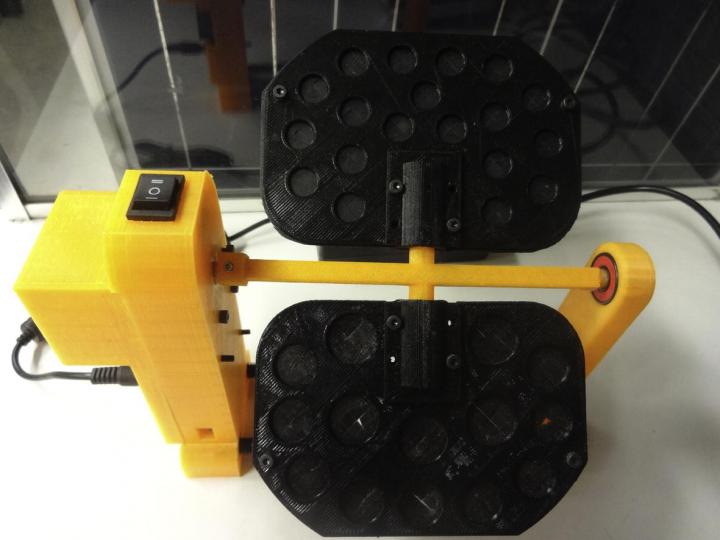
Credit: Karankumar C. Dhankani, Joshua M. Pearce
FOSH is rapidly gaining momentum as part of a global “open design movement”, whereby the free release of information on customized research hardware, such as design, schematics and bill of materials are easily accessible anywhere with an internet connection.
This information can then be fed into 3D printing devices for hassle-free and cost-effective manufacturing which, after the initial investment of a 3D printer, would only be as expensive as the raw printing materials. This enables rapid and much less expensive hardware to be produced, which can be produced rapidly at scale, such as ventilators during the current pandemic.
The study is the first national-level one of its kind, and the group included Ismo Heikkinen, Hele Savin, Jouni Partanen and Jukka Seppälä from Aalto, and visiting Fulbright Finland professor, Joshua Pearce, from Michigan Technological University. Pearce explains the reason behind using Finland as the country to base their study on, ‘Finland has a superior education system which is focused on specializations in science, and it has a very approachable scale. However, in saying that, the approach of strategic support of open hardware design applies to any country’.
Pearce and his colleagues looked at all the research infrastructures & facilities in Finland and calculated the savings in a scenario where all of the research hardware (that is over 10K in value) would be converted to free & open source.’ We looked at the infrastructure that made the most sense to open source first and then determined how much could be saved on research capital costs alone’.
FOSH research priorities for Finland would include developing open-source transmission electron microscopes and scanning electron microscopes
The study concluded that conservatively speaking, FOSH development of two-electron microscopy tools would save Finland over 40m€ so equivalent level of nano-scale imaging could be obtained. Similarly, millions of Euros would be saved nation-wide, while significantly strengthening Finland’s atomic layer deposition (ALD)-related research excellence.
Overall, the results indicate Finnish science funders could save millions of Euros annually on scientific equipment purchases if all hardware costing over 10,000€/item is converted to FOSH. Furthermore, the majority of this would become ‘on shore’ production, currently carried out by equipment manufacturers in other countries.
Pearce says, ‘I believe it’s of significant national/European interest. We have looked at how Finland could strategically alter how science funding is allocated to save millions of Euros a year while getting better equipment, reducing imports, and improving the national economy’.
Pearce explains that the money saved from FOSH will prove invaluable elsewhere in the research, ‘Instead of doing the same amount of science innovation for less money – the concept we were using was to do more science innovation for the same amount of money. Maybe even ten times more! The idea was if x-million is allocated for equipment instead of spending x-amount to purchase the equipment, you will spend a fraction of it to do open-source hardware design. Then in the next year instead of buying one tool, you could buy ten or more of the same thing and help many more researchers go faster’.
Pearce points out, ‘In my lab, we have saved hundreds of thousands easily. In the paper – the open hardware that already exists has saved substantial money. Estimates on open-source syringe pumps alone are that they have saved scientists millions and that is only one device. Hardware X, the open hardware journal for science, just published its 100th design – and in general, those devices are saving about 90% off the purchase cost of proprietary tools. Frankly, spending money to buy black-box hardware is a waste of money if there is an open-source option’.
###
Media Contact
Joshua Pearce
[email protected]
Original Source
https:/
Related Journal Article
http://dx.