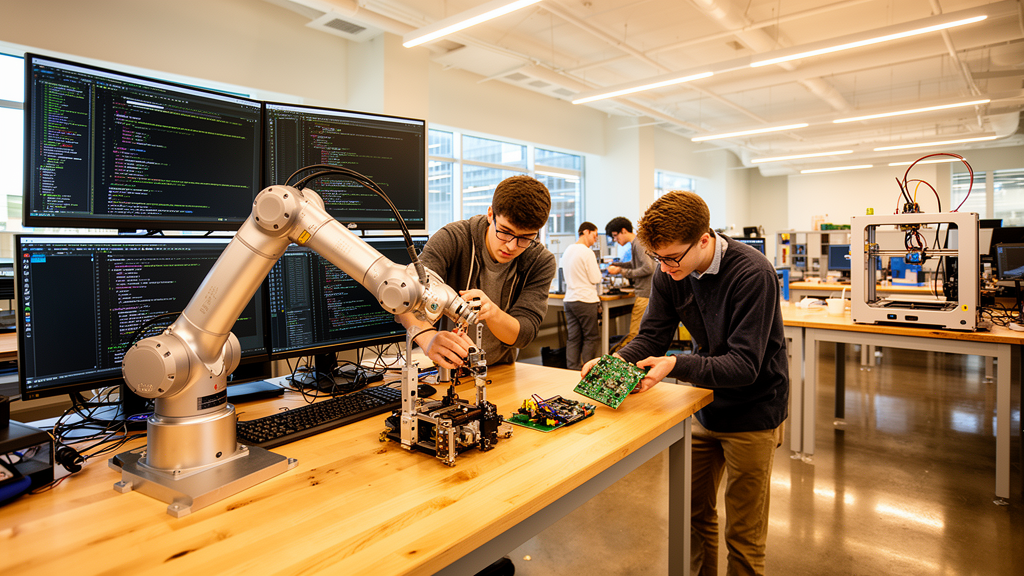
In a newly published analysis in Technology and Innovation, engineering researchers Cengiz S. Ozkan and Mihrimah Ozkan from the University of California Riverside argue that the rapid acceleration of artificial intelligence requires a comprehensive transformation of engineering education. Emerging from its historical position as a specialized computational tool, artificial intelligence has expanded into a general-purpose operational infrastructure that influences reasoning, mechanical design, physical simulation, and scientific discovery across the global economy. This shift represents a defining hallmark of the Fourth Industrial Revolution, accelerated by modern advances in large language models, multimodal systems, and generative computing platforms. Despite these sweeping industrial transformations, conventional academic institutions continue to treat artificial intelligence as an isolated elective topic or narrow specialization rather than an indispensable foundational discipline. The authors contend that educational programs must discard this fragmented structure in favor of a vertically integrated educational model that embeds technological literacy, human-machine collaboration, and ethical principles across every tier of engineering development.
The conceptual framework developed by the researchers establishes a sequential educational pipeline designed to cultivate technical fluency and analytical capability across the complete engineering talent lifecycle. This progression spans five interconnected phases, advancing methodically from early childhood learning to undergraduate coursework, specialized graduate discovery, industrial practice, and perpetual workforce renewal. Within this framework, early preparation establishes mathematical curiosity and computational thinking, which undergraduate programs subsequently expand into applied disciplinary proficiency and data literacy. Graduate research further develops domain-specific architectural modeling, while professional sectors translate these competencies into operational productivity, systems optimization, and sustainable societal solutions. The final continuous stage, designated conceptually as the Starship Academy, represents an adaptive paradigm of lifelong education, microlearning, and global knowledge exchange necessary to sustain technical leadership amid relentless technological change. Throughout every stage of this educational pipeline, cross-cutting competencies such as critical thinking, algorithmic accountability, systems thinking, and data literacy serve as common foundational threads unifying educational curricula with evolving societal requirements.
At the foundational pre-college level, the framework emphasizes that introducing artificial intelligence should inspire curiosity and strengthen science, technology, engineering, and mathematics education rather than attempt to train children as specialized computational programmers. Modern artificial intelligence platforms facilitate this introductory phase by delivering adaptive tutoring systems that dynamically identify knowledge gaps, modify problem difficulty, and reinforce foundational concepts in real time. Contemporary conversational assistants and generative tutors expand these capabilities by providing multilingual guidance, step-by-step reasoning scaffolds, and interactive mathematical explanations tailored to individual student learning velocities. Furthermore, tangible learning environments bridge abstract algorithmic principles with physical experimentation through visual block-based programming environments and educational robotics platforms. By integrating computational modules with physical toolkits such as LEGO Mindstorms, younger students learn fundamental sequencing, automated decision loops, object recognition, and basic spatial navigation. These interactive experiences demystify technical disciplines, stimulate creative problem decomposition, and encourage broader demographic participation among historically underrepresented student groups early in the engineering pipeline.
Alongside technical fundamentals, the authors stress that pre-college integration must establish early habits of ethical reflection and address substantial institutional implementation barriers. Young learners benefit from exploring age-appropriate engineering dilemmas, including algorithmic fairness, personal data privacy, and moral responsibility when autonomous systems malfunction. However, deploying intelligent platforms across elementary and secondary classrooms introduces significant logistical and ethical hurdles that require deliberate administrative oversight. Significant disparities in hardware access, high-speed broadband infrastructure, and specialized educational software threaten to concentrate instructional advantages within well-funded school districts while leaving resource-constrained schools further behind. Additionally, continuous diagnostic tracking generates sensitive behavioral histories and performance records, necessitating strict safeguards regarding parental consent, data minimization, transparent governance, and retention boundaries. Successful adoption also hinges on sustained professional development for teachers who may lack formal preparation in computational pedagogy. Crucially, curricula must teach students to interrogate algorithmic outputs with healthy skepticism, recognizing that underlying training datasets can reproduce cultural or demographic biases.
Transitioning into undergraduate education, the framework leverages intelligent platforms to reinforce foundational mathematical fluency, analytical vetting, and conceptual understanding. Before students can design electrical circuits, fluid networks, or structural frameworks, they must master advanced mathematical principles that have historically relied on mechanical memorization. Dynamic educational software enhances this learning process by providing interactive, real-time visualizations of complex abstractions, enabling students in linear algebra to manipulate matrix inputs and immediately inspect resulting eigenvector shifts and transformations. Similar visual tools illuminate difficult concepts in multivariate calculus, differential equations, and dynamic control theory. Because modern computational tools can effortlessly execute symbolic manipulation and algebraic procedures, instructors can redirect valuable lecture hours toward conceptual framing, physical modeling assumptions, and diagnostic verification. Students transition from passive recipients of calculated answers into rigorous analytical evaluators who must interrogate automated solutions, confirm unit consistency, evaluate boundary conditions, and verify that numerical outputs strictly obey governing physical laws and first-principles reasoning.
Undergraduate curricula must integrate artificial intelligence directly into core engineering courses, experimental laboratories, and practical design sequences to cultivate versatile T-shaped engineers. These professionals combine deep disciplinary mastery in traditional engineering domains with broad horizontal competencies in computational modeling, statistical data analysis, and machine learning. In mechanical engineering statics courses, students already implement predictive algorithms to anticipate material structural failure and systematically compare empirical data models against classical analytical formulas. Similarly, chemical engineering sequences utilize intelligent algorithms to predict complex reaction kinetics and optimize operational reactor parameters for superior chemical yield and thermodynamic efficiency. Concurrently, intelligent virtual laboratories provide safe, economical, and scalable experimental sandboxes where undergraduates can execute hazardous or resource-intensive simulations without physical risk. These adaptive virtual setups offer real-time operational feedback and allow unlimited trial-and-error iterations, building experimental confidence. Coding copilots and computer-aided design assistants further streamline mechanical modeling, provided instructors mandate that students explicitly defend their automated workflows.
In upper-division design curricula and culminating senior capstone projects, artificial intelligence fundamentally transforms design philosophy by shifting student focus from narrow parameter optimization toward expansive design exploration. Traditional engineering design often relies on sequential refinement and human intuition, which can unintentionally constrain student teams to familiar precedents and cognitive fixation. In contrast, generative design platforms rapidly synthesize thousands of viable, unconventional configurations satisfying predetermined structural, material, thermal, and manufacturing constraints. Furthermore, artificial intelligence accelerates computationally burdensome simulations—such as finite element analysis and computational fluid dynamics—by deploying surrogate models that deliver near real-time performance estimates, compressing multi-week iteration cycles into minutes. This computational acceleration enables capstone cohorts to tackle sophisticated multidisciplinary challenges, including structural health monitoring in civil bridges using machine learning stress predictions, predictive maintenance algorithms for rotating industrial machinery, or automated sensor control for aerial drones tested across millions of simulated edge-case flight scenarios.
Beyond individual technical execution, integrating collaborative artificial intelligence tools fundamentally reshapes team dynamics, multidisciplinary communication, and collective engineering decision-making. In complex group initiatives, mechanical, civil, electrical, and computer engineering students frequently struggle with incompatible mental paradigms and fragmented professional terminology. Intelligent shared data environments, digital twins, and unified simulation frameworks overcome these barriers by providing interactive, centralized reference models that allow diverse specialists to evaluate design modifications collaboratively. Furthermore, generative brainstorming tools foster creative synthesis by harmonizing competing functional priorities, such as balancing a materials specialist’s structural durability requirements with a manufacturing engineer’s fabrication constraints and an environmental engineer’s lifecycle sustainability targets. Crucially, working alongside intelligent systems trains students in human-machine collaboration and strategic delegation. Teams learn to assign routine calculations, documentation generation, and scenario benchmarking to automated systems while reserving critical human judgment for ethical deliberation, holistic problem formulation, creative risk assessment, and system-level architectural synthesis.
At the graduate research level, artificial intelligence transitions from an instructional aid into an indispensable engine for original scientific discovery and computational innovation. Advanced researchers utilize large language models, multimodal foundation architectures, and automated scientific pipelines to accelerate comprehensive literature syntheses, formulate novel scientific hypotheses, and interpret massive experimental datasets generated by sensor networks and electron imaging. In addition, graduate engineers construct high-fidelity surrogate models to approximate computationally prohibitive physical equations governing fluid dynamics, electrochemical transport, and structural mechanics, enabling rapid parameter sweeps and inverse design. Graduate students also develop domain-specific machine learning architectures, most notably physics-informed neural networks that embed fundamental scientific laws, such as conservation equations and differential boundary conditions, directly into algorithmic training loss functions. By enforcing adherence to scientific principles, these specialized architectures enhance predictive interpretability, dramatically reduce experimental training data requirements, and provide reliable analytical models across materials science, climate modeling, advanced semiconductor design, and biomedical technology development.
From an industrial perspective, hiring engineers trained through vertically integrated educational frameworks offers immediate economic advantages by compressing onboarding timelines and elevating organizational productivity. Historical industrial onboarding for entry-level engineers routinely spans several months to a full calendar year before new employees become fully productive. Graduates already proficient in data-centric workflows, probabilistic reasoning, and human-machine collaboration adapt rapidly to digital operating environments, allowing corporate mentors to focus on strategic leadership rather than basic software instruction. Major international enterprises across manufacturing, mobility, energy, semiconductors, and cloud computing—including Siemens, Tesla, General Electric, Nvidia, and Google—increasingly prioritize professionals who can bridge traditional physical principles with advanced data science. However, the authors caution that widespread academic adoption must actively guard against passive cognitive reliance, intellectual atrophy, and privacy violations. Preserving human agency, rigorous independent skepticism, and unyielding adherence to foundational physical principles ensures that artificial intelligence acts as a multiplier of human innovation.
Subject of Research: Vertical integration of artificial intelligence across the engineering education continuum
Article Title: THE AI-INTEGRATED ENGINEER: TRANSFORMING ENGINEERING EDUCATION FOR THE FOURTH INDUSTRIAL REVOLUTION
Article References: Ozkan, C. S., & Ozkan, M. (2026). THE AI-INTEGRATED ENGINEER: TRANSFORMING ENGINEERING EDUCATION FOR THE FOURTH INDUSTRIAL REVOLUTION. Technology and Innovation, 25(1-2), 14-32. https://doi.org/10.1080/19498241.2026.2718544
Image Credits: AI Generated
DOI: 10.1080/19498241.2026.2718544
Keywords: engineering education, artificial intelligence, physics-informed neural networks, generative design, surrogate modeling, computational thinking, T-shaped engineers, finite element analysis, computational fluid dynamics, autonomous experimentation, intelligent tutoring systems, educational robotics, workforce readiness, human-AI collaboration, capstone projects, Industry 4.0, predictive maintenance
News Source: Denise Maddox. (November 24, 2026). Framework Outlines Vertical Artificial Intelligence Integration Across Entire Engineering Education Pipeline. Scienmag.