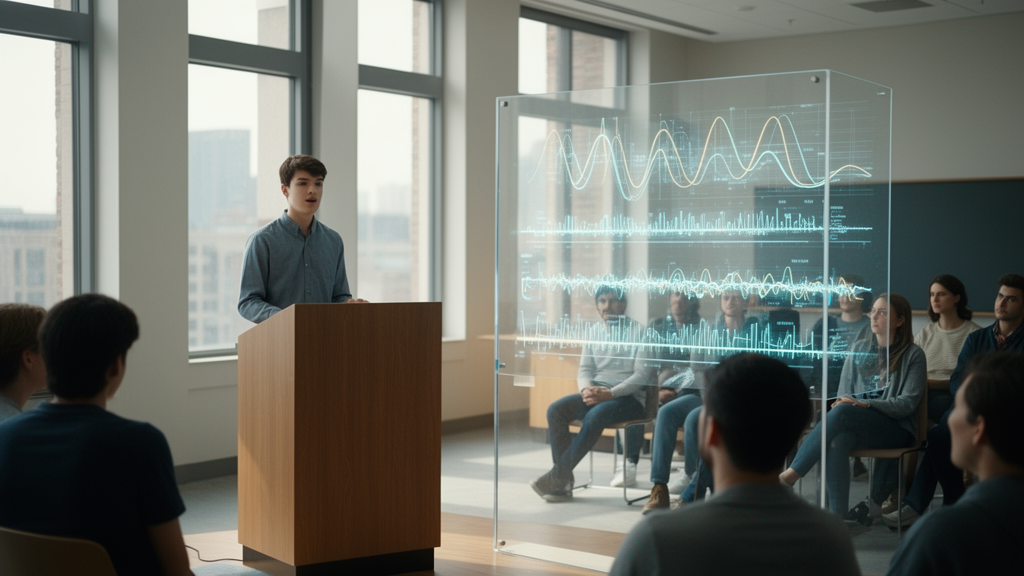
University researchers have introduced an automated evaluation architecture that systematically decouples the semantic text of oral presentations from dynamic delivery behaviors, providing real-time, multi-dimensional scoring across spoken fluency, emotional expressiveness, and physical posture. In traditional higher education speech classrooms, instructional evaluations have historically suffered from inconsistent subjective rubrics, prolonged grading turnaround, and narrow evaluative criteria. While modern deep learning has advanced unimodal automated tasks such as acoustic recognition and sentiment estimation, comprehensive speech assessment requires measuring vocal nuance, physical stance, and pacing simultaneously. A central challenge identified by the investigators is that automated systems frequently conflate the prepared script content with genuine communicative delivery. To solve this limitation, the study establishes the Semantic-Expression Decoupled Multimodal Perception Algorithm and an accompanying full-stack classroom system, demonstrating that isolating delivery signals yields highly objective scoring and substantial learning gains.
To support model training and empirical validation, the investigators constructed the Speech Anxiety Corpus using naturalistic recordings captured across college English speech classrooms. Publicly available benchmark corpora often exhibit severe constraints, including single-modality recordings, restricted scale, and a lack of granular pedagogical labels. The newly compiled classroom dataset encompasses 2,136 sentence-level multimodal fragments recorded across two complete course sections totaling 60 undergraduate students. Spanning approximately 18.4 hours of synchronized video, audio, original speech scripts, and automated speech recognition transcripts, the dataset captures an average of 18.4 minutes of spoken delivery per student. To establish reliable ground truth, four annotators—comprising three linguistics graduate researchers and an expert English instructor—independently labeled all fragments on a continuous zero-to-ten scale. Inter-annotator agreement yielded Fleiss’ Kappa coefficients of 0.842 for oral fluency, 0.796 for emotional expression, and 0.818 for body posture, confirming substantial to high concordance according to standard Landis-Koch thresholds.
To overcome the burdensome labor and high expense of fully annotating dense multimodal classroom data, the researchers introduced a priority annotation algorithm grounded in active learning. Rather than relying on traditional sample uncertainty and gradient features, which often induce excessive computational overhead and model overconfidence, the team designed an iterative binary classification framework based on a linear projection layer. This algorithm maps raw multimodal data to an embedded feature space and models the probability that an unannotated sample provides maximum information gain for subsequent training iterations. In benchmark testing on the SAC validation set, achieving an 85 percent target accuracy under standard random annotation necessitated labeling all 1,495 training samples. In comparison, Bayesian Active Learning by Disagreement required 1,076 samples and K-means clustering required 1,180 samples. The proposed priority algorithm reached the target benchmark using only 822 annotated samples, effectively reducing human labeling workload by 45.02 percent.
Standardized feature extraction was executed across acoustic, visual, and textual modalities to ensure consistent input representation prior to algorithmic fusion. Real-time automatic speech recognition text and prepared student manuscripts were encoded using pre-trained Bidirectional Encoder Representations from Transformers models to capture linguistic semantics. For acoustic processing, raw waveforms were resampled at 16 kilohertz, stripped of silent passages, and processed through a pre-trained wav2vec 2.0 network. By employing multi-layer convolutional neural networks alongside contrastive loss and masked feature modeling, the acoustic pipeline generated 512-dimensional feature sequences capturing prosodic contours, dynamic volume fluctuations, and vocal stability. Concurrently, video frame sequences were normalized and sampled at fixed intervals to extract dynamic facial expressions and upper-body skeletal movements. Temporal sequences across all channels were subsequently compressed into sentence-level vector representations via mean aggregation, preserving global contextual properties while reducing dimensional complexity.
At the center of the perceptual scoring pipeline is the Lightweight Multi-modal Decoupled Fusion Model, which implements a dual-encoder architecture to isolate linguistic meaning from physical delivery. The network establishes two distinct representations: a semantic encoder that anchors speech manuscripts to isolate conceptual content, and an expression encoder that discards semantic text to focus exclusively on acoustic pacing, vocal stress, and physical movements. Optimization is driven by a composite loss function integrating four targeted objectives: a joint regression loss quantifying indicator errors against ground-truth labels, a semantic similarity loss applying central moment difference constraints to align cross-modal semantic benchmarks, an orthogonal difference loss explicitly separating semantic and expressive feature spaces, and a reconstruction loss ensuring informational integrity after feature separation. Hyperparameter sensitivity analyses established that balancing regression weight at 1.0, semantic similarity at 0.3, orthogonal difference at 0.5, and reconstruction at 0.2 produced optimal model convergence and stability.
The evaluation framework scores three distinct non-verbal and delivery dimensions on a standardized continuous scale ranging from zero to ten, which maps directly to categorical performance tiers designated as excellent, good, pass, and fail. Oral fluency evaluates speech rate consistency, pauses, verbal flow interruptions, self-corrections, and unnecessary filler vocalizations. Emotional expressiveness measures tonal inflections, pitch variability, dynamic volume modulation, facial responsiveness, and purposeful eye contact aligned with the speech topic. Body posture scores assess foundational standing balance, appropriate hand gesturing, and the absence of distracting head movements or nervous swaying. These individual component metrics are subsequently aggregated via weighted summation guided by established pedagogical expertise to produce an overall instructional presentation score. By enforcing strict feature orthogonality, the architecture prevents high-vocabulary scripts from artificially masking poor physical presence or dysfluent delivery.
In rigorous comparative testing on the SAC test split, the lightweight decoupled model demonstrated marked superiority over conventional and multimodal baselines, including Support Vector Machines, Low-rank Multimodal Fusion, and Disentangled Multi-modal Fusion Networks. The support vector baseline exhibited severe fitting errors, yielding mean squared errors exceeding 0.60 and Pearson correlation coefficients below 0.72 across all evaluative dimensions. While low-rank fusion improved predictive consistency, it failed to isolate mixed communicative features. The proposed decoupled architecture reduced the mean squared error to 0.265 for oral fluency, 0.283 for emotional expressiveness, and 0.252 for body posture, while keeping mean absolute errors between 0.245 and 0.271. Furthermore, Pearson correlation coefficients exceeded 0.90 across all three instructional dimensions, and multi-class classification accuracies remained stable between 87.5 percent and 89.2 percent, verifying close alignment with expert human evaluations.
To investigate the risk of participant-specific memorization and assess cross-individual generalization, the researchers conducted an isolated speaker-partitioning experiment separating the 60 participants into strictly independent groups of 42 training, 12 validation, and 6 testing students. When transitioning from random sample splitting to speaker-independent testing, the model exhibited only a minor performance decline, with mean classification accuracy dropping by an average of 2.0 percent. Under complete subject isolation, oral fluency accuracy reached 86.4 percent with an error of 0.289, emotional expressiveness achieved 85.1 percent accuracy, and body posture recognition retained an accuracy of 87.3 percent. These findings confirm that the decoupled encoding mechanism does not depend on speaker-specific vocal or facial artifacts, but instead successfully abstracts universal, cross-individual delivery features that generalize reliably across unfamiliar students.
Ablation experiments and end-to-end algorithm comparisons further validated the necessity of each constituent module within the dual-encoder framework. Testing an undecoupled baseline variant using direct multimodal feature concatenation yielded an overall classification accuracy of 78.5 percent, illustrating that entangled semantic and expressive data creates substantial interference noise. Introducing the semantic encoder alone lifted accuracy to 81.4 percent, while deploying the expression encoder in isolation raised accuracy to 83.2 percent and lowered mean absolute error to 0.425. When both encoders functioned synergistically, the complete model attained peak performance. Evaluated in end-to-end task benchmarking alongside contemporary frameworks such as Decoupled Visual-Linguistic Pre-training, Self-Attention Fusion, and Cross-Modal Contrastive Learning, the proposed SED-MPA architecture converged more rapidly, achieving a composite micro-average accuracy of 72.4 percent at iteration 20 and an optimal accuracy of 87.2 percent at iteration 100.
To translate the algorithmic model into regular classroom utility, the authors engineered an enterprise-grade multimodal teaching platform using a separated browser-server architecture. The user interface was developed in Vue to render real-time instructional dashboards and interactive radar charts generated via ECharts. On the back end, a lightweight Flask service orchestrates routine user authentication and administrative data management, while an asynchronous Django service encapsulates deep learning inference pipelines. Distributed computing frameworks including Kubernetes, Ray, and Horovod govern model scheduling, feature extraction, and GPU resource allocation across PyTorch and TensorFlow environments. Stress testing conducted with LoadRunner demonstrated that under standard classroom concurrency of up to 100 simultaneous users, response times remained below 0.84 seconds. Under multi-class concurrent loads of 200 to 300 users, response latency reached 1.98 seconds, while an extreme stress test of 500 simultaneous uploads recorded a peak response of 3.12 seconds with hardware utilization remaining stable.
The practical efficacy of the integrated platform was evaluated through an eight-week classroom deployment involving two intact sections of 30 sophomore non-English majors, balanced for baseline spoken proficiency (pretest averages of 7.08 versus 7.15). Both cohorts were taught by the same instructor following identical syllabi, with one class receiving traditional manual grading and delayed paper feedback while the other used the automated multimodal platform. In terms of pedagogical efficiency, traditional manual evaluation required 4.2 minutes per student, whereas the automated platform completed evaluations in 0.35 seconds. Subjective scoring deviation dropped from 12.80 percent under human assessment to 3.20 percent on the platform. By the conclusion of the term, students utilizing automated visual feedback achieved higher average speech scores (8.36 versus 7.12), a superior competency improvement rate (42.30 percent versus 18.60 percent), 100 percent feedback immediacy compared to 35.00 percent in the control group, and a 95.70 percent overall satisfaction rating.
Despite these demonstrable instructional gains, the authors highlighted clear empirical constraints that delimit current deployment. The underlying Speech Anxiety Corpus was derived from two classes within a single university, producing an inherently homogeneous cohort regarding demographic diversity, physical classroom acoustics, and visual recording angles. Furthermore, evaluations were conducted in relatively controlled instructional environments, leaving the architecture’s operational robustness against intense ambient acoustic noise, varied microphone hardware, overlapping classroom conversations, and erroneous speech-to-text transcriptions partially unverified. Additionally, cultural differences in non-verbal communicative norms, such as culturally variable gesture appropriateness and gaze patterns, were not incorporated into current rubrics. Future investigations will aim to expand data collection across multi-institutional cohorts, institute rigorous cross-cultural calibration mechanisms for body posture and expressive metrics, and enhance algorithmic fault tolerance under adverse acoustic conditions.
Subject of Research: Multimodal artificial intelligence platform for automated evaluation of college English speech instruction using semantic-expressive decoupling
Article Title: A multimodal platform for English speech teaching evaluation based on semantic–expressive decoupling
Article References: Sun, S., & Yan, R. (2026). A multimodal platform for English speech teaching evaluation based on semantic–expressive decoupling. Systems and Soft Computing, 9, Article 200666. https://doi.org/10.1016/j.sasc.2026.200666
Image Credits: AI Generated
DOI: 10.1016/j.sasc.2026.200666
Keywords: multimodal assessment, speech evaluation, SED-MPA, LMDFM, semantic decoupling, Speech Anxiety Corpus, active learning, oral fluency, emotional expressiveness, body posture, acoustic feature extraction, wav2vec2, computer-assisted language learning, classroom technology, higher education, speech recognition, distributed computing
News Source: Denise Maddox. (November 24, 2026). Decoupling Speech Delivery from Text Semantics Enhances Multimodal Classroom Presentation Evaluation. Scienmag.