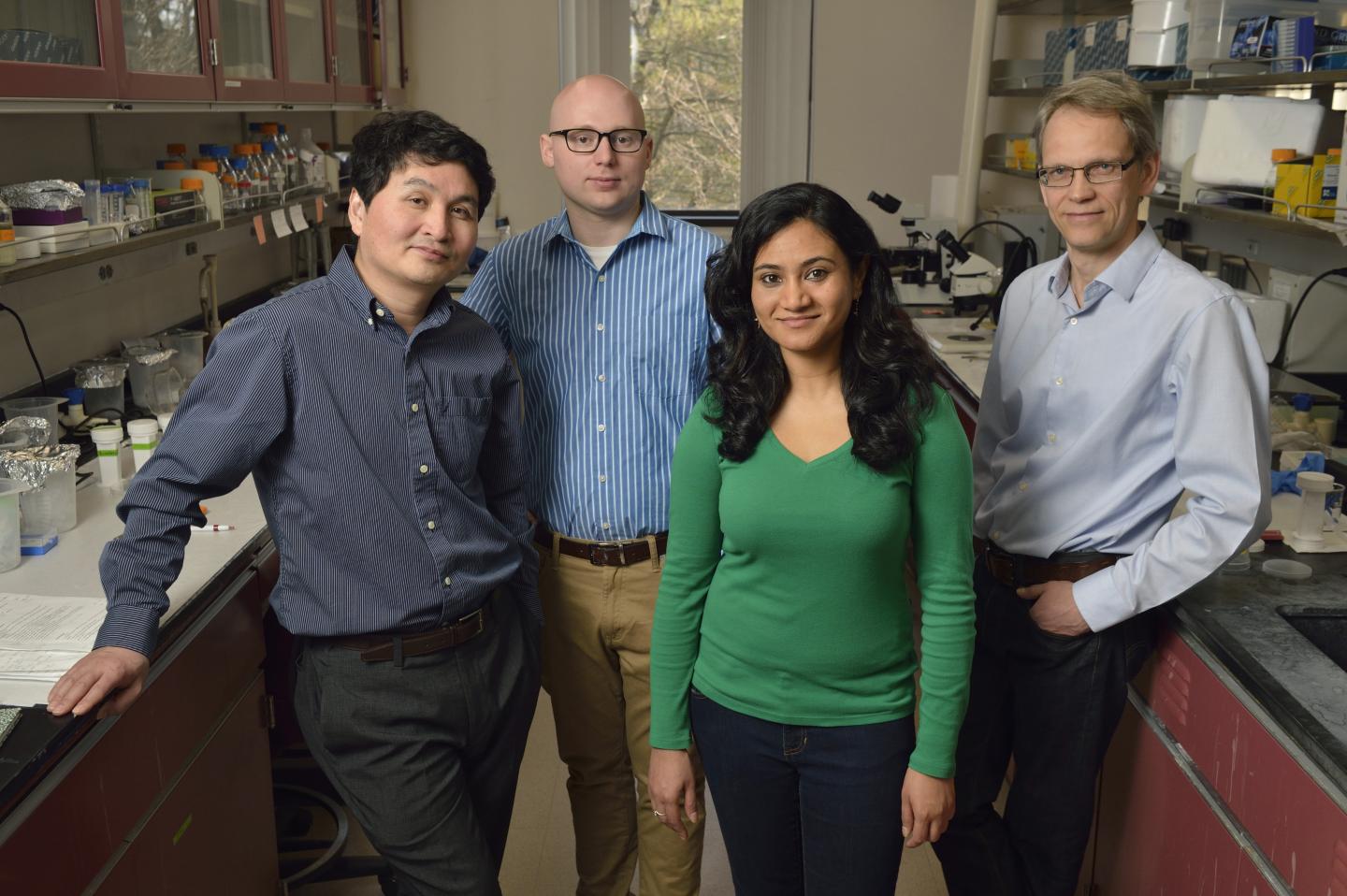
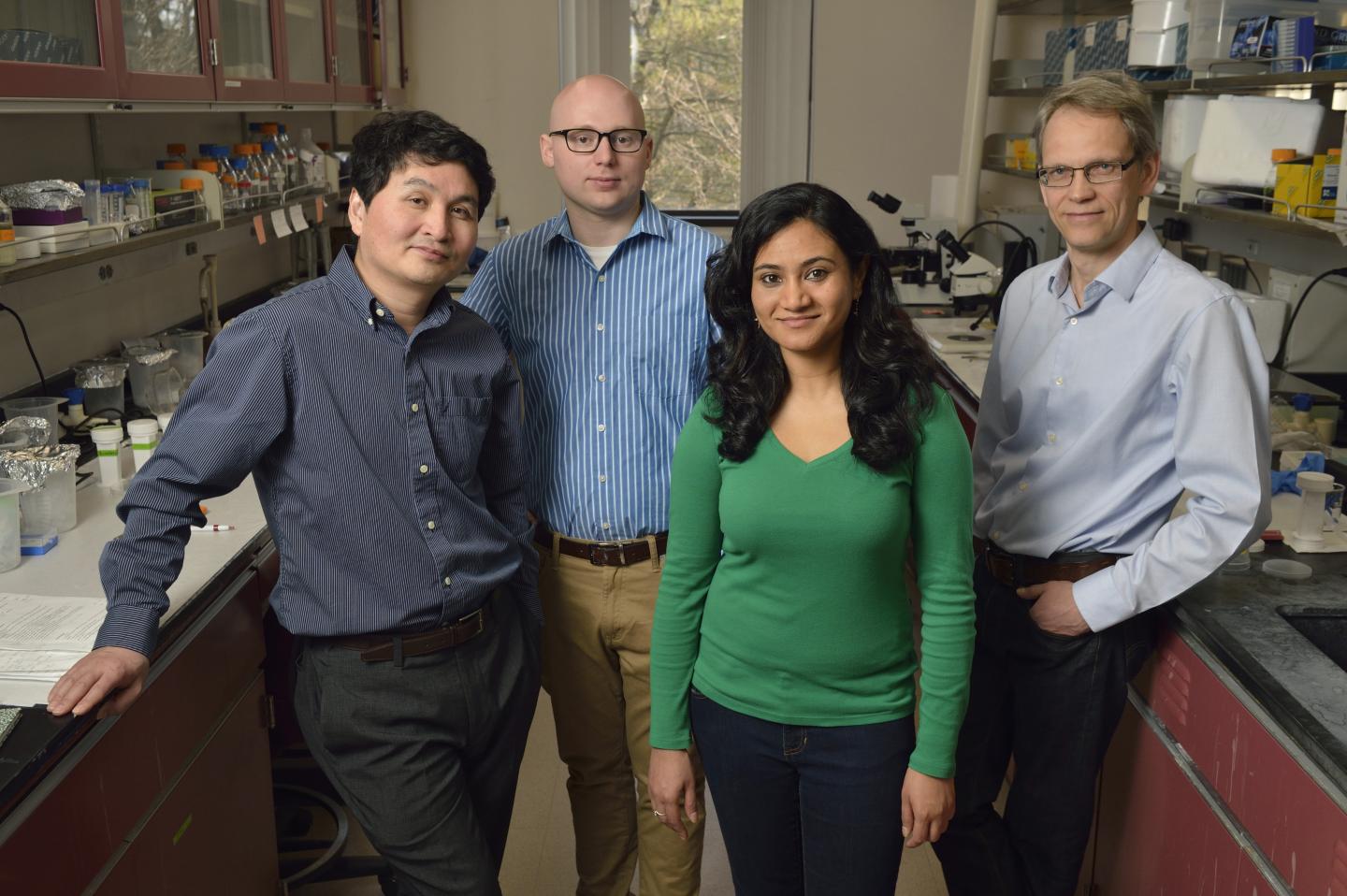
Credit: Jim Stroup, Virginia Tech
A team of researchers with the Fralin Life Science Institute at Virginia Tech, working with a large international consortium, has sequenced the Y chromosome–the genetic driver of sex-determination and male fertility– in a family of malaria spreading mosquitoes.
The findings, published in the Proceedings of the National Academy of Sciences today (Monday, March 28) will inform a variety of genetically based mosquito control strategies that focus on creating more males than females.
Male mosquitoes do not bite and are harmless to humans, while female mosquitoes bite humans to get the blood they need for egg production.
"Thirteen years after the publication of a draft genome of the Anopheles gambiae mosquito, we've finally characterized its Y chromosome," said co-author Zhijian Jake Tu, a professor of biochemistry in the College of Agriculture and Life Sciences and a Fralin Life Science Institute affiliate. "This is one of the last pieces of the puzzle. Having the Y will help us figure out the genetic basis of male biology in future studies."
The new information about the Y chromosome will facilitate efforts to reduce female mosquitoes or create sterile males–strategies of interest to research teams across the world.
"The Y chromosome had previously not been characterized because it mostly consists of repetitive DNA sequences that stump the algorithms used by computers to assemble the mosquito's entire genetic make-up", said co-author Brantley Hall of Christiansburg, Va., a doctoral student in the genetics, bioinformatics and computational biology program.
"We were able to get around this obstacle (at least partially) by using a new long single-molecule sequencing technology, a new bioinformatics algorithm specifically designed to identify Y sequences, and physical mapping of DNA directly to the Y chromosome," said co-author Igor Sharakhov, an associate professor of entomology in the College of Agriculture and Life Sciences and a Fralin Life Science Institute affiliate. "Our study provides a long-awaited foundation for studying mosquito Y chromosome biology and evolution."
"Our combined efforts have resulted in the most extensive characterization of Y chromosome to date in additional malaria vectors as well, which will help identify targeted vector control approaches for different species," said co-author Atashi Sharma, a doctoral student in the department of entomology in the College of Agriculture and Life Sciences.
The research was in collaboration with Nora Besansky, the Rev. John Cardinal O'Hara C.S.C. professor of biological sciences at the University of Notre Dame. Three graduate students at Virginia Tech were involved in the study, with Brantley Hall and Atashi Sharma being co-first authors on the paper. Xiaofang Jiang, a graduate student in the genetics, bioinformatics, and computational biology and biochemistry, Vladimir Timoshevskiy, a research associate, and Maria Sharakhova, an assistant professor of entomology in the College of Agriculture and Life Sciences, from Virginia Tech also participated in the study. Philippos-Aris Papathanos of the University of Perugia and Changde Cheng of the University of Norte Dame are also co-first authors.
Malaria causes as many as 907,000 deaths each year, mostly among children in sub-Saharan Africa. Anopheles mosquitoes, which bite mainly between dusk and dawn, transmit human malaria by spreading Plasmodium parasites that multiply in the human liver and infect red blood cells.
###
Media Contact
Lindsay Key
[email protected]
540-231-6594
@VTresearch
http://www.vtnews.vt.edu