Morocco is racing toward an ambitious renewable energy future, but a stubborn problem has long frustrated its planners: nobody knows, with real precision, how ordinary households actually consume energy. Smart meters, which stream detailed consumption data in Europe and North America, remain scarce across much of Africa. Without that granular picture, energy poverty goes unseen, grid investments get misdirected, and the promise of an equitable transition risks becoming a slogan rather than a plan. A new study published in Neural Computing and Applications by Safaa Safouan and Karim El Moutaouakil of Sidi Mohamed Ben Abdellah University in Taza offers a strikingly original way out of this data darkness, and its results could reshape how data-scarce countries profile their energy consumers.
The researchers built a machine learning framework they call the Enhanced Fractional Probabilistic Self-Organizing Map, or EF-PRSOM. The name sounds forbidding, but the underlying idea is elegant. Self-organizing maps, first invented by Teuvo Kohonen in 1990, are neural networks that learn to arrange high-dimensional data, such as a household’s daily electricity curve, onto a two-dimensional grid, so that similar consumption patterns end up clustered together. A probabilistic variant, developed in the late 1990s, adds statistical rigor by modeling each cluster with radial basis functions, giving a measure of uncertainty rather than a hard, brittle assignment. These tools have long been workhorses for load profiling, but they share a well-known weakness: their optimization is memoryless. At each training step, the algorithm updates its clusters based only on the current state, discarding the rich history of how the solution has evolved. That amnesia makes the methods sensitive to initialization and prone to getting trapped in local minima, the mediocre solutions that plague iterative optimization.
Safouan and El Moutaouakil attacked this memory problem with an unexpected weapon from mathematics: a fractional derivative. Classical calculus deals with derivatives of integer order, first, second, third. Fractional calculus generalizes the concept to non-integer orders, and its operators are inherently non-local, meaning the value of a fractional derivative at a given point depends on the entire history of the function, not just its immediate neighborhood. By embedding the Atangana–Baleanu–Caputo fractional derivative, a formulation introduced in 2016 with a non-singular kernel, into the learning rule of the probabilistic self-organizing map, the researchers gave their algorithm a form of long-term memory. In effect, the network remembers where it has been during optimization and uses that accumulated experience to steer its updates, smoothing out erratic trajectories and escaping the shallow traps that snare conventional methods.
There was one more twist. The fractional order itself, the parameter that controls how much historical information the derivative retains, is not obvious in advance. Setting it by hand would be guesswork. So the team turned to a genetic algorithm, an evolutionary search method inspired by natural selection, to tune the fractional-order parameter automatically. The result is a hybrid system in which fractional calculus supplies memory and evolutionary computation supplies calibration, a combination the authors had previously explored in earlier work on fuzzy clustering and on memory-enhanced probabilistic maps.
To prove the framework was more than mathematical exotica, the researchers first tested it on a well-known benchmark: a French smart-meter dataset of individual household electricity consumption, publicly available through the UCI machine learning repository. This is where smart-meter data is abundant, so the ground truth of household behavior can be examined in fine detail. The EF-PRSOM delivered the best clustering quality of any method compared, achieving a Silhouette score of 0.6709, a measure of how tightly grouped and well separated the clusters are, and a Davies–Bouldin Index of 0.8769, a measure where lower values indicate better separation. Against the plain probabilistic self-organizing map, the enhanced version improved the Silhouette score by 124.8 percent and reduced the Davies–Bouldin Index by 84.2 percent. It also outperformed K-means, the standard self-organizing map, and Gaussian mixture models, the classic statistical clustering approach. Those are not marginal gains; they represent a qualitative leap in how cleanly the algorithm distinguishes different kinds of energy consumers.
With the method validated on rich European data, the team turned to the real target: Morocco. They applied the framework to the Moroccan Household Consumption and Living Conditions Survey, a nationally representative dataset collected by the country’s statistical authority, the Haut-Commissariat au Plan. Unlike smart-meter streams, survey data captures household characteristics, expenditures, and living conditions, precisely the kind of information available in developing economies where metering infrastructure lags. The clustering analysis revealed three distinct household energy consumption profiles: low, medium, and high consumers. Crucially, these profiles were not random. They aligned strongly with income, poverty status, and whether a household lived in an urban or rural area, associations that held with statistical significance at p < 0.001. In other words, the algorithm independently rediscovered the social geography of Moroccan energy use, but in a systematic, quantifiable form that policymakers can act on.
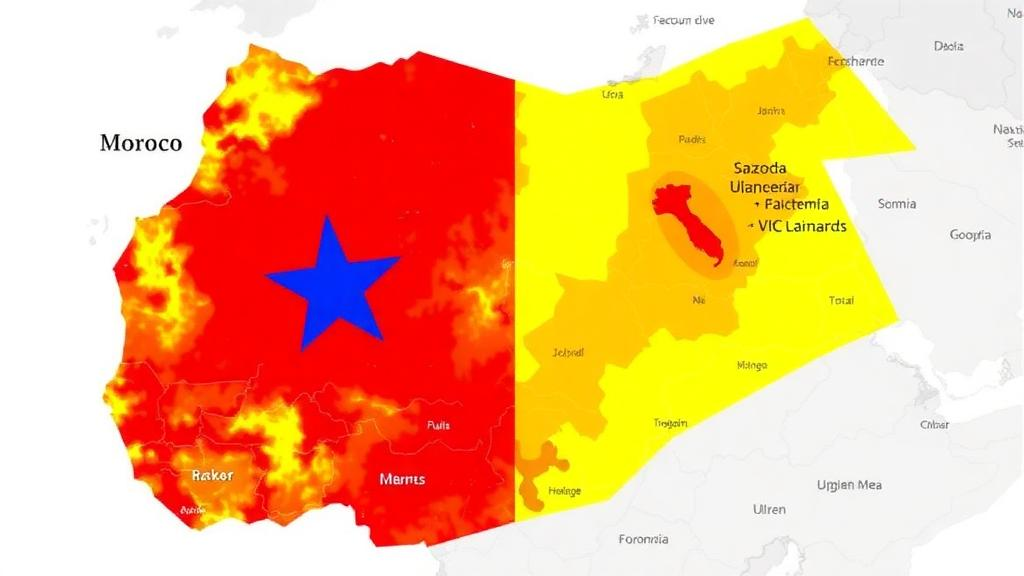
The spatial analysis may prove the most consequential finding of all. When the researchers mapped consumption profiles across Morocco’s regions, they uncovered a structural mismatch: the northern coastal regions, where demand is highest, are not the places endowed with the greatest renewable energy resources. That wealth sits in the southeast, home to the solar potential that has made Morocco a renewable poster child, from the Noor complex onward. High demand in the north, abundant supply potential in the south and east, and a transmission network that must bridge the two: this is exactly the kind of insight that transmission infrastructure planning requires, and exactly the kind that has been missing from household-level analysis in the region. Grid expansion decisions worth billions can now be grounded in a data-driven portrait of who uses energy, where, and how much.
Beyond infrastructure, the findings speak directly to energy poverty. Morocco has made notable progress on electrification, but access to a connection is not the same as access to affordable, adequate energy services. Households in the low-consumption cluster, disproportionately poor and rural, may be underconsuming not by choice but by constraint, a pattern long documented in the energy ladder literature across Africa, where families stack biomass and electricity rather than progressing cleanly from one fuel to the next. By attaching poverty status to consumption profiles with rigorous statistical confidence, the framework gives governments a targeting tool: subsidies, efficiency programs, and clean cooking initiatives can be aimed at the households that need them, identified by their position in the consumption landscape rather than by crude geographic averages.
The broader significance of the study extends well beyond Morocco’s borders. Across Africa and much of the Global South, rapid urbanization and economic development are driving steady growth in energy demand, while reliable household-level consumption data remains scarce. The lesson of EF-PRSOM is that this gap is not a dead end. With a clustering framework that extracts maximal structure from survey data, validated against smart-meter benchmarks where they exist, data-scarce regions can produce energy profiles of genuine analytical quality. The technique also offers something to wealthy countries: the memory-enhanced optimization could improve load profiling, demand response design, and customer segmentation wherever consumption data flows. As Morocco pursues its target of roughly half renewable electricity by 2030, the quiet mathematics of fractional derivatives and self-organizing maps may turn out to be among the most practical tools in its transition toolkit, proving that the path to an equitable energy future sometimes begins with teaching an algorithm to remember.
Subject of Research: Machine learning clustering of household energy consumption patterns in Morocco
Article Title: Household energy consumption patterns in Morocco’s energy transition: a clustering framework using enhanced fractional probabilistic self-organizing maps
Article References: Safouan, S., & El Moutaouakil, K. (2026). Household energy consumption patterns in Morocco’s energy transition: a clustering framework using enhanced fractional probabilistic self-organizing maps. Neural Computing and Applications, 38(19), Article 790. https://doi.org/10.1007/s00521-026-12528-8
Image Credits: AI Generated
DOI: 10.1007/s00521-026-12528-8
Keywords: Morocco, household energy consumption, self-organizing maps, fractional calculus, clustering, energy poverty, smart meter data, renewable energy planning, genetic algorithm, energy transition, machine learning, survey data
News Source: Denise Maddox. (October 10, 2026). Fractional AI Maps Morocco’s Household Energy Divide for a Fairer Transition. Scienmag.