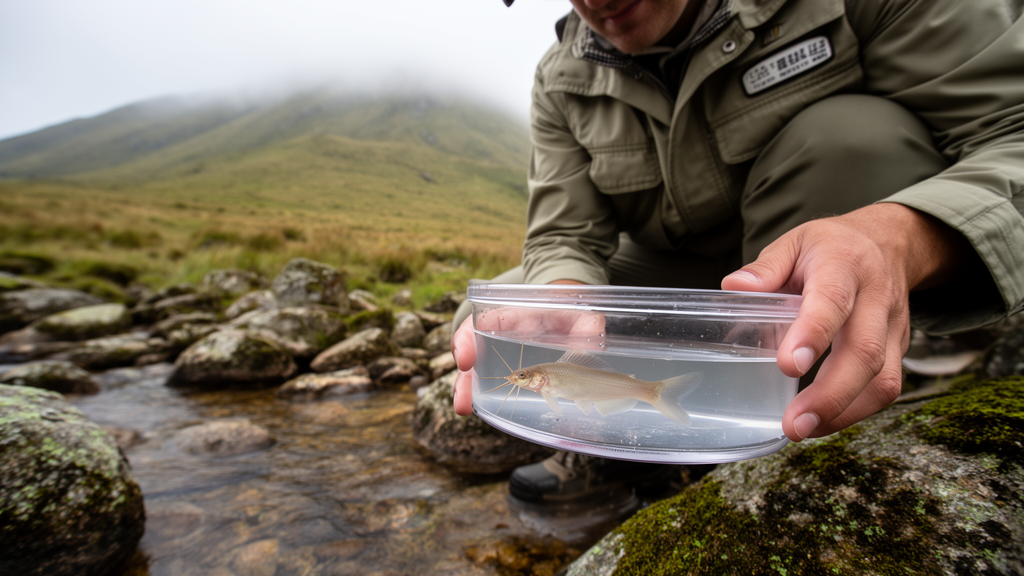
High on the Serra do Espigão, a long east-west plateau in southern Brazil where altitudes hover between 900 and 1,200 meters above sea level, scientists have discovered four previously unknown species of small catfish, each apparently confined to a tiny patch of mountain streams. The finds, published in the journal Evolutionary Systematics, add to a growing body of evidence that the mountain ranges of subtropical South America are hotspots of narrowly distributed biodiversity that remain poorly surveyed.
The new species belong to the genus Cambeva, a group of trichomycterid catfishes commonly known as pencil catfishes or cambevas. These are small, slender fishes with subcylindrical bodies, dorsally positioned eyes, and barbels around the mouth that they use to probe stream bottoms for food. Trichomycterines are the most diverse catfish lineage in South American river mountains, and species have been recorded from high Andean localities since the eighteenth century. Yet field inventories in the top mountains of southern Brazil, where peaks barely exceed 1,800 meters, have been rare, leaving many sites unsampled.
The discovery came from a detailed field campaign in March and April 2023 across roughly 9,000 square kilometers of the Rio Iguaçu drainage at the Serra do Espigão, an area the researchers abbreviate RISE. The Rio Iguaçu, a major tributary of the Rio Paraná basin, drains about 72,600 square kilometers of a landscape of mountain ranges and plateaus, including the Serra da Esperança, Serra do Espigão, and Serra do Mar. Most of the Cambeva species collected during the survey occurred below about 840 meters and were conspecific with, or morphologically similar to, species widely distributed elsewhere in the drainage, such as C. naipi, C. papillifera, and C. stawiarski, or in adjacent coastal basins, such as C. barbosae.
But at isolated points between roughly 970 and 1,020 meters above sea level, four unmistakably distinct fishes turned up. One species, Cambeva galactica, lives in the eastern portion of RISE, in a stream tributary of the Rio Preto in Santa Catarina State. The other three, C. atrobrunnea, C. luteoreticulata, and C. rotundipinna, inhabit neighbouring drainages in the western portion of the plateau. Despite sampling at many points across different altitudes of their sub-drainages, the researchers found each species only within a small area, and individuals were rare in their habitats, forcing a second collecting trip in June and July 2023 to gather enough material for formal descriptions.
To place the new species within the evolutionary tree of the genus, the team sequenced three genes: the mitochondrial cytochrome b and cytochrome c oxidase I genes and the nuclear recombination activating 2 gene, yielding a concatenated matrix of 2,469 base pairs. Bayesian inference in BEAST and maximum likelihood analyses in IQTREE2 produced similar topologies. All four RISE species were confirmed as members of the Cambeva beta-clade, the lineage comprising all catfishes endemic to the Rio Iguaçu drainage, and more specifically as members of a well-supported subgroup the authors call the Cambeva beta1-clade.
The phylogenetic results carry a surprise: the four high-altitude species do not form a monophyletic group, meaning they do not share a single common origin within the sampled tree. Cambeva galactica, the only eastern RISE species, occupies a basal position in the beta1-clade, sister to all other species in that group. The three western RISE species appear in different sections of the tree with weak support, positioned as basal taxa relative to an apical clade that includes C. barbosae, C. diabola, C. castroi, and C. davisi, species found at low and middle altitudes between about 15 and 850 meters. This pattern suggests the high-altitude species may be older lineages, with highland endemism arising independently rather than through one colonization event.
Each species was diagnosed using unique morphological character states, unique combinations of traits, and molecular diagnoses based on nucleotide substitutions in the COX1 and CYTB genes. Cambeva galactica, named for the Ancient Greek word for milky in reference to its rows of yellowish white vermiculate marks reminiscent of the Milky Way, bears six pectoral-fin rays, a trait otherwise absent in the beta1-clade but present in more basal beta-clade species, possibly a retained ancestral feature. Its sesamoid supraorbital bone carries a distinctive anterior projection connected by ligamentous tissue to the autopalatine, a unique osteological configuration.
The western species show equally striking specializations. Cambeva atrobrunnea, from the Latin for dull black and brown, is the only known congener with the two posterior-most procurrent caudal-fin rays segmented. Cambeva luteoreticulata, named for its saffron-yellow reticulated adult pattern, develops a unique rounded, spatula-shaped caudal fin above about 40 millimeters standard length and undergoes a dramatic ontogenetic colour change from pale yellow juveniles with dark blotches to dark brown adults with yellow reticulations. Cambeva rotundipinna, named for its rounded fins, has a broader autopalatine than its western relatives and a shorter parurohyal posterior process. Notably, the three western species, superficially similar in external appearance, revealed highly divergent bone morphology under osteological examination, corroborating that they are not close relatives.
The findings reinforce the role of mountainous regions in concentrating small-ranged species and delineating biodiversity hotspots. Thirteen nominal Cambeva species had previously been recorded for the Rio Iguaçu drainage, but all records were concentrated in its northern part, with no data from the southern rivers draining the Serra do Espigão. The new species, each known from one or two localities at around 970 to 1,015 meters, suggest that many more narrowly endemic fishes await discovery in the unsampled highlands of the Serra Geral chain that stretches across southern Brazil. The researchers caution that more robust phylogenies, including undescribed species from neighbouring regions and species not yet available for molecular analysis, are needed to reconstruct the full evolutionary history of the Cambeva beta-clade in southern Brazilian mountains.
Subject of Research: Taxonomy and molecular phylogenetics of four new small-ranged catfish species from the Serra do Espigão in the Rio Iguaçu drainage, southern Brazil
Article Title: Top mountain areas of subtropical southern Brazil sheltering four new small-ranged catfishes ( Siluriformes , Trichomycteridae ): relationships and taxonomy
Article References: Costa, W. J. E. M., Feltrin, C. R. M., Mattos, J. L. O., & Katz, A. M. (2024). Top mountain areas of subtropical southern Brazil sheltering four new small-ranged catfishes (Siluriformes, Trichomycteridae): relationships and taxonomy. Evolutionary Systematics, 8(2), 199-218. https://doi.org/10.3897/evolsyst.8.126393
Image Credits: AI Generated
DOI: 10.3897/evolsyst.8.126393
Keywords: catfish, new species, Brazil, biodiversity, phylogenetics, taxonomy, freshwater fish, Serra do Espigão, mountain, areas, subtropical, southern
News Source: Margaret Porter. (October 19, 2026). Four new miniature catfish species discovered hiding atop Brazil’s subtropical mountains. Scienmag.