• HOME
  • NEWS
  • EXPLORE
    • CAREER
      • Companies
      • Jobs
    • EVENTS
    • iGEM
      • News
      • Team
    • PHOTOS
    • VIDEO
    • WIKI
  • BLOG
  • COMMUNITY
    • FACEBOOK
    • INSTAGRAM
    • TWITTER
Saturday, February 7, 2026
BIOENGINEER.ORG
No Result
View All Result
  • Login
  • HOME
  • NEWS
  • EXPLORE
    • CAREER
      • Companies
      • Jobs
        • Lecturer
        • PhD Studentship
        • Postdoc
        • Research Assistant
    • EVENTS
    • iGEM
      • News
      • Team
    • PHOTOS
    • VIDEO
    • WIKI
  • BLOG
  • COMMUNITY
    • FACEBOOK
    • INSTAGRAM
    • TWITTER
  • HOME
  • NEWS
  • EXPLORE
    • CAREER
      • Companies
      • Jobs
        • Lecturer
        • PhD Studentship
        • Postdoc
        • Research Assistant
    • EVENTS
    • iGEM
      • News
      • Team
    • PHOTOS
    • VIDEO
    • WIKI
  • BLOG
  • COMMUNITY
    • FACEBOOK
    • INSTAGRAM
    • TWITTER
No Result
View All Result
Bioengineer.org
No Result
View All Result
Home NEWS Science News Chemistry

Forward or backward? New pathways for protons in water or methanol

Bioengineer by Bioengineer
October 8, 2019
in Chemistry
Reading Time: 2 mins read
0
IMAGE
Share on FacebookShare on TwitterShare on LinkedinShare on RedditShare on Telegram

IMAGE

Credit: MBI


A collaborative ultrafast spectroscopy and ab initio molecular dynamics simulations study shows that proton vacancies in the form of hydroxide/methoxide ions are as relevant for proton transfer between acids and bases as hydrated excess protons (H3O+, H5O2+), thus pointing for a clear demand for refinement of the microscopic picture for aqueous proton transport – in solution as well as in hydrogen fuel cells or transmembrane proteins – away from currently often assumed dominant role of hydrated excess protons. The study is recently published by scientists of the Max Born Institute of Nonlinear Optics and Short Pulse Spectroscopy (MBI) and the Martin-Luther-University Halle-Wittenberg (MLU) in the renowned Journal of the American Chemical Society.

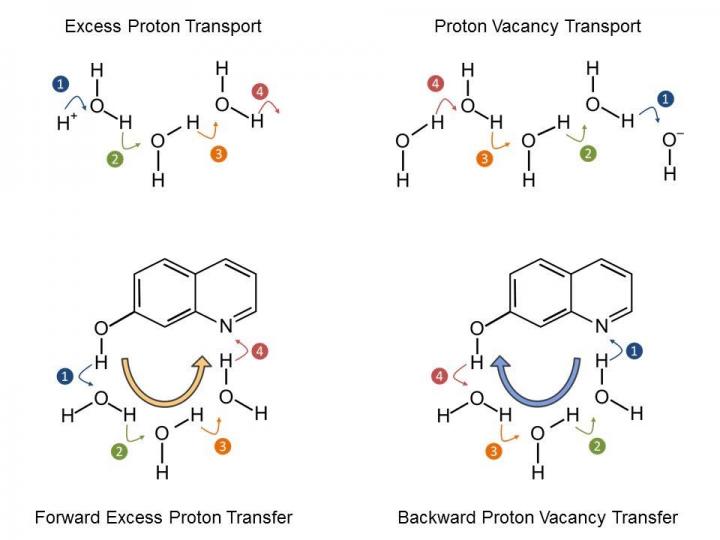
The exchange of protons between two chemical groups (acid-base neutralization) is a textbook chemistry problem for many years. Surprisingly, up to this date new fundamental insight about the elementary steps of proton transport is being obtained. This may well lie in the fact that the elementary steps (by protons or proton vacancies) take place on extremely short time scales, that are not accessible with conventional laboratory techniques (Figure 1). Observation of these elementary reaction steps, as achieved by the research teams of MBI and MLU thus requires direct access to time scales of 1-100 picoseconds (0.000000000001 until 0.0000000001 seconds), necessitating an experimental set-up with an accordingly high time resolution as well as high performance computer systems.

The research teams have jointly studied a particular model system (7-hydroxyquinoline in water/methanol mixtures), where an ultrashort laser pulse triggers the deprotonation of an OH-group and the protonation of a nitrogen atom. The precise chronology of the elementary steps with these class of chemical reactions have remained elusive, leading to numerous speculations. The scientists of the MBI and MLU have now been able to determine that the release of a proton from the OH-group to the solvent is indeed ultrafast, yet the pick-up of a proton by the nitrogen atom is even faster. This results in a transport mechanism of proton vacancies, i.e. of hydroxide/methoxide ions. The elementary reaction steps have been elucidated with time-resolved IR spectra and detailed quantum chemical calculations (see Figure 2).

###

Media Contact
Erik T. J. Nibbering
[email protected]

Original Source

https://www.fv-berlin.de/en/info-for/the-media-and-public/news/news/neue-wege-fuer-den-protonentransport/

Related Journal Article

http://dx.doi.org/10.1021/jacs.9b03471

Tags: Atomic/Molecular/Particle PhysicsChemistry/Physics/Materials SciencesMolecular PhysicsOptics
Share13Tweet8Share2ShareShareShare2

Related Posts

blank

Breakthrough in Environmental Cleanup: Scientists Develop Solar-Activated Biochar for Faster Remediation

February 7, 2026
blank

Cutting Costs: Making Hydrogen Fuel Cells More Affordable

February 6, 2026

Scientists Develop Hand-Held “Levitating” Time Crystals

February 6, 2026

Observing a Key Green-Energy Catalyst Dissolve Atom by Atom

February 6, 2026
Please login to join discussion

POPULAR NEWS

  • Robotic Ureteral Reconstruction: A Novel Approach

    Robotic Ureteral Reconstruction: A Novel Approach

    82 shares
    Share 33 Tweet 21
  • Digital Privacy: Health Data Control in Incarceration

    63 shares
    Share 25 Tweet 16
  • Study Reveals Lipid Accumulation in ME/CFS Cells

    57 shares
    Share 23 Tweet 14
  • Breakthrough in RNA Research Accelerates Medical Innovations Timeline

    53 shares
    Share 21 Tweet 13

About

We bring you the latest biotechnology news from best research centers and universities around the world. Check our website.

Follow us

Recent News

Digital Health Perspectives from Baltic Sea Experts

Florida Cane Toad: Complex Spread and Selective Evolution

Exploring Decision-Making in Dementia Caregivers’ Mobility

Subscribe to Blog via Email

Enter your email address to subscribe to this blog and receive notifications of new posts by email.

Join 73 other subscribers
  • Contact Us

Bioengineer.org © Copyright 2023 All Rights Reserved.

Welcome Back!

Login to your account below

Forgotten Password?

Retrieve your password

Please enter your username or email address to reset your password.

Log In
No Result
View All Result
  • Homepages
    • Home Page 1
    • Home Page 2
  • News
  • National
  • Business
  • Health
  • Lifestyle
  • Science

Bioengineer.org © Copyright 2023 All Rights Reserved.