

• HOME
  • NEWS
  • EXPLORE
    • CAREER
      • Companies
      • Jobs
    • EVENTS
    • iGEM
      • News
      • Team
    • PHOTOS
    • VIDEO
    • WIKI
  • BLOG
  • COMMUNITY
    • FACEBOOK
    • INSTAGRAM
    • TWITTER
Tuesday, May 5, 2026
BIOENGINEER.ORG
No Result
View All Result
  • Login
  • HOME
  • NEWS
  • EXPLORE
    • CAREER
      • Companies
      • Jobs
        • Lecturer
        • PhD Studentship
        • Postdoc
        • Research Assistant
    • EVENTS
    • iGEM
      • News
      • Team
    • PHOTOS
    • VIDEO
    • WIKI
  • BLOG
  • COMMUNITY
    • FACEBOOK
    • INSTAGRAM
    • TWITTER
  • HOME
  • NEWS
  • EXPLORE
    • CAREER
      • Companies
      • Jobs
        • Lecturer
        • PhD Studentship
        • Postdoc
        • Research Assistant
    • EVENTS
    • iGEM
      • News
      • Team
    • PHOTOS
    • VIDEO
    • WIKI
  • BLOG
  • COMMUNITY
    • FACEBOOK
    • INSTAGRAM
    • TWITTER
No Result
View All Result
Bioengineer.org
No Result
View All Result
Home NEWS Science News Biology

Forest carbon stocks have been overestimated for 50 years

Bioengineer by Bioengineer
October 16, 2018
in Biology
Reading Time: 2 mins read
0
Share on FacebookShare on TwitterShare on LinkedinShare on RedditShare on Telegram
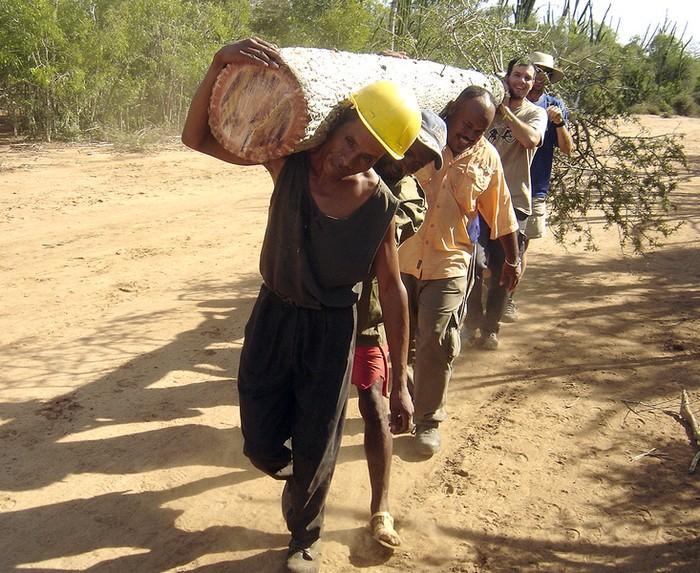
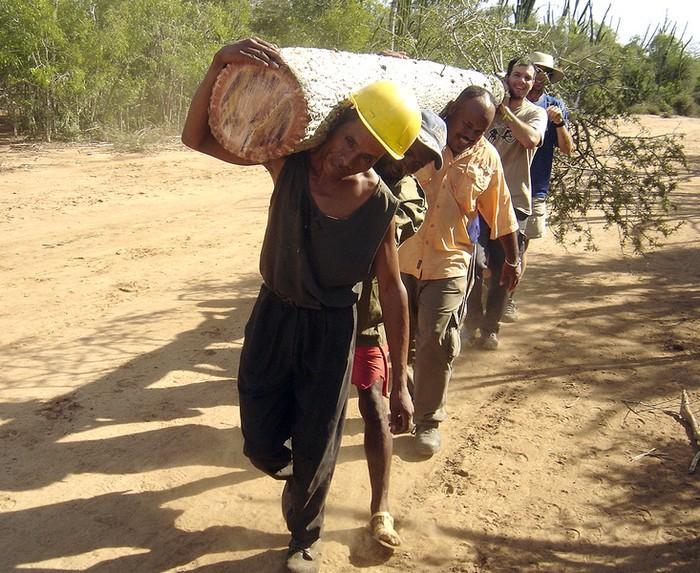
IMAGE

Credit: © CIRAD, G. Vieilledent

It may be a small correction, but it is far from negligible as far as forest ecologists and carbon cycle specialists are concerned. The error lay in a formula established almost 50 years ago (in 1971) for calculating basic wood density. Given that basic density is used to assess the amount of carbon stored in a tree, the fact that the formula had to be corrected meant that forest carbon stocks may have been overestimated by 4 to 5%. "This new formula should enable us to determine more accurately the role of forests in the carbon cycle and the impact of deforestation on climate change" , says Ghislain Vieilledent, an ecologist with CIRAD who was the corresponding author of the work published in the journal American Journal of Botany on 16 October.

For more than 70 years, CIRAD has had a database on 1300 wood species and almost 4500 trees. It was when they came to promote this resource that Ghislain Vieilledent and his colleagues at CIRAD and at Paul Sabatier University in Toulouse discovered an incoherence in a conversion factor: the one used to compute the basic density of a tree based on wood density at 12% moisture, which corresponds to the average wood moisture content in temperate regions. Since this technical characteristic is widely available in wood technology databases, ecologists only have to apply a conversion factor to it in order to establish the basic density of a tree species. However, it was precisely that conversion factor that did not tally with the researchers' new calculations. "To start with, I thought we had made a mistake in our calculations or that there was some uncertainty surrounding measurement of the relevant data. It was not easy to cast doubt on a formula that had been widely accepted for years and quoted in several scientific articles."

The researchers took a new look at the data in CIRAD's historic database in order to determine a new formula for establishing basic density based on density at 12%. The new conversion factor will be used to calculate the basic density of woods in forest ecology databases. In particular, it will serve to update the global wood density database on which Jérôme Chave and Fabian Fischer are working at CNRS-Paul Sabatier University in Toulouse, who were co-authors of the publication. The correction will make it possible to estimate carbon forest stocks more accurately and understand more clearly the role played by forests in climate regulation.

###

A database of 70-years' standing

Physical, mechanical, chemical, durability and processing properties, amongst other data… CIRAD measures the technological characteristics of tropical woods and inputs them into a database launched in the 1940s. This information on the intrinsic properties of tropical woods comes from several thousand tests and series of trials, and now includes data on more than 1250 tropical tree species. This priceless tool is currently updated and supplemented by Jean Gérard, a co-author of the publication, and his colleagues at CIRAD's BioWooEB research unit.

Media Contact

Ghislain Vieilledent
[email protected]
33-788-468-285

http://www.cirad.fr/

Original Source

https://www.cirad.fr/en/news/all-news-items/articles/2018/science/forest-carbon-stocks-overestimated http://dx.doi.org/10.1002/ajb2.1175


Share12Tweet7Share2ShareShareShare1

Related Posts

GWAS Uncovers SUBER GENE1 Role in Suberization — Biology

GWAS Uncovers SUBER GENE1 Role in Suberization

May 5, 2026
New Study from The Morton Arboretum Reveals Why Mexico and Central America’s Mountain Forests Are Oak Tree Hotspots — Biology

New Study from The Morton Arboretum Reveals Why Mexico and Central America’s Mountain Forests Are Oak Tree Hotspots

May 5, 2026

Gerald Joyce Elected to Prestigious American Philosophical Society

May 5, 2026

Author Correction: Lipopeptide Immunity Linked to Membrane Remodelling

May 4, 2026
Please login to join discussion

POPULAR NEWS

  • Research Indicates Potential Connection Between Prenatal Medication Exposure and Elevated Autism Risk

    834 shares
    Share 334 Tweet 209
  • New Study Reveals Plants Can Detect the Sound of Rain

    719 shares
    Share 287 Tweet 180
  • Scientists Investigate Possible Connection Between COVID-19 and Increased Lung Cancer Risk

    67 shares
    Share 27 Tweet 17
  • Salmonella Haem Blocks Macrophages, Boosts Infection

    61 shares
    Share 24 Tweet 15

About

We bring you the latest biotechnology news from best research centers and universities around the world. Check our website.

Follow us

Recent News

Brain Health Alert: Microplastic Accumulation in the Human Brain Linked to Stroke and Dementia; Apheresis Emerges as a Promising Removal Method

New Alcohol Warning Labels Could Encourage Reduced Consumption: Study Finds

Here’s a rewritten version of the headline for a science magazine post: “A Simple Model Explaining How AI Learns” Or, if you want it a bit more engaging: “Understanding AI Learning Through a Toy Model” Let me know if you want it shorter, more technical, or more casual!

Subscribe to Blog via Email

Enter your email address to subscribe to this blog and receive notifications of new posts by email.

Join 82 other subscribers
  • Contact Us

Bioengineer.org © Copyright 2023 All Rights Reserved.

Welcome Back!

Login to your account below

Forgotten Password?

Retrieve your password

Please enter your username or email address to reset your password.

Log In
No Result
View All Result
  • Homepages
    • Home Page 1
    • Home Page 2
  • News
  • National
  • Business
  • Health
  • Lifestyle
  • Science

Bioengineer.org © Copyright 2023 All Rights Reserved.
