

• HOME
  • NEWS
  • EXPLORE
    • CAREER
      • Companies
      • Jobs
    • EVENTS
    • iGEM
      • News
      • Team
    • PHOTOS
    • VIDEO
    • WIKI
  • BLOG
  • COMMUNITY
    • FACEBOOK
    • INSTAGRAM
    • TWITTER
Tuesday, July 7, 2026
BIOENGINEER.ORG
No Result
View All Result
  • Login
  • HOME
  • NEWS
  • EXPLORE
    • CAREER
      • Companies
      • Jobs
        • Lecturer
        • PhD Studentship
        • Postdoc
        • Research Assistant
    • EVENTS
    • iGEM
      • News
      • Team
    • PHOTOS
    • VIDEO
    • WIKI
  • BLOG
  • COMMUNITY
    • FACEBOOK
    • INSTAGRAM
    • TWITTER
  • HOME
  • NEWS
  • EXPLORE
    • CAREER
      • Companies
      • Jobs
        • Lecturer
        • PhD Studentship
        • Postdoc
        • Research Assistant
    • EVENTS
    • iGEM
      • News
      • Team
    • PHOTOS
    • VIDEO
    • WIKI
  • BLOG
  • COMMUNITY
    • FACEBOOK
    • INSTAGRAM
    • TWITTER
No Result
View All Result
Bioengineer.org
No Result
View All Result
Home NEWS Science News Chemistry

For autonomous cars, a new laser beam steering device

Bioengineer by Bioengineer
November 10, 2022
in Chemistry
Reading Time: 2 mins read
0
Weidong Zhou
Share on FacebookShare on TwitterShare on LinkedinShare on RedditShare on Telegram

A University of Texas at Arlington electrical engineering professor is leading a project that will explore an optical laser beam steering device for 3D sensing in autonomous driving cars.
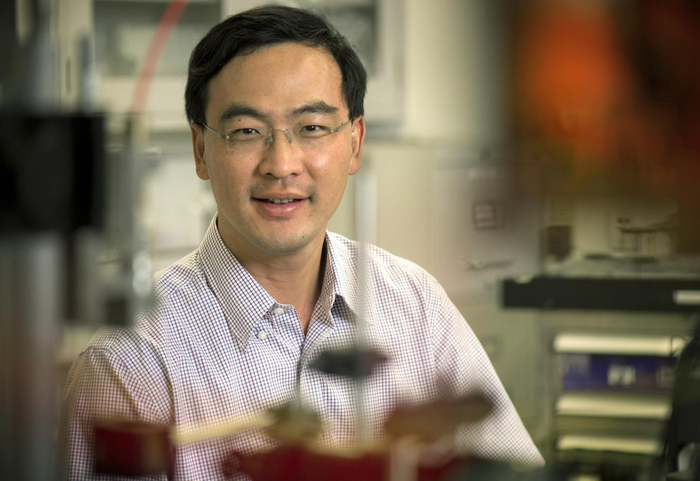
Weidong Zhou

Credit: UT Arlington

A University of Texas at Arlington electrical engineering professor is leading a project that will explore an optical laser beam steering device for 3D sensing in autonomous driving cars.

To make the device, Weidong Zhou, UTA professor in the Department of Electrical Engineering, will use a four-year, $400,000 National Science Foundation grant titled “Fast 2D Beam Steering Device Integrated Directly on High Power VCSEL Arrays.”

“We’re investigating an optical beam steering device based on the electrical tuning of photonic crystal cavities, a type of nanophotonic structure, that can be designed to manipulate light beams,” Zhou said. “Right now most existing methods use mechanical movements to steer the light beam direction. That’s slow and bulky. What we’re doing is much faster, very compact and more reliable.”

High-speed beam steering is important in many emerging applications, including autonomous driving, augmented reality, free space communications, 3D sensing and imaging systems. Zhou said the vertical-cavity, surface-emitting laser (VCSEL) used in the project is also found in computer mice, fiber optic communications, face identification, smart phones, laser printers and smart glasses.

“VCSEL arrays can provide a disruptive technology for high-performance laser detection and ranging systems,” he said. “In addition, the project offers a platform for student education and training and helps workforce preparation in photonics and optics, semiconductors, sensing and imaging, nanotechnology and manufacturing.”

Diana Huffaker, chair of the Department of Electrical Engineering, said the application for Zhou’s project could reach the entire semiconductor sector.

“A new-age optical beam steering device would speed up so many aspects of the semiconductor world,” Huffaker said. “It could revolutionize that world in making current operations so immediate and so effortless.”




Share12Tweet8Share2ShareShareShare2

Related Posts

Salt adaptation linked to higher disease risk, Mizzou study finds

Salt adaptation linked to higher disease risk, Mizzou study finds

July 6, 2026
Intelligent Microgrid Management Promises Lower Household Energy Bills and Reduced Diesel Emissions — Chemistry

Intelligent Microgrid Management Promises Lower Household Energy Bills and Reduced Diesel Emissions

July 4, 2026

Graz University of Technology Deciphers the Structural Secrets of MOF Thin Films

July 2, 2026

Breaking Thermodynamic Limits: Wavelength-Driven Catalysis Advances Ammonia Synthesis

July 2, 2026

POPULAR NEWS

  • Detection of EDCs in Breast Milk and Infant Urine Up to Six Months Highlights Early Exposure Risks

    77 shares
    Share 31 Tweet 19
  • New Drug Candidate Developed at McMaster Shows Potential for Treating Brain Cancer

    58 shares
    Share 23 Tweet 15
  • Saying Goodbye to PGY-6: Pediatric Fellowship Realities

    103 shares
    Share 41 Tweet 26
  • KTU Researchers Explore Ultrasound’s Role in Enhancing Blood Flow Beyond Diagnostics

    53 shares
    Share 21 Tweet 13

About

We bring you the latest biotechnology news from best research centers and universities around the world. Check our website.

Follow us

Recent News

Flame retardant BDE-209 targets molecularly linked to ulcerative colitis

Ultra-high frequency particle impacts mimic rockbursts to shatter hard rock

Kidney transplant outcomes in older adults studied by German researchers

Subscribe to Blog via Email

Enter your email address to subscribe to this blog and receive notifications of new posts by email.

Join 83 other subscribers
  • Contact Us

Bioengineer.org © Copyright 2023 All Rights Reserved.

Welcome Back!

Login to your account below

Forgotten Password?

Retrieve your password

Please enter your username or email address to reset your password.

Log In
No Result
View All Result
  • Homepages
    • Home Page 1
    • Home Page 2
  • News
  • National
  • Business
  • Health
  • Lifestyle
  • Science

Bioengineer.org © Copyright 2023 All Rights Reserved.