


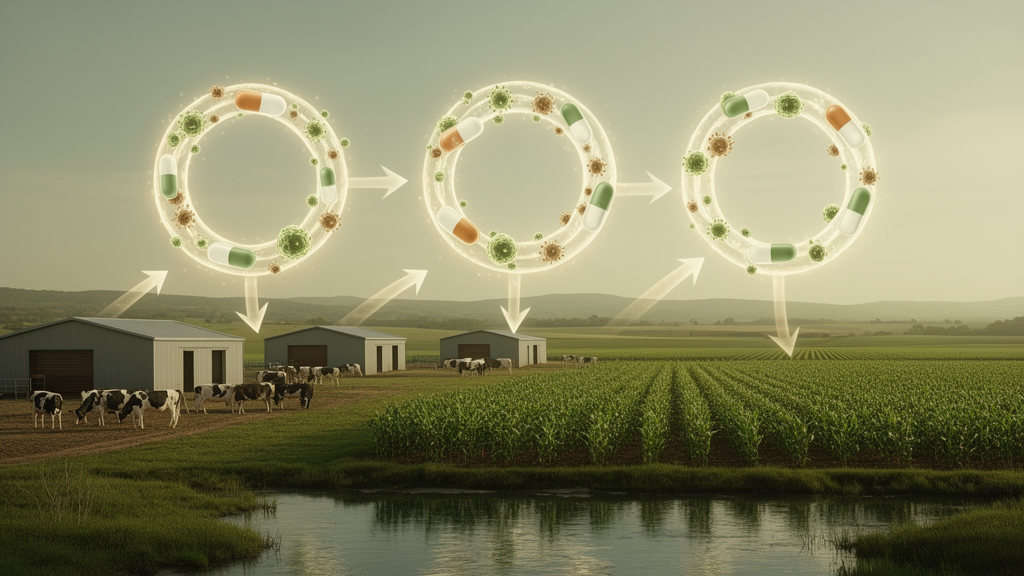
Antimicrobial resistance in food systems may persist because of three recurring structural dynamics — the overuse of a shared and finite resource, dependence on a quick fix that crowds out lasting solutions, and the runaway dominance of antimicrobial-intensive production — according to a participatory systems analysis conducted in Canada, Senegal and the Netherlands. The study, published in BMC Global and Public Health, combined group model building workshops with a One Health perspective to map how resistance emerges in food production and to identify which stakeholder-proposed actions might actually disrupt those dynamics rather than merely treat their symptoms.
The research team, led by Chloe Clifford Astbury and Tarra L. Penney of York University with collaborators in Senegal, the Netherlands and elsewhere, ran one workshop in each of the three countries with stakeholders drawn from policy, research, civil society and industry. In total, 39 people took part: 10 in Canada, 22 in Senegal and 7 in the Netherlands. Participants were purposively recruited to cover human, animal and ecosystem health sectors, in line with the One Health framing, and all worked or lived in the country whose workshop they attended. The workshops produced qualitative causal loop diagrams, which the researchers refined with participants and then analysed using systems archetypes, a conceptual tool for diagnosing recurring behaviours in complex adaptive systems.
The three countries were deliberately chosen for their contrasting contexts. Canada and the Netherlands are high-income economies whose food systems are classified as ‘Industrialized and Consolidated’, marked by technology-intensive agriculture and supermarket-centred retail, though the Netherlands operates within European Union regulation. Senegal is a lower-middle-income economy with an ‘Informal and Expanding’ food system, greater reliance on markets and stalls, and agricultural productivity that depends more on workforce than on inputs. Each country has a national action plan on antimicrobial resistance grounded in a One Health approach, and each carries a different burden: Canada ranks 9th lowest of 204 countries for age-standardized AMR-associated mortality, the Netherlands 12th lowest, while Senegal had the 43rd highest rate as of 2019.
The first archetype the researchers identified is the tragedy of the commons. Antimicrobial use delivers clear individual gains to producers — reduced morbidity and mortality in animals and crops, with knock-on benefits for productivity and profitability. But antimicrobial use is a key driver of resistance: pathogens exposed to antimicrobials can develop resistance, and as resistance emerges and spreads, the effective supply of these drugs declines. Producers then shift to second- or third-line treatments, and eventually individual gains fall as resistant infections require longer, more complex and costlier regimens. Crucially, a delay separates rising use from falling returns, meaning the shared resource may be depleted well before the balancing pressure kicks in.
Participants in all three countries recognised the incentives pushing individual producers toward antimicrobials for treatment and prevention. Growth promotion use was reported in Senegal, and to a lesser extent in Canada, where growth promotion claims have been removed from labels; in the Netherlands the practice is banned outright under EU regulation and was considered nearly non-existent. The archetype also scales up to nations: countries gain competitively by producing and exporting food at lower cost, so weaker regulation anywhere can threaten the global pool of effective antimicrobials. Cross-border travel and trade in livestock and food products were discussed in every workshop as routes for resistance to spread between jurisdictions.
The second archetype, shifting the burden, describes how reliance on antimicrobials to keep crops and livestock healthy diverts attention and investment from slower-acting internal solutions such as infection prevention, biosecurity, vaccination, phage therapy and gene editing. Antimicrobials act quickly, so production systems come to depend on them while alternative strategies remain underdeveloped. Participants across all countries stressed that the goal was not antimicrobial-free food systems but judicious use combined with other approaches. In Senegal, capacity-building and infrastructure were seen as requiring investment; in Canada, participants flagged equity concerns, since smaller farms may struggle to afford the infrastructure changes needed to reduce reliance on antimicrobials while larger farms can absorb the costs.
The third archetype, success to the successful, captures how antimicrobial-intensive production systems entrench their dominance. Because antimicrobials let producers cut costs and sell at lower prices, these systems capture consumer spending and shape expectations about what food should cost — a dynamic that weighs hardest on consumers living in food insecurity — while lower-use systems struggle to remain viable. One disruption lever already in place is withdrawal-period regulation, which exists in all three countries: producers must wait before selling animal products after antimicrobial use, forfeiting profit in ways that disadvantage intensive users and may incentivise reduced use. In Senegal, participants proposed monitoring antibiotic residues in food as an enforcement mechanism for existing rules.
The Netherlands offered a concrete case of levelling the playing field through consumer demand. Civil society organisations pushed for a shift in poultry production toward slower-growing varieties and lower-density systems, and consumer norms shifted accordingly; slower-growing varieties now dominate the Dutch domestic market. Participants saw further potential in labelling schemes such as the Better Life (Beter Leven) certification for higher-welfare animal products, though transitioning other sectors was viewed as a long-term project with potential profitability costs.
Across the workshops, participants generated 63 priority actions. Drawing on systems theory, the researchers identified which actions were positioned to disrupt each archetype: education, regulation and surveillance to counter the tragedy of the commons; balanced strategies pairing judicious antimicrobial use with sustained investment in livestock management, infection prevention and vaccination to address shifting the burden; and regulatory measures plus consumer pressure to level the field against antimicrobial-intensive systems. Notably, the authors argue that research and development of new antimicrobials, while important, would not disrupt the underlying system dynamics — if root drivers remain, resistance will keep developing against new drugs.
The authors caution that the relevance of the archetypes and the potential of the proposed actions rest on insights from systems theory rather than on evaluated outcomes, and they call for systems-informed evaluation of the interventions discussed. The study also has limitations: workshop formats differed between countries, online sessions were shortened and seeded with a pre-built structure derived from a prior literature review, and the Netherlands workshop lacked industry and civil society representation, which may have emphasised some perspectives over others. Data collected in Hungary was excluded for insufficient sectoral representation. Even so, the analysis suggests that antimicrobial resistance in food systems is not simply a matter of individual misuse but of feedback structures — and that interventions ignoring those structures risk providing only short-term relief.
Subject of Research: Complex systems analysis of antimicrobial resistance dynamics in food systems in Canada, Senegal and the Netherlands
Article Title: Disrupting antimicrobial resistance in food systems from a One Health perspective: a complex systems analysis in Canada, Senegal and the Netherlands
Article References: Astbury, C. C., Hu, C., Sow, M. M., Ciss, M., Dückers, M., Schneeberger, C., van Heuvel, L., Aenishaenslin, C., Benko, R., Bordier, M., De Leon, V., Kavulikirwa, O. K., Loboda, É., Rajan, A., Ruckert, A., Villanueva, S., Wiktorowicz, M., & Penney, T. L. (2026). Disrupting antimicrobial resistance in food systems from a One Health perspective: a complex systems analysis in Canada, Senegal and the Netherlands. BMC Global and Public Health, 4(1), Article 94. https://doi.org/10.1186/s44263-026-00322-6
Image Credits: AI Generated
DOI: 10.1186/s44263-026-00322-6
Keywords: antimicrobial resistance, food systems, One Health, systems archetypes, group model building, antimicrobial use, Canada, Senegal, Netherlands, causal loop diagrams, antimicrobial stewardship, complex systems
News Source: Kristina Jarvis. (October 29, 2026). Food Systems Trapped in Three Self-Reinforcing Loops That Fuel Antimicrobial Resistance. Scienmag.



