• HOME
  • NEWS
  • EXPLORE
    • CAREER
      • Companies
      • Jobs
    • EVENTS
    • iGEM
      • News
      • Team
    • PHOTOS
    • VIDEO
    • WIKI
  • BLOG
  • COMMUNITY
    • FACEBOOK
    • INSTAGRAM
    • TWITTER
Monday, June 29, 2026
BIOENGINEER.ORG
No Result
View All Result
  • Login
  • HOME
  • NEWS
  • EXPLORE
    • CAREER
      • Companies
      • Jobs
        • Lecturer
        • PhD Studentship
        • Postdoc
        • Research Assistant
    • EVENTS
    • iGEM
      • News
      • Team
    • PHOTOS
    • VIDEO
    • WIKI
  • BLOG
  • COMMUNITY
    • FACEBOOK
    • INSTAGRAM
    • TWITTER
  • HOME
  • NEWS
  • EXPLORE
    • CAREER
      • Companies
      • Jobs
        • Lecturer
        • PhD Studentship
        • Postdoc
        • Research Assistant
    • EVENTS
    • iGEM
      • News
      • Team
    • PHOTOS
    • VIDEO
    • WIKI
  • BLOG
  • COMMUNITY
    • FACEBOOK
    • INSTAGRAM
    • TWITTER
No Result
View All Result
Bioengineer.org
No Result
View All Result
Home NEWS Science News Biology

Food scientists slice time off salmonella identification process

Bioengineer by Bioengineer
March 5, 2020
in Biology
Reading Time: 2 mins read
0
IMAGE
Share on FacebookShare on TwitterShare on LinkedinShare on RedditShare on Telegram

IMAGE

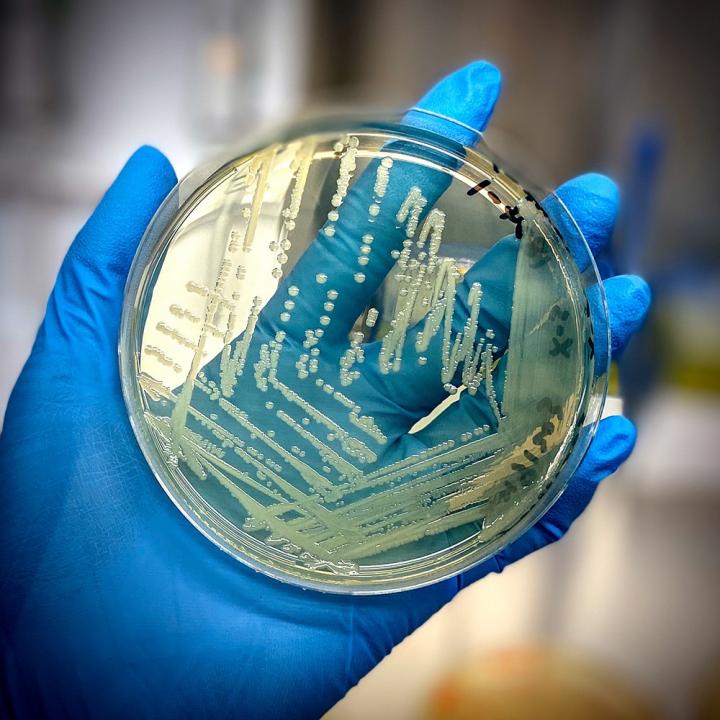
Credit: Mars Global Food Safety Center


ITHACA, N.Y. – Researchers from Cornell University, the Mars Global Food Safety Center in Beijing, and the University of Georgia have developed a method for completing whole-genome sequencing to determine salmonella serotypes in just two hours and the whole identification process within eight hours.

Determining salmonella’s serotype makes it easier for food safety sleuths to find the source of bacterial contamination, which can occur in a wide range of foods, such as fruits, vegetables, nuts, meat, cereal, infant formula and pet food.

“As the food supply chain becomes ever more global and interconnected, the opportunity for food to become contaminated with salmonella increases,” said lead author Silin Tang, senior research scientist in microbial risk management at the Mars Global Food Safety Center in China. “In the fast-moving world of food manufacturing, where rapid identification and response to salmonella contamination incidents is critical, developing a more efficient pathogen identification method is essential.”

Conventional serotyping has been at the core of public health monitoring of salmonella infections for a half-century, Tang said. But long turnaround times, high costs and complex sample preparations have led global food safety regulators, food authorities and public health agencies to change to whole-genome sequencing methods for pathogen subtyping.

All 38 salmonella strains – representing 34 serotypes – assessed in this study were accurately predicted to the serotype level using whole-genome sequencing.

This is important news for the food industry, as very few laboratories can conduct classical serotyping, said Martin Wiedmann, food safety professor and a Cornell Institute for Food Systems faculty fellow.

“In some countries,” Wiedmann said, “it can take up to two days to even get the suspected salmonella to a certified lab.”

With whole genome sequencing, he said, the new state-of-the-art test relies on simple equipment. “For the food industry, processing plants are in the middle of nowhere,” he said. “Now you can conduct testing in a lab that’s close to the food processing plant.”

###

In addition to Silin and Wiedmann, the other researchers on the study that published in the Journal Food Microbiology are Feng Xu, Chongtao Ge, Hao Luo, Guangtao Zhang, Abigail Stevenson and Robert C. Baker of the Mars Global Food Safety Center; and Shaoting Li and Xiangyu Deng of the University of Georgia. Funding was provided by the Mars Global Food Safety Center.

Cornell University has dedicated television and audio studios available for media interviews supporting full HD, ISDN and web-based platforms.

Media Contact
Lindsey Hadlock
[email protected]
607-269-6911

Original Source

https://news.cornell.edu/stories/2020/03/food-scientists-slice-time-salmonella-identification-process

Related Journal Article

http://dx.doi.org/10.1016/j.fm.2020.103452

Tags: AgricultureBacteriologyBiologyFood/Food ScienceGenetics
Share12Tweet8Share2ShareShareShare2

Related Posts

Natural Hallucinogens: Evolution’s Ecological Tools, Not Mere Chemical Byproducts

June 25, 2026

This Famous Butterfly Revealed: Three Distinct Species Hidden in One

June 25, 2026

Scientists Attack Soybean Cyst Nematode by Starving Its Food Source

June 25, 2026

Decoding the Secret Code of a Crucial Immune Sensor

June 24, 2026
Please login to join discussion

POPULAR NEWS

  • Saying Goodbye to PGY-6: Pediatric Fellowship Realities

    103 shares
    Share 41 Tweet 26
  • Multi-Hospital Study Reveals Long Covid Burden Is Twice as High as Current Estimates

    92 shares
    Share 36 Tweet 23
  • Detection of EDCs in Breast Milk and Infant Urine Up to Six Months Highlights Early Exposure Risks

    77 shares
    Share 31 Tweet 19
  • New Drug Candidate Developed at McMaster Shows Potential for Treating Brain Cancer

    58 shares
    Share 23 Tweet 15

About

We bring you the latest biotechnology news from best research centers and universities around the world. Check our website.

Follow us

Recent News

Tracking Lanthanide-Labeled Microplastics in Plants

POSTECH Researchers Slash Cost of Reconstituted Cell-Free Systems by 95%

AI and Physics Collaborate to Design Advanced Hydrogen Storage Materials

Subscribe to Blog via Email

Success! An email was just sent to confirm your subscription. Please find the email now and click 'Confirm' to start subscribing.

Join 82 other subscribers
  • Contact Us

Bioengineer.org © Copyright 2023 All Rights Reserved.

Welcome Back!

Login to your account below

Forgotten Password?

Retrieve your password

Please enter your username or email address to reset your password.

Log In
No Result
View All Result
  • Homepages
    • Home Page 1
    • Home Page 2
  • News
  • National
  • Business
  • Health
  • Lifestyle
  • Science

Bioengineer.org © Copyright 2023 All Rights Reserved.