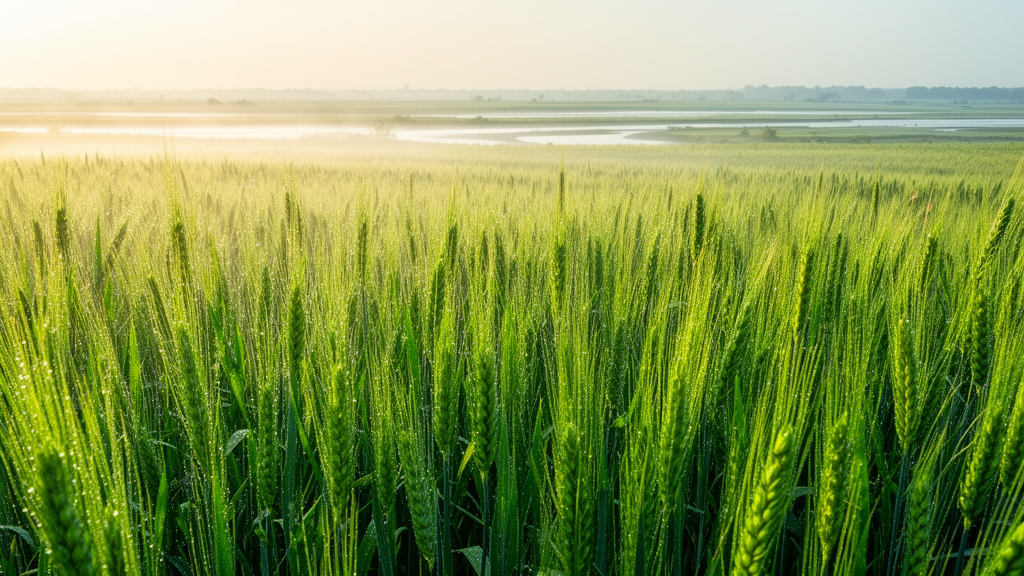
A two-year agronomic field experiment conducted in the coastal soils of the Ganges delta in Bangladesh has established that foliar applications of silicon dioxide significantly improved wheat productivity, generating a 21.8 percent increase in grain yield compared to untreated control plots. The research trial, carried out across the consecutive winter cropping seasons of 2024–25 and 2025–26, evaluated the comparative effectiveness of three distinct silicon sources delivered through either direct soil incorporation or repeated foliar sprays. The experimental results indicated that plots treated with four morning foliar sprays of a 0.3 percent silicon dioxide suspension achieved the highest mean grain yield of 4.47 tons per hectare, rising substantially above the 3.67 tons per hectare recorded in the unamended control. This peak performance was statistically comparable to foliar application of sodium meta-silicate, which produced 4.21 tons per hectare, as well as soil-applied silicon dioxide, which yielded 4.17 tons per hectare, underscoring the potential role of exogenous silicon supplementation in challenging coastal environments.
Wheat cultivation within the south-central coastal agro-ecological zone of the Ganges tidal floodplains faces intense agronomic constraints that frequently suppress crop establishment, tillering, and reproductive success. The regional farming system depends heavily on monsoon transplanted Aman rice, leaving fields moist and poorly drained until late December. Consequently, farmers face substantial obstacles when attempting timely sowing of winter crops through conventional full tillage, while facing seasonal salinity intrusion, low baseline soil fertility, erratic rainfall, and periodic tidal inundations. To navigate these local moisture conditions, the researchers deployed strip tillage technology using a hand-operated furrower immediately following rice harvest. This conservation tillage approach permitted the rapid sowing of the popular high-yielding wheat variety BARI Gom-33 into narrow furrows spaced twenty centimeters apart, leaving intermediate soil undisturbed while establishing a uniform seeding rate of 140 kilograms per hectare across both experimental years.
Silicon has attracted widespread agricultural attention as a beneficial element that reinforces plant defenses against abiotic stresses, including drought, salinity, and nutrient imbalances. While not categorized as an essential plant nutrient for all higher plants, silicon deposition in vegetative structures enhances structural rigidity, cellular water relations, membrane stability, and antioxidant defenses, particularly within monocot cereals such as rice and wheat. However, comparative evidence regarding the performance of diverse silicon chemical sources across contrasting delivery pathways under actual field conditions has remained limited. The trial directly addressed this knowledge gap by systematically contrasting three commercial materials: slow-release calcium silicate, highly soluble sodium meta-silicate, and fumed silicon dioxide nanoparticles featuring an average particle size of roughly twelve nanometers and very high specific surface area, assessing each material across both root-zone soil incorporation and aerial canopy spraying.
The study was situated within a farmer’s field in Kartikpasha village within the Dumki upazila of Patuakhali district, positioned at 22.44343 degrees north latitude and 90.33671 degrees east longitude. Initial laboratory analysis of composite plough-layer soil samples taken from zero to fifteen centimeters depth classified the substrate as a silty clay loam belonging to the Jhalokathi soil series. The soil demonstrated an initial pH of 5.9 in a 1:2.5 soil-water suspension, a bulk density of 1.39 grams per cubic centimeter, an organic matter content of 1.68 percent, total Kjeldahl nitrogen of 1.1 grams per kilogram, available phosphorus of 5.8 milligrams per kilogram, ammonium acetate exchangeable potassium of 0.254 centimoles per kilogram, and an acetic acid extractable available silicon concentration of 32 milligrams per kilogram. The initial electrical conductivity of the saturated soil paste extract measured 1.87 deciSiemens per meter. Meteorological records confirmed a dry winter period devoid of rainfall during the peak growth months of December, January, and February, necessitating two scheduled flood irrigations using fresh water below one deciSiemens per meter to satisfy crop water requirements.
The experiment employed a randomized complete block design featuring three replications across twenty-one distinct field plots, each measuring four meters by three meters and separated by earthen bunds and drainage channels. Basal fertilization provided uniform rates of nitrogen at 120 kilograms per hectare from split urea, phosphorus at 24 kilograms per hectare from triple superphosphate, and potassium at 60 kilograms per hectare from muriate of potash. The seven experimental treatments comprised an unamended control receiving zero silicon; soil band placement of calcium silicate, sodium meta-silicate, and silicon dioxide each supplying 80 kilograms of elemental silicon per hectare mixed into the furrow sole; and four successive foliar sprayings of 0.3 percent silicon solutions or suspensions supplying a cumulative 30 kilograms of elemental silicon per hectare applied at 20, 30, 40, and 50 days after sowing. Control and soil-treated plots simultaneously received equal volumes of water containing 0.05 percent Tween 20 surfactant to isolate chemical nutrient impacts from moisture or wetting agent effects.
Vegetative growth metrics revealed that silicon supplementation significantly stimulated vegetative stature and tiller density across all formulations compared to untreated plots, although differences between the various silicon sources themselves were relatively minor. Across pooled two-way analysis of variance models, plant height expanded by 2.4 to 3.8 centimeters over the control value of 72.9 centimeters, reaching a numerical maximum of 76.7 centimeters under soil-applied calcium silicate. Tiller population ranged from 288 tillers per square meter in the untreated control to 337 tillers per square meter under soil-applied silicon dioxide, representing an enhancement of 9.0 to 17.0 percent. The statistical analysis showed that main effects of silicon application were significant for both vegetative parameters, whereas experimental year and year-by-treatment interactions were not significant, indicating that silicon availability itself served as the primary driver of enhanced structural development by supporting cell elongation and tissue rigidity.
Reproductive development and yield components responded vigorously to silicon nutrition, exhibiting substantial gains in spike dimensions, floret fertility, and grain filling. Mean spike length varied between 7.74 centimeters in control plots and 9.35 centimeters under silicon treatments, reflecting an overall improvement of 10.8 to 20.8 percent, with a significant year-by-treatment interaction reflecting seasonal shifts in canopy performance. The number of grains per spike showed significant variation across both years and treatments, averaging 26.0 grains in control plants and peaking at 31.9 grains per spike under foliar silicon dioxide, closely followed by 31.5 grains under soil silicon dioxide, representing a 22.7 percent increase in fertilized grains per spike. Thousand-grain weight also increased from 51.5 grams in control plots to 54.0 grams under soil silicon dioxide and 53.9 grams under foliar silicon dioxide, reflecting gains of up to 4.9 percent that pointed toward improved assimilate translocation during grain development.
Total crop biomass mirrored these reproductive gains, as silicon treatments delivered significant improvements in both grain and straw yield while maintaining steady harvest index values. Across the two-year period, mean grain yields varied from 3.67 tons per hectare in control plots to 4.47 tons per hectare under foliar silicon dioxide, with seasonal averages exhibiting higher productivity in 2024–25 at 4.20 tons per hectare compared to 3.99 tons per hectare in 2025–26. Mean straw yield similarly climbed from 5.10 tons per hectare in untreated plots to 5.99 tons per hectare under foliar silicon dioxide, a response statistically comparable to soil-applied silicon dioxide at 5.83 tons and soil-applied sodium meta-silicate at 5.66 tons per hectare. Harvest index values showed narrow, non-significant fluctuations between 41.7 percent and 44.3 percent across treatments, demonstrating that silicon amendments promoted balanced whole-plant biomass accumulation rather than selectively altering assimilate partitioning between vegetative and reproductive structures.
Laboratory analysis of plant tissue revealed marked increases in straw silicon concentration and total elemental uptake, with significant variations governed by the chosen chemical source and delivery pathway. Because grain silicon levels fell below laboratory detection limits, accumulation was quantified exclusively within straw tissue using acid digestion and muffle furnace gravimetric charring. Straw silicon content rose from 1.29 percent in untreated control plants to 1.60 percent under soil-applied silicon dioxide, with both foliar and soil applications of silicon dioxide and sodium meta-silicate exhibiting equivalent statistical groupings. Total straw silicon uptake ranged from 65.8 kilograms per hectare in control plots to 93.3 kilograms per hectare under soil silicon dioxide and 91.2 kilograms per hectare under foliar silicon dioxide. Calcium silicate produced the lowest uptake figures among the tested sources across both delivery modes, reflecting its lower aqueous solubility and coarser particle dimensions.
Apparent recovery efficiency, measured as the percentage uptake of applied silicon, revealed an extraordinary divergence between application pathways that strongly favored foliar delivery. When incorporated into the soil at 80 kilograms per hectare, calcium silicate, sodium meta-silicate, and silicon dioxide achieved apparent uptake rates of 12.5, 30.2, and 34.9 percent in the first year, and 16.8, 26.7, and 33.8 percent in the second year. In stark contrast, foliar spraying at 30 kilograms per hectare yielded recovery efficiencies of 41.1, 50.3, and 86.0 percent in 2024–25, and 38.0, 45.3, and 83.1 percent in 2025–26. A secondary three-way factorial analysis of variance excluding the control confirmed that foliar application produced significantly higher grain yields than soil application, while silicon dioxide maintained superior performance across grain yield, straw yield, and silicon uptake regardless of delivery method, supported by the prolonged solubility of high-surface-area nanoparticles.
Partial budget economic analysis revealed that foliar spraying of silicon dioxide was the most financially rewarding management strategy, generating the highest gross return of 201,225 Bangladesh taka per hectare and a net return of 36,150 taka per hectare. Because foliar spraying required substantially lower quantities of raw material than soil incorporation, foliar silicon dioxide carried the lowest added cost among all active treatments at 16,048 taka per hectare, achieving a marginal benefit-cost ratio of 2.253. Across the entire trial, the hierarchy of economic efficiency strictly followed application mode: foliar silicon dioxide exceeded foliar sodium meta-silicate, foliar calcium silicate, soil silicon dioxide, soil sodium meta-silicate, and soil calcium silicate in descending order. This consistent pattern confirmed that lower input volume combined with elevated grain yields allowed foliar approaches to substantially outperform their corresponding soil incorporation counterparts.
Pearson correlation analysis confirmed strong positive associations between grain yield and plant height, tiller numbers, spike length, grains per spike, straw yield, silicon concentration, and total silicon uptake, with the strongest positive relationships recorded between straw yield and silicon uptake. However, the study authors emphasized critical methodological limitations, noting that calculated silicon uptake mathematically incorporates straw yield, meaning these strong correlations reflect shared mathematical dependence rather than proven direct physiological causation. Furthermore, because canopy spraying deposited approximately 2,500 liters of total liquid per hectare, incidental canopy runoff likely delivered a fraction of foliar silicon directly to the soil, while gravimetric furnace analysis could not distinguish internal absorbed silicon from external mineral deposits adhering to plant surfaces. Given that the experiment evaluated a single wheat cultivar at one coastal research site without continuous in-season soil salinity tracking, multi-location trials across diverse wheat genotypes and dynamic salinity regimes remain essential before broad regional implementation.
Subject of Research: Comparative effectiveness of soil and foliar silicon applications on wheat productivity and economic performance in coastal delta soils
Article Title: Comparative effectiveness of soil and foliar application of different silicon sources on wheat productivity in coastal soils of the Ganges delta
Article References: Soha, M. M., Dhrubo, P. S., Lamia, F. N., Paul, U. N. M., Al-Nahid, M. F., & Haque, M. A. (2026). Comparative effectiveness of soil and foliar application of different silicon sources on wheat productivity in coastal soils of the Ganges delta. Discover Plants, 3(1), Article 529. https://doi.org/10.1007/s44372-026-01028-7
Image Credits: AI Generated
DOI: 10.1007/s44372-026-01028-7
Keywords: wheat productivity, silicon fertilization, foliar application, soil application, Ganges delta, silicon dioxide nanoparticles, sodium metasilicate, calcium silicate, coastal agriculture, BARI Gom-33, crop resilience, marginal benefit-cost ratio, straw silicon uptake, strip tillage, grain yield enhancement, saline soil conditions, tiller production
News Source: Alan Morgan. (November 12, 2026). Foliar Silicon Dioxide Application Improves Wheat Yield in Coastal Ganges Delta. Scienmag.