

• HOME
  • NEWS
  • EXPLORE
    • CAREER
      • Companies
      • Jobs
    • EVENTS
    • iGEM
      • News
      • Team
    • PHOTOS
    • VIDEO
    • WIKI
  • BLOG
  • COMMUNITY
    • FACEBOOK
    • INSTAGRAM
    • TWITTER
Friday, March 27, 2026
BIOENGINEER.ORG
No Result
View All Result
  • Login
  • HOME
  • NEWS
  • EXPLORE
    • CAREER
      • Companies
      • Jobs
        • Lecturer
        • PhD Studentship
        • Postdoc
        • Research Assistant
    • EVENTS
    • iGEM
      • News
      • Team
    • PHOTOS
    • VIDEO
    • WIKI
  • BLOG
  • COMMUNITY
    • FACEBOOK
    • INSTAGRAM
    • TWITTER
  • HOME
  • NEWS
  • EXPLORE
    • CAREER
      • Companies
      • Jobs
        • Lecturer
        • PhD Studentship
        • Postdoc
        • Research Assistant
    • EVENTS
    • iGEM
      • News
      • Team
    • PHOTOS
    • VIDEO
    • WIKI
  • BLOG
  • COMMUNITY
    • FACEBOOK
    • INSTAGRAM
    • TWITTER
No Result
View All Result
Bioengineer.org
No Result
View All Result
Home NEWS Science News Health

FOCUS may lower PE diagnosis in ED patients with suspected PE and abnormal vitals

Bioengineer by Bioengineer
November 6, 2019
in Health
Reading Time: 2 mins read
0
IMAGE
Share on FacebookShare on TwitterShare on LinkedinShare on RedditShare on Telegram

IMAGE

Credit: Josh Lupton, MD, Oregon Health & Science University and resident editor, Academic Emergency Medicine journal


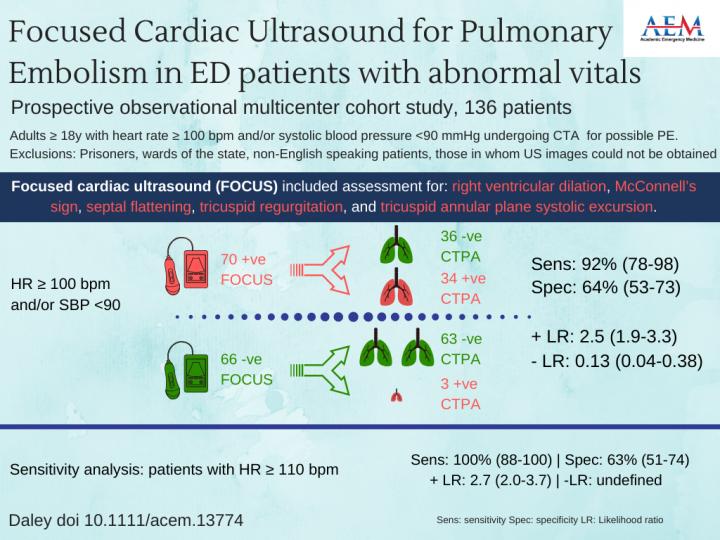
DES PLAINES, IL — Focused cardiac ultrasound (FOCUS) performed by emergency physicians with advanced training in emergency ultrasound may significantly lower the likelihood of the diagnosis of pulmonary embolism (PE) in most patients who are suspected of PE and have abnormal vital signs. This was especially true in those patients with a heart rate > 110 beats/min. That is the conclusion of a study to be published in the November 2019 issue of Academic Emergency Medicine (AEM), a journal of the Society for Academic Emergency Medicine (SAEM).

The lead author of the prospective observational multicenter cohort study is James I. Daley MD, MS, MPH, an instructor in the Department of Emergency Medicine at Yale School of Medicine. Daley et. al suggest that further study in a larger cohort of patients (which would yield narrower 95% confidence intervals) is required before focused cardiac ultrasound can be used to reliably exclude pulmonary embolism in this patient population.

The results suggest that FOCUS can be an important tool in the initial evaluation of emergency department (ED) patients with suspected PE and abnormal vital signs.

Commenting on the study is Robert R. Ehrman, MD, MS, the director of emergency ultrasound research at Wayne State University School of Medicine/Detroit Medical Center in Detroit, MI:
 

“This is an important study as it is the first to demonstrate that point-of-care echocardiography can meaningfully reduce the likelihood of pulmonary embolism when clinical suspicion is high, potentially obviating the need for CT scanning in some patients. Moreover, the skills required to perform this exam are within the scope of all Emergency Physicians and thus the potential benefits at the population level are immense.”

###

ABOUT ACADEMIC EMERGENCY MEDICINE

Academic Emergency Medicine, the monthly journal of Society for Academic Emergency Medicine, features the best in peer-reviewed, cutting-edge original research relevant to the practice and investigation of emergency care. The above study is published open access and can be downloaded by following the DOI link: 10.1111/acem.13774. Journalists wishing to interview the authors may contact Stacey Roseen at [email protected].

ABOUT THE SOCIETY FOR ACADEMIC EMERGENCY MEDICINE

SAEM is a 501(c)(3) not-for-profit organization dedicated to the improvement of care of the acutely ill and injured patient by leading the advancement of academic emergency medicine through education and research, advocacy, and professional development. To learn more, visit saem.org.

Media Contact
Stacey Roseen
[email protected]
708-606-7120

Related Journal Article

http://dx.doi.org/10.1111/acem.13774

Tags: CardiologyClinical TrialsCritical Care/Emergency MedicineDiagnosticsHealth Care Systems/ServicesHealth ProfessionalsMedicine/HealthTrauma/Injury
Share12Tweet8Share2ShareShareShare2

Related Posts

Aversive Learning Hijacks Brain Sugar Sensor

March 25, 2026

Can Psychosocial Factors Influence Cancer Risk?

March 23, 2026

Depression Factors in Elderly: Pre vs. Post-COVID Analysis

March 23, 2026

Hidden Health Crises Among US and UK Volunteers in Ukraine Uncovered in New Study

March 23, 2026
Please login to join discussion

POPULAR NEWS

  • blank

    Revolutionary AI Model Enhances Precision in Detecting Food Contamination

    96 shares
    Share 38 Tweet 24
  • Imagine a Social Media Feed That Challenges Your Views Instead of Reinforcing Them

    1003 shares
    Share 397 Tweet 248
  • Uncovering Functions of Cavernous Malformation Proteins in Organoids

    54 shares
    Share 22 Tweet 14
  • Promising Outcomes from First Clinical Trials of Gene Regulation in Epilepsy

    51 shares
    Share 20 Tweet 13

About

We bring you the latest biotechnology news from best research centers and universities around the world. Check our website.

Follow us

Recent News

In-Sensor Cryptography Links Physical Process to Digital Identity

Can Psychosocial Factors Influence Cancer Risk?

Depression Factors in Elderly: Pre vs. Post-COVID Analysis

Subscribe to Blog via Email

Success! An email was just sent to confirm your subscription. Please find the email now and click 'Confirm' to start subscribing.

Join 78 other subscribers
  • Contact Us

Bioengineer.org © Copyright 2023 All Rights Reserved.

Welcome Back!

Login to your account below

Forgotten Password?

Retrieve your password

Please enter your username or email address to reset your password.

Log In
No Result
View All Result
  • Homepages
    • Home Page 1
    • Home Page 2
  • News
  • National
  • Business
  • Health
  • Lifestyle
  • Science

Bioengineer.org © Copyright 2023 All Rights Reserved.


