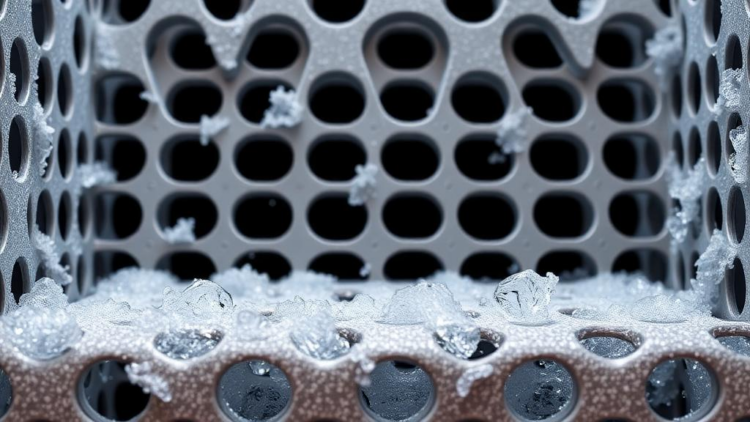
Engineers designing protective systems for artillery, aerospace platforms, and high-speed vehicles face a brutal trade-off: the structures that absorb impact energy best are usually the ones that take up the most room. Now a team of researchers in China has reported a compact energy absorber barely taller than a fingertip that punches far above its weight, dissipating nearly a kilojoule of impact energy within a crushing height of just 12 millimeters. The design, described in the journal iScience, combines a multi-cell thin-walled aluminum frame with a hybrid filler made by infiltrating open-cell aluminum foam with polyurethane, and it may point the way toward a new generation of miniature shock absorbers for tightly packed electronic and instrumentation systems.
The motivation came from a very concrete engineering problem. In the 125-millimeter cannon system considered by the team, the space available for an energy absorber is severely constrained: although the cannon’s outer diameter is 125 millimeters, the designated installation region offers only 85 millimeters of diameter and a mere 12 millimeters of axial height. Protecting sensitive testing and electronic components inside such a platform requires not just high energy absorption but stable, predictable crushing under extreme loads. Many previously reported foam-filled absorbers stand 25 millimeters or taller, which rules them out for this kind of application outright. The researchers, led by Peng Zhang and Yu’nan Chen of North University of China along with colleagues, set out to see how much performance could be squeezed into that tiny envelope.
Their answer was a multi-cell thin-walled structure, or MTS, machined from 5052-H14 aluminum alloy. The geometry consists of an outer ring 70 millimeters in diameter, an inner ring 35 millimeters across, and four radial connecting ribs, together dividing the interior into a central cylindrical cell and several fan-shaped cells. Multi-cell designs are prized in crash engineering because subdividing the cross-section creates many potential plastic hinges, encouraging a stable, progressive folding mode under axial compression rather than sudden, catastrophic buckling. Earlier work by Chen and Wierzbicki and others showed that partitioning a tube into multiple cells can raise mean crushing force substantially; one classic study found that a 3-by-3 grid of cells could improve energy absorption efficiency by up to 50 percent over a single-cell tube of the same weight.
But geometry alone was not enough for the team’s purposes, because the energy dissipation of an empty thin-walled structure still depends entirely on the deformation of its walls. So the researchers turned to fillers. They used spherical open-cell aluminum foam, a metallic honeycomb-like material with spherical pores 4 to 6 millimeters across, an average density of about 900 kilograms per cubic meter, and a porosity of roughly 67 percent. Into the interconnected pore network they infiltrated a commercially available GF-5 polyurethane using a straightforward vacuum process: the foam was cleaned in ethanol and ultrasonically bathed, mixed polyurethane components were poured into a mold holding the foam and frame, a vacuum defoaming machine drew the polymer into the accessible pores for ten minutes, and the assembly cured at 90 degrees Celsius for ten hours. Gravimetric measurements showed the polyurethane filled about 67 percent of the foam’s volume, closely matching the foam’s porosity, and scanning electron microscopy and micro-computed tomography confirmed close interfacial contact between the polymer, the foam skeleton, and the aluminum walls.
From these ingredients the team built five structural configurations: an empty multi-cell frame; frames partially filled with plain aluminum foam or foam-polyurethane composite in the fan-shaped cells; and fully filled versions that also packed the central cylinder. Each configuration was tested at three wall thicknesses of 0.8, 1.0, and 1.2 millimeters, yielding fifteen specimen groups evaluated under both slow quasi-static compression and dynamic drop-hammer impact at 1176 joules. The results were striking. Under quasi-static loading, the best configuration, a partially foam-polyurethane-filled structure with 1.2-millimeter walls, absorbed 895.41 joules, nearly double the 448.47 joules of its unfilled counterpart. Under dynamic impact, the same design reached 984.40 joules, a 115.65 percent improvement over the empty frame.
Perhaps the most counterintuitive finding was that filling everything was not the best strategy. The fully filled structures generated higher mean crushing forces, but the central filler restricted the inward folding of the inner ring and shortened the effective crushing stroke, the distance over which the structure can deform before densifying. At the 1.0- and 1.2-millimeter wall thicknesses, complete filling raised the mean crushing force by roughly 15 percent but cut the effective stroke by about 17 percent, so total energy absorption actually fell below that of the partially filled design. Energy absorbed is the product of force and stroke, and the partially filled configuration struck the better balance: it left the central cell open as deformation space while the fan-shaped composite fillers braced the walls. The researchers are careful to note this balance is specific to their geometry rather than a universal rule, but within their design space the partial fill won decisively at every wall thickness.
The polyurethane infiltration itself proved remarkably effective in the partially filled topology. Compared with structures filled with plain aluminum foam, the polymer-infiltrated versions showed mean crushing forces 23 to 27 percent higher and energy absorption 35 to 49 percent higher under quasi-static loading, with similar gains of 39 to 52 percent under dynamic impact. Post-crushing microscopy revealed why: the polyurethane had fractured and torn during compression, indicating substantial polymer deformation, while the aluminum foam skeleton showed cell-wall cracking, and the polymer remained bonded to both the foam and the frame. The three phases did not deform independently; the foam provided lateral support, the polyurethane constrained local collapse and stretched as it failed, and the interfaces transferred stress between them, extending the region of the structure participating in plastic work.
To understand and predict this behavior, the team combined finite element simulation in LS-DYNA with an analytical model built on the simplified super-folding element theory. The theory treats the frame’s energy dissipation as the sum of plastic hinge bending and membrane stretching, deriving an optimal folding half-wavelength and a theoretical mean crushing force. Predictions agreed with quasi-static experiments within roughly 4 to 8 percent across all configurations, respectable accuracy for an engineering approximation. The validated simulations showed that the thin-walled frame contributed about 65 percent of the energy absorption in the partially filled design, with the fan-shaped composite fillers supplying the remaining 35 percent, and that dynamic loading amplified mean crushing forces by 4 to 20 percent through inertia, rate-dependent polymer response, and frame-filler interaction.
The headline number for compact applications is volumetric specific energy absorption. Because installation volume, not mass, is the binding constraint in the cannon platform, the researchers emphasized energy absorbed per unit volume. Their best structure achieved 21.32 joules per cubic centimeter with a crushing force efficiency of 0.84, all within a 12-millimeter height. Compared against previously reported absorbers, including aluminum honeycombs filled with polyurethane foam, 3D-printed lattices, and foam-filled CFRP tubes, the new design offers one of the best combinations of compactness, volumetric efficiency, and load stability. Simulations of a harsh acceleration pulse, a half-sine input peaking at 40,000 g over 200 microseconds, suggested the structure could cut the transmitted peak acceleration on a protected object by roughly 75 percent, holding the response below 10,000 g.
The authors are candid about limitations. They did not independently characterize the polyurethane’s modulus, strength, or strain-rate dependence, did not quantify pore-size distributions in the foam, and could not fully separate the energy contributions of the foam skeleton, the polymer, and their interfaces. The finite element model was validated against only one configuration, and dynamic testing covered a single impact condition. Environmental durability, fatigue, and temperature effects remain unexamined. Still, the core message stands: by pairing a multi-cell aluminum frame with a cheap, commercially available polyurethane infiltrated into open-cell foam, and by deliberately leaving part of the structure empty to preserve crushing stroke, the team has shown that extreme miniaturization and high energy absorption need not be enemies. For anyone packing electronics into missiles, satellites, or other cramped, high-g environments, that 12-millimeter slab of crumpling aluminum, foam, and polymer may be exactly the cushion they have been looking for.
Subject of Research: Energy absorption of compact polyurethane-infiltrated aluminum foam-filled multi-cell thin-walled structures under quasi-static and dynamic crushing
Article Title: Energy absorption of multicell thin walled structures filled with polyurethane infiltrated open cell aluminum foam
Article References: Zhang, P., Chen, Y., Shi, Y., Zhao, R., Guo, T., Guo, H., Chen, L., & Yu, P. (2026). Energy absorption of multicell thin walled structures filled with polyurethane infiltrated open cell aluminum foam. iScience, 29(10), Article 117716. https://doi.org/10.1016/j.isci.2026.117716
Image Credits: AI Generated
DOI: 10.1016/j.isci.2026.117716
Keywords: energy absorption, thin-walled structures, aluminum foam, polyurethane, multi-cell tubes, impact protection, crashworthiness, progressive folding, finite element analysis, drop hammer test, specific energy absorption, hybrid materials
Cite Scienmag News
APA MLA Chicago
Denise Maddox. (October 2, 2026). Foam-Filled Aluminum Lattice Crushes Impact Energy in Just 12 Millimeters. Scienmag. https://scienmag.com/foam-filled-aluminum-lattice-crushes-impact-energy-in-just-12-millimeters/
Denise Maddox. “Foam-Filled Aluminum Lattice Crushes Impact Energy in Just 12 Millimeters.” Scienmag, 2 October 2026, https://scienmag.com/foam-filled-aluminum-lattice-crushes-impact-energy-in-just-12-millimeters/. Accessed 2 October 2026.
Denise Maddox. “Foam-Filled Aluminum Lattice Crushes Impact Energy in Just 12 Millimeters.” Scienmag. October 2, 2026. https://scienmag.com/foam-filled-aluminum-lattice-crushes-impact-energy-in-just-12-millimeters/
Copy citation Download RIS
Tags: aerospace impact protectionaluminum foamaluminum lattice structuresartillery protection systemscompact protective systemscrashworthinessdrop hammer testenergy absorptionfinite element analysisfoam-filled energy absorbershigh-impact energy dissipationhigh-speed vehicle crash protectionhybrid aluminum foam and polyurethanehybrid materialsimpact energy absorptionimpact protectionminiature shock absorbersmulti-cell thin-walled aluminum framesmulti-cell tubespolyurethaneprogressive foldingspace-efficient energy absorbing materialsspecific energy absorptionthin-walled structures