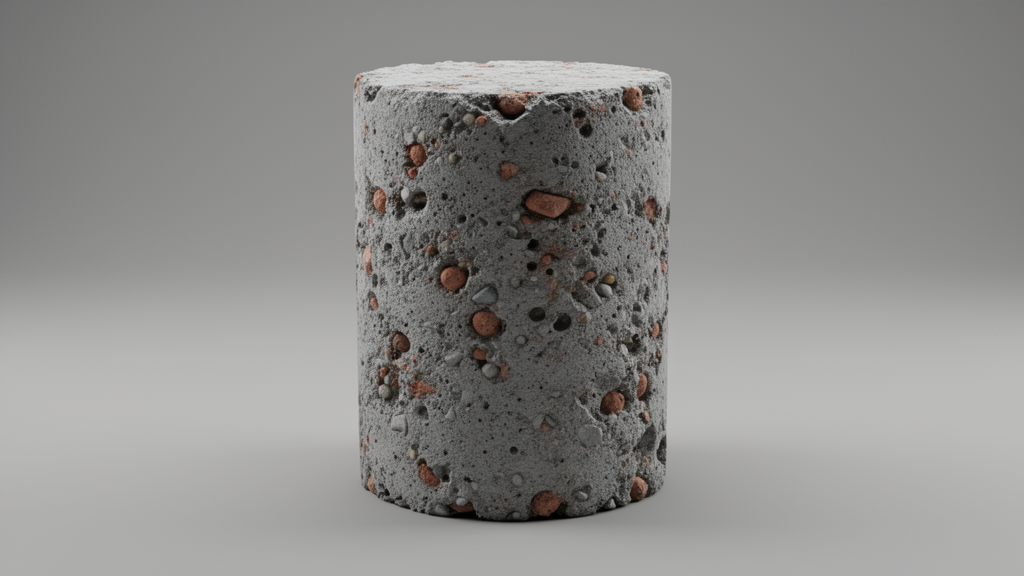
A study published in Scientific Reports reports that lightweight aggregate concrete (LWAC) containing fly ash ceramsite maintains a longer steady-state creep period than normal-weight aggregate concrete (NWAC) after exposure to high temperatures. The research, led by Dong Xiao and colleagues, investigated the influence of aggregate types on the long-term deformation performance of concrete following high-temperature treatment. By comparing the creep behavior of the two concrete types, the team identified specific mechanisms by which the porous structure of the lightweight aggregate affects structural response under thermal stress.
The investigation utilized uniaxial step-wise compression creep tests on specimens subjected to temperatures ranging from 20 °C to 800 °C. The primary focus was to compare and analyze the effects of aggregate types on total strain, load-induced thermal strain (LITS), creep deformation, and rate patterns. This experimental design allowed for a direct comparison of how normal-weight and lightweight aggregates respond to thermal exposure and subsequent mechanical loading.
Below 200 °C, the LWAC exhibited a higher load-induced thermal strain than the NWAC. Specifically, the LITS of the lightweight concrete was approximately 83.3% higher than that of the normal-weight concrete. The study attributes this difference to the lower modulus of the lightweight aggregate, which results in a different initial strain response compared to the denser normal-weight material.
A significant divergence in behavior was observed above 400 °C. At this temperature threshold, the NWAC experienced a rapid increase in creep strain. The researchers identified the thermal expansion mismatch between the aggregate and the cement paste at the interface transition zone (ITZ) as the driving factor for this accelerated deformation. This mismatch creates internal stresses that alter the creep rate of the normal-weight concrete.
In contrast, the LWAC containing fly ash ceramsite aggregate displayed a different response mechanism. The porous structure of the fly ash ceramic aggregate was found to play a “thermal mitigating” effect. This porosity effectively inhibited the propagation of microcracks within the material. As a result, the LWAC was able to maintain a longer steady-state creep period compared to the NWAC, indicating a more stable deformation profile under sustained load after high-temperature exposure.
Scanning electron microscopy (SEM) analysis provided microstructural evidence supporting these mechanical observations. At high temperatures, the ITZ of the NWAC developed tensile cracks measuring several micrometers in width. These cracks are consistent with the rapid increase in creep strain observed in the normal-weight specimens. Conversely, the LWAC specimens maintained a relatively intact structure at the interface, with fewer signs of the microcracking seen in the NWAC.
The study also evaluated the applicability of the Burgers model to the creep data of the lightweight concrete. The fitting degree of the Burgers model for the LWAC creep data was high, with an R-squared value of 0.99. This high correlation verifies the model’s applicability in describing the deceleration and constant-speed creep behavior of LWAC after high-temperature treatment. The successful fit provides a mathematical framework for characterizing the specific creep phases of this material.
The findings reveal the deformation mechanism of fly ash ceramic aggregate in high-temperature environments. The research provides a theoretical basis for the design and post-disaster assessment of the fire resistance of LWAC structures. By understanding how the porous aggregate mitigates thermal stresses and inhibits crack propagation, the study offers insights into the long-term deformation performance of lightweight concrete after exposure to extreme temperatures.
Subject of Research: Creep behavior of lightweight concrete containing fly ash ceramsite aggregate after high-temperature exposure
Article Title: Creep behavior of lightweight concrete containing fly ash ceramsite aggregate after exposure to high temperatures
Article References: Xiao, D., Chen, S., Wen, L., Dou, Y., Liu, H., & Zhao, J. (2026). Creep behavior of lightweight concrete containing fly ash ceramsite aggregate after exposure to high temperatures. Scientific Reports. https://doi.org/10.1038/s41598-026-77256-4
Image Credits: AI Generated
DOI: 10.1038/s41598-026-77256-4
Keywords: lightweight concrete, fly ash ceramsite, creep behavior, high temperature, structural engineering, load-induced thermal strain, interface transition zone, Burgers model, Creep, behavior, lightweight, concrete
News Source: Denise Maddox. (October 24, 2026). Fly Ash Ceramsite Concrete Resists Creep After High Temperatures. Scienmag.